





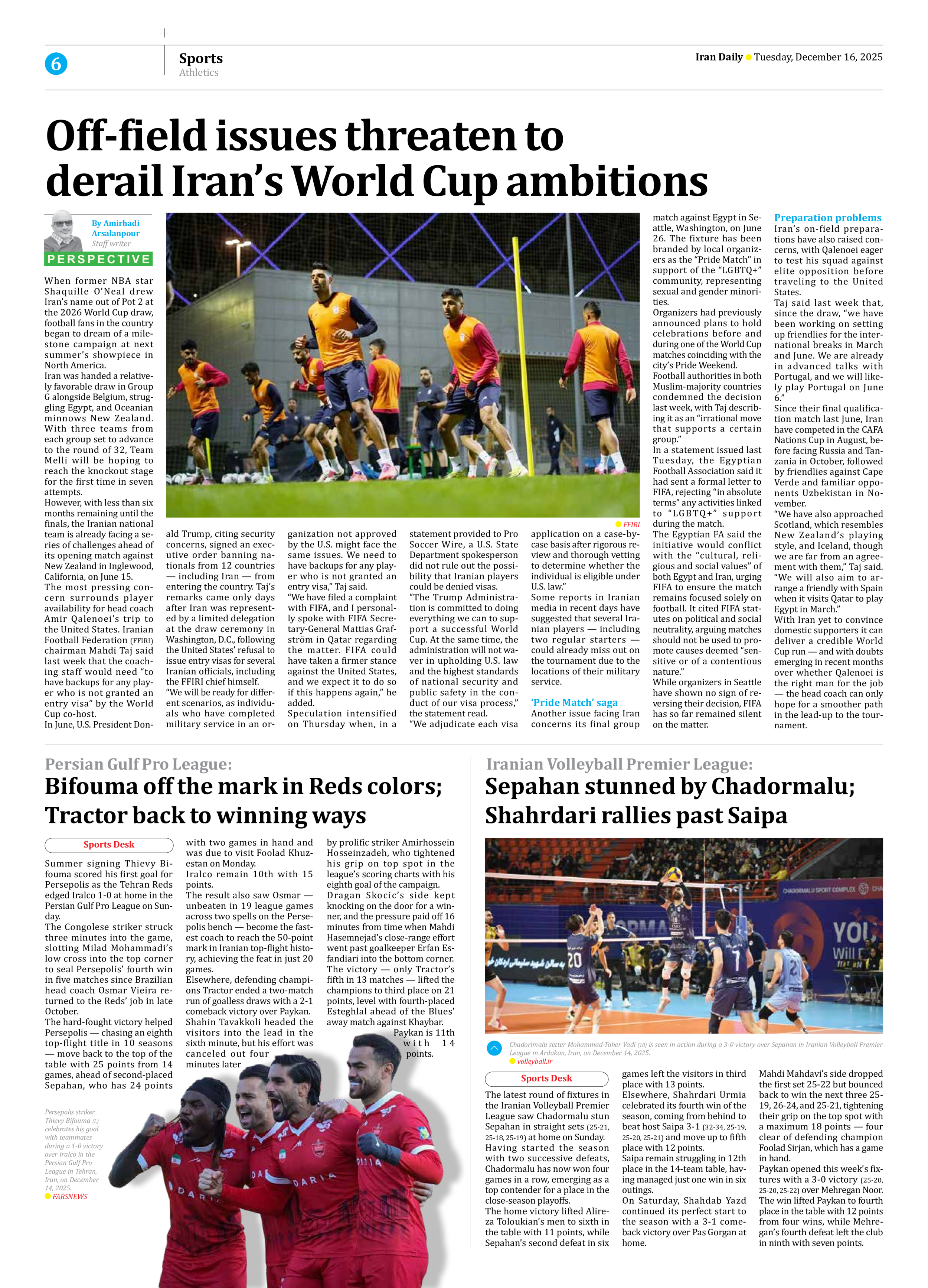


Off-field issues threaten to derail Iran’s World Cup ambitions
By Amirhadi
Arsalanpour
Staff writer
When former NBA star Shaquille O’Neal drew Iran’s name out of Pot 2 at the 2026 World Cup draw, football fans in the country began to dream of a milestone campaign at next summer’s showpiece in North America.
Iran was handed a relatively favorable draw in Group G alongside Belgium, struggling Egypt, and Oceanian minnows New Zealand. With three teams from each group set to advance to the round of 32, Team Melli will be hoping to reach the knockout stage for the first time in seven attempts.
However, with less than six months remaining until the finals, the Iranian national team is already facing a series of challenges ahead of its opening match against New Zealand in Inglewood, California, on June 15.
The most pressing concern surrounds player availability for head coach Amir Qalenoei’s trip to the United States. Iranian Football Federation (FFIRI) chairman Mahdi Taj said last week that the coaching staff would need “to have backups for any player who is not granted an entry visa” by the World Cup co-host.
In June, U.S. President Donald Trump, citing security concerns, signed an executive order banning nationals from 12 countries — including Iran — from entering the country. Taj’s remarks came only days after Iran was represented by a limited delegation at the draw ceremony in Washington, D.C., following the United States’ refusal to issue entry visas for several Iranian officials, including the FFIRI chief himself.
“We will be ready for different scenarios, as individuals who have completed military service in an organization not approved by the U.S. might face the same issues. We need to have backups for any player who is not granted an entry visa,” Taj said.
“We have filed a complaint with FIFA, and I personally spoke with FIFA Secretary-General Mattias Grafström in Qatar regarding the matter. FIFA could have taken a firmer stance against the United States, and we expect it to do so if this happens again,” he added.
Speculation intensified on Thursday when, in a statement provided to Pro Soccer Wire, a U.S. State Department spokesperson did not rule out the possibility that Iranian players could be denied visas.
“The Trump Administration is committed to doing everything we can to support a successful World Cup. At the same time, the administration will not waver in upholding U.S. law and the highest standards of national security and public safety in the conduct of our visa process,” the statement read.
“We adjudicate each visa application on a case-by-case basis after rigorous review and thorough vetting to determine whether the individual is eligible under U.S. law.”
Some reports in Iranian media in recent days have suggested that several Iranian players — including two regular starters — could already miss out on the tournament due to the locations of their military service.
‘Pride Match’ saga
Another issue facing Iran concerns its final group match against Egypt in Seattle, Washington, on June 26. The fixture has been branded by local organizers as the “Pride Match” in support of the “LGBTQ+” community, representing sexual and gender minorities.
Organizers had previously announced plans to hold celebrations before and during one of the World Cup matches coinciding with the city’s Pride Weekend.
Football authorities in both Muslim-majority countries condemned the decision last week, with Taj describing it as an “irrational move that supports a certain group.”
In a statement issued last Tuesday, the Egyptian Football Association said it had sent a formal letter to FIFA, rejecting “in absolute terms” any activities linked to “LGBTQ+” support during the match.
The Egyptian FA said the initiative would conflict with the “cultural, religious and social values” of both Egypt and Iran, urging FIFA to ensure the match remains focused solely on football. It cited FIFA statutes on political and social neutrality, arguing matches should not be used to promote causes deemed “sensitive or of a contentious nature.”
While organizers in Seattle have shown no sign of reversing their decision, FIFA has so far remained silent on the matter.
Preparation problems
Iran’s on-field preparations have also raised concerns, with Qalenoei eager to test his squad against elite opposition before traveling to the United States.
Taj said last week that, since the draw, “we have been working on setting up friendlies for the international breaks in March and June. We are already in advanced talks with Portugal, and we will likely play Portugal on June 6.”
Since their final qualification match last June, Iran have competed in the CAFA Nations Cup in August, before facing Russia and Tanzania in October, followed by friendlies against Cape Verde and familiar opponents Uzbekistan in November.
“We have also approached Scotland, which resembles New Zealand’s playing style, and Iceland, though we are far from an agreement with them,” Taj said.
“We will also aim to arrange a friendly with Spain when it visits Qatar to play Egypt in March.”
With Iran yet to convince domestic supporters it can deliver a credible World Cup run — and with doubts emerging in recent months over whether Qalenoei is the right man for the job — the head coach can only hope for a smoother path in the lead-up to the tournament.