







Kamalvandi: Safeguards Agreement ignores post-war circumstances
Iran holds ‘firm legal position’
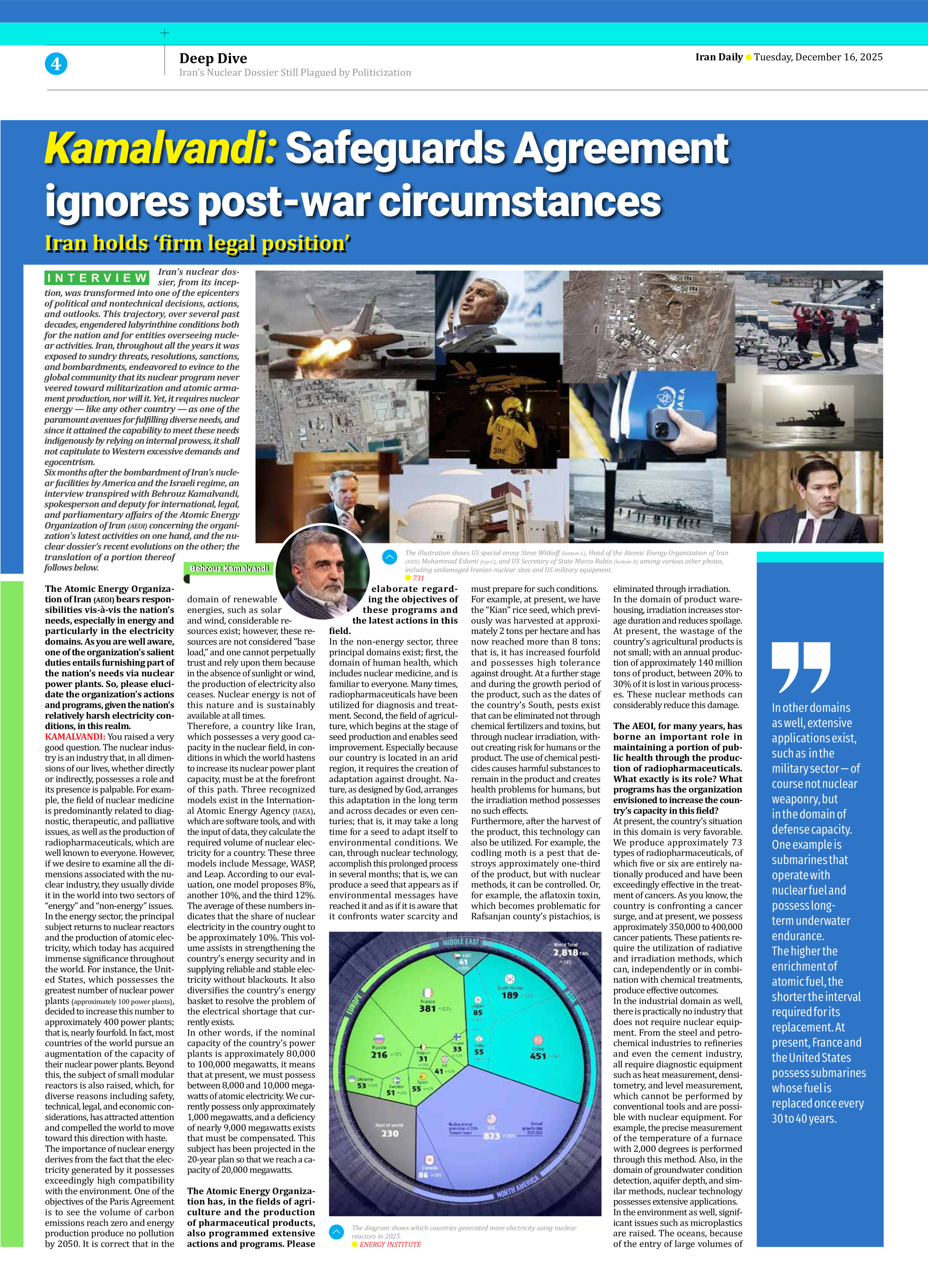
Iran’s nuclear dossier, from its inception, was transformed into one of the epicenters of political and nontechnical decisions, actions, and outlooks. This trajectory, over several past decades, engendered labyrinthine conditions both for the nation and for entities overseeing nuclear activities. Iran, throughout all the years it was exposed to sundry threats, resolutions, sanctions, and bombardments, endeavored to evince to the global community that its nuclear program never veered toward militarization and atomic armament production, nor will it. Yet, it requires nuclear energy — like any other country — as one of the paramount avenues for fulfilling diverse needs, and since it attained the capability to meet these needs indigenously by relying on internal prowess, it shall not capitulate to Western excessive demands and egocentrism. Six months after the bombardment of Iran’s nuclear facilities by America and the Israeli regime, an interview transpired with Behrouz Kamalvandi, spokesperson and deputy for international, legal, and parliamentary affairs of the Atomic Energy Organization of Iran (AEOI) concerning the organization’s latest activities on one hand, and the nuclear dossier’s recent evolutions on the other; the translation of a portion thereof follows below.
The Atomic Energy Organization of Iran (AEOI) bears responsibilities vis-à-vis the nation’s needs, especially in energy and particularly in the electricity domains. As you are well aware, one of the organization’s salient duties entails furnishing part of the nation’s needs via nuclear power plants. So, please elucidate the organization’s actions and programs, given the nation’s relatively harsh electricity conditions, in this realm.
KAMALVANDI: You raised a very good question. The nuclear industry is an industry that, in all dimensions of our lives, whether directly or indirectly, possesses a role and its presence is palpable. For example, the field of nuclear medicine is predominantly related to diagnostic, therapeutic, and palliative issues, as well as the production of radiopharmaceuticals, which are well known to everyone. However, if we desire to examine all the dimensions associated with the nuclear industry, they usually divide it in the world into two sectors of “energy” and “non-energy” issues.
In the energy sector, the principal subject returns to nuclear reactors and the production of atomic electricity, which today has acquired immense significance throughout the world. For instance, the United States, which possesses the greatest number of nuclear power plants (approximately 100 power plants), decided to increase this number to approximately 400 power plants; that is, nearly fourfold. In fact, most countries of the world pursue an augmentation of the capacity of their nuclear power plants. Beyond this, the subject of small modular reactors is also raised, which, for diverse reasons including safety, technical, legal, and economic considerations, has attracted attention and compelled the world to move toward this direction with haste.
The importance of nuclear energy derives from the fact that the electricity generated by it possesses exceedingly high compatibility with the environment. One of the objectives of the Paris Agreement is to see the volume of carbon emissions reach zero and energy production produce no pollution by 2050. It is correct that in the domain of renewable energies, such as solar and wind, considerable resources exist; however, these resources are not considered “base load,” and one cannot perpetually trust and rely upon them because in the absence of sunlight or wind, the production of electricity also ceases. Nuclear energy is not of this nature and is sustainably available at all times.
Therefore, a country like Iran, which possesses a very good capacity in the nuclear field, in conditions in which the world hastens to increase its nuclear power plant capacity, must be at the forefront of this path. Three recognized models exist in the International Atomic Energy Agency (IAEA), which are software tools, and with the input of data, they calculate the required volume of nuclear electricity for a country. These three models include Message, WASP, and Leap. According to our evaluation, one model proposes 8%, another 10%, and the third 12%. The average of these numbers indicates that the share of nuclear electricity in the country ought to be approximately 10%. This volume assists in strengthening the country’s energy security and in supplying reliable and stable electricity without blackouts. It also diversifies the country’s energy basket to resolve the problem of the electrical shortage that currently exists.
In other words, if the nominal capacity of the country’s power plants is approximately 80,000 to 100,000 megawatts, it means that at present, we must possess between 8,000 and 10,000 megawatts of atomic electricity. We currently possess only approximately 1,000 megawatts, and a deficiency of nearly 9,000 megawatts exists that must be compensated. This subject has been projected in the 20-year plan so that we reach a capacity of 20,000 megawatts.
The Atomic Energy Organization has, in the fields of agriculture and the production of pharmaceutical products, also programmed extensive actions and programs. Please elaborate regarding the objectives of these programs and the latest actions in this field.
In the non-energy sector, three principal domains exist; first, the domain of human health, which includes nuclear medicine, and is familiar to everyone. Many times, radiopharmaceuticals have been utilized for diagnosis and treatment. Second, the field of agriculture, which begins at the stage of seed production and enables seed improvement. Especially because our country is located in an arid region, it requires the creation of adaptation against drought. Nature, as designed by God, arranges this adaptation in the long term and across decades or even centuries; that is, it may take a long time for a seed to adapt itself to environmental conditions. We can, through nuclear technology, accomplish this prolonged process in several months; that is, we can produce a seed that appears as if environmental messages have reached it and as if it is aware that it confronts water scarcity and must prepare for such conditions.
For example, at present, we have the “Kian” rice seed, which previously was harvested at approximately 2 tons per hectare and has now reached more than 8 tons; that is, it has increased fourfold and possesses high tolerance against drought. At a further stage and during the growth period of the product, such as the dates of the country’s South, pests exist that can be eliminated not through chemical fertilizers and toxins, but through nuclear irradiation, without creating risk for humans or the product. The use of chemical pesticides causes harmful substances to remain in the product and creates health problems for humans, but the irradiation method possesses no such effects.
Furthermore, after the harvest of the product, this technology can also be utilized. For example, the codling moth is a pest that destroys approximately one-third of the product, but with nuclear methods, it can be controlled. Or, for example, the aflatoxin toxin, which becomes problematic for Rafsanjan county’s pistachios, is eliminated through irradiation.
In the domain of product warehousing, irradiation increases storage duration and reduces spoilage. At present, the wastage of the country’s agricultural products is not small; with an annual production of approximately 140 million tons of product, between 20% to 30% of it is lost in various processes. These nuclear methods can considerably reduce this damage.
The AEOI, for many years, has borne an important role in maintaining a portion of public health through the production of radiopharmaceuticals. What exactly is its role? What programs has the organization envisioned to increase the country’s capacity in this field?
At present, the country’s situation in this domain is very favorable. We produce approximately 73 types of radiopharmaceuticals, of which five or six are entirely nationally produced and have been exceedingly effective in the treatment of cancers. As you know, the country is confronting a cancer surge, and at present, we possess approximately 350,000 to 400,000 cancer patients. These patients require the utilization of radiative and irradiation methods, which can, independently or in combination with chemical treatments, produce effective outcomes.
In the industrial domain as well, there is practically no industry that does not require nuclear equipment. From the steel and petrochemical industries to refineries and even the cement industry, all require diagnostic equipment such as heat measurement, densitometry, and level measurement, which cannot be performed by conventional tools and are possible with nuclear equipment. For example, the precise measurement of the temperature of a furnace with 2,000 degrees is performed through this method. Also, in the domain of groundwater condition detection, aquifer depth, and similar methods, nuclear technology possesses extensive applications.
In the environment as well, significant issues such as microplastics are raised. The oceans, because of the entry of large volumes of plastic, have become polluted. The fragmented plastic particles enter the aquatic nutrition on a molecular scale and ultimately create health problems for humans. At present, at the global level, nuclear methods are utilized to confront this problem, and their results have been effective. In other domains as well, extensive applications exist, such as in the military sector — of course not nuclear weaponry, but in the domain of defense capacity. One example is submarines that operate with nuclear fuel and possess long-term underwater endurance. The higher the enrichment of atomic fuel, the shorter the interval required for its replacement. At present, France and the United States possess submarines whose fuel is replaced once every 30 to 40 years.
In general, the scope of nuclear technology and industry is exceedingly vast and creates high added economic value and plays a significant role in other sectors as well. This subject is beneficial. Alongside the two other technologies, namely quantum technology and artificial intelligence, these three domains shall shape the future of the world. Although nuclear technology has been raised for 80 years, it continues to be exceedingly important in the long-term horizon.
Our principal advantage in this domain is the knowledge and expertise of our human resources and the valuable experience we have attained during recent years. Unfortunately, precisely this point is what adversaries cannot stand; that is, a powerful Iran, whether in the nuclear, atomic, missile, or other strategic domains, is unacceptable to them. Nevertheless, it must be noted that the nuclear industry must not be viewed solely from the perspective of the Atomic Energy Organization; rather, it must also be viewed from the perspective of the populace because this industry is an important and indispensable capacity for the country.
At present, Mr. Grossi and the IAEA Board of Governors believe that Iran, as a member of the NPT, must act in accordance with this treaty and emphasize the inspection of Iran’s bombarded and damaged facilities. The question is whether, essentially, such inspection and presence are considered among the obligations of NPT member states, and what Iran’s perspective regarding this request of the IAEA is.
When a country becomes a member of the NPT, it accepts that, in addition to that convention, it must also conclude an agreement with the agency, which Iran also did. The INFCIRC/153 agreement is formulated in a manner that presupposes normal conditions, not wartime conditions. However, Article 68 exists, which refers to “unusual circumstances”; that is, cases in which, by an “unusual incident or circumstances,” the state “believes that there is or may have been loss of nuclear materials”. In such circumstances, the country is obligated to notify the agency. In 1991, when this convention was under review, precisely this issue received attention.
At the time of the finalization of the NPT convention, a question was raised regarding this article of the agreement because, as you know, agreements possess similar structures. At that time, the representative of Australia asked whether this article also includes wartime circumstances or not. We examined the negotiations of 1970, that is, 9 years before Iran’s Islamic Revolution. The agency’s representative at that time, who bore responsibility for preparing the groundwork for these agreements, responded that, officially, wartime circumstances are not included in this article, but, practically, there is no alternative but to have such an interpretation.
Therefore, from a legal perspective, it may be said that the safeguards agreement did not provide specific grounding for wartime circumstances. The reason is evident; if access is granted under such circumstances, its meaning is that the agency would obtain information and transfer it to the Board of Governors, and ultimately, this information would reach governments. As a result, confidential, military, and usable information would reach our enemy, and this means that we would, by our own hands, provide them information that could form the basis of their future actions. No country does such a thing; I do not imagine that any country in the world that possesses nuclear facilities and is attacked would be prepared to grant the agency access under those circumstances.
Our position is that in the sectors of the facilities that are undamaged, no issue exists; the agency can possess the necessary information because this information is not subject to enemy misuse. However, regarding damaged facilities, we must first reach an understanding and an agreement. This requires negotiation, and the safeguards system itself provides such capacity. The grounding for amending the agreement also exists; although its path is legal and must be pursued in Iran through the Parliament and in the agency through the Board of Governors and other legal stages. This is one of the ways. Because this matter is to create precedent, perhaps it is necessary to involve other countries as well; this event may also occur for them, and they cannot remain indifferent.
Therefore, we now return again to our initial legal assertion. We had discovered a political pathway, on the condition that they also politically assisted. Now that this possibility is not available, we possess a firm legal foundation and position, and our belief is that the safeguards agreement provided no grounding for wartime circumstances. The safeguards system also permits this. Articles 20, 21, and 22 state that, if necessary, the agreement must be amended. If, in wartime circumstances in which a portion of these facilities has been destroyed and, as they themselves say, “annihilated,” this is not a reason for amendment, what other reason could exist? When must the agreement be amended?
These arguments of ours, when placed in a legal framework, are entirely logical; however, the subject receives political treatment — that is, they say, “No, the same Article 68 of the agreement suffices.” Of course, from a legal standpoint as well, capacity exists. If a dispute arises in interpretation and implementation, various stages exist that may even be referred to international arbitration or, if necessary, the International Court of Justice may intervene.
This legal and rightful argument that you elucidated has surely been transmitted to the agency. Have Iran’s concerns and apprehensions been specifically raised, and has a definite legal response been received? We are hoping for a legal response and a new framework because, in any case, the agency bears responsibility for the supervision of the nuclear activities of countries, and it appears that the solution must commence from them. Have they, essentially, provided any response to Iran’s concerns?
When they proposed meeting in Cairo, and negotiation was conducted there, they essentially accepted that the agreement was not adequate for the existing circumstances. Even the Cairo Accord talked about the post-war circumstances. There, preparations were made, and matters were divided into two categories of damaged and undamaged zones, and the pathway was selected through our own Security Council. When the agency accepts that this pathway must be traversed, and when, after considerable time, we speak with them, and they themselves reach an initial political agreement concerning those 72-hour deadlines — which in the agreement is based on Article 68, and then, in the safeguards approach, it becomes Article 73 — its meaning is that they accepted our legal argument. Otherwise, they could have decisively stated that the information must be delivered within 72 hours.
Thus, from a legal standpoint, they accepted the issue, but their interpretation is that political pressure on Iran is effective. Instead of solving the matter legally, they desire to resolve it politically and through pressure. Therefore, if we maintain perseverance — and perseverance is not solely martial perseverance, but also continuity in pursuing our rightful legal claims and presenting legal arguments — we can continue the correct path.
How, with regard to all security considerations, does our cooperation with the agency stand at present? Has it been completely terminated? In what fields does cooperation exist? Does the agency possess inspection presence in Iran?
There were requests that the agency had, and there was the trajectory that was followed with regard to the law that suspends Iran’s cooperation with the agency, which permits issues to be referred to Iran’s Security Council to be decided. In connection with undamaged sites, we may state that the major portion of them has been inspected. Occasionally, cases existed in which, for example, one type of inspection was conducted once, and the next time, another type of inspection was conducted. There are diverse inspections — for design verification, inventory measurement, and such. We endeavored, in these severe circumstances, to maintain the utmost cooperation.
The request we submitted to the Security Council, with a relatively reasonable interval, received its response, and we raised it. We are now approaching the subject of the damaged sites. I elucidated that we cannot easily permit access; there must certainly exist measures, and conditions must be created under which this becomes possible. Our most significant issue is the security issue. As I stated, in the safeguards agreement, this circumstance was not anticipated; that is, they wrote the safeguards as if no war would ever occur. Even Article 68, which refers to “unusual circumstances”, intends flood, earthquake, fire, and similar cases. For example, it says you must notify within 72 hours that the materials have been lost. Now, if a fire occurred, it says that if 72 hours became four days, then they cannot accept that the materials have been lost.
However, no country can perform such a task within 72 hours. We had 12 days of war just recently; that is, on the first and last day of the war, attacks were conducted upon our nuclear facilities. How is it possible to notify the agency within 72 hours, and for them to come and conduct verification? For this reason, I state that neither practically, nor rationally, nor legally, is the safeguards agreement adequate. I think that if we raise this subject in the agency, the countries of the world shall also reflect that the statute of this agreement must be amended.
Until the agreement is amended and until threats exist, the rational and logical course is that the country exercise caution. For this reason, they must not expect normal behavior under normal circumstances from us. At least in private sessions, the officials of the agency state precisely this and confirm it; the countries also state this. But when they come under the pressure of the United States and European powers, they utter different remarks.
Alongside our legal discussions, the capacities and capabilities of the country are also raised. They cannot impose many things upon Iran, provided that this resolve exists. We must sit with the agency, converse, find a method, and determine a procedure. We have also contemplated this subject. Because the principal subject of the agreement, which is mentioned in paragraph “d” of Article 1 of the GOV/2025/38 agreement, is to ensure “verification of the non-diversion of nuclear material” toward weaponry. We possess various other methods that create this assurance for them, even under “unusual circumstances” and under threat conditions. And when they observe, they shall state, “Yes, this is also a correct method.” These are matters that are negotiable and require that we sit, provided that these negotiations are not coercive, meaning that both sides must persuade each other in negotiation, not compel each other.
The principal point, which I repeatedly emphasize, is that we are not a country they can compel. If they accept this subject, they shall recognize that some of the desires, aspirations, and objectives they pursue must be abandoned. They desired many things, and even now they desire many things, but they must abandon these. If this occurs, things shall be easier for both sides. I think that with the agency, we can find a path; it is not as if no path exists. They desire paragraph “d” of Article 1; that is, assurance of “non-diversion”. Various methods exist, and we can, in negotiation, converse with them regarding these methods.
The full interview first appeared in Persian on IRNA.