







Humans settle, expand knowledge in Neolithic Iran
For millions of years, humans lived according to a common pattern of hunting and gathering, and the shift in lifestyle was not a sudden decision but a process spanning thousands of years. Around 12,000 years ago, this process culminated in the Neolithic period, or the beginning of settled village life, which many scholars consider the most important event in human history.
Mohammad Hossein Azizi Kharanqi, an archaeologist, told chtn.ir that one of the most fundamental chapters in human evolution shows that “humans did not leave the caves by a sudden decision.”
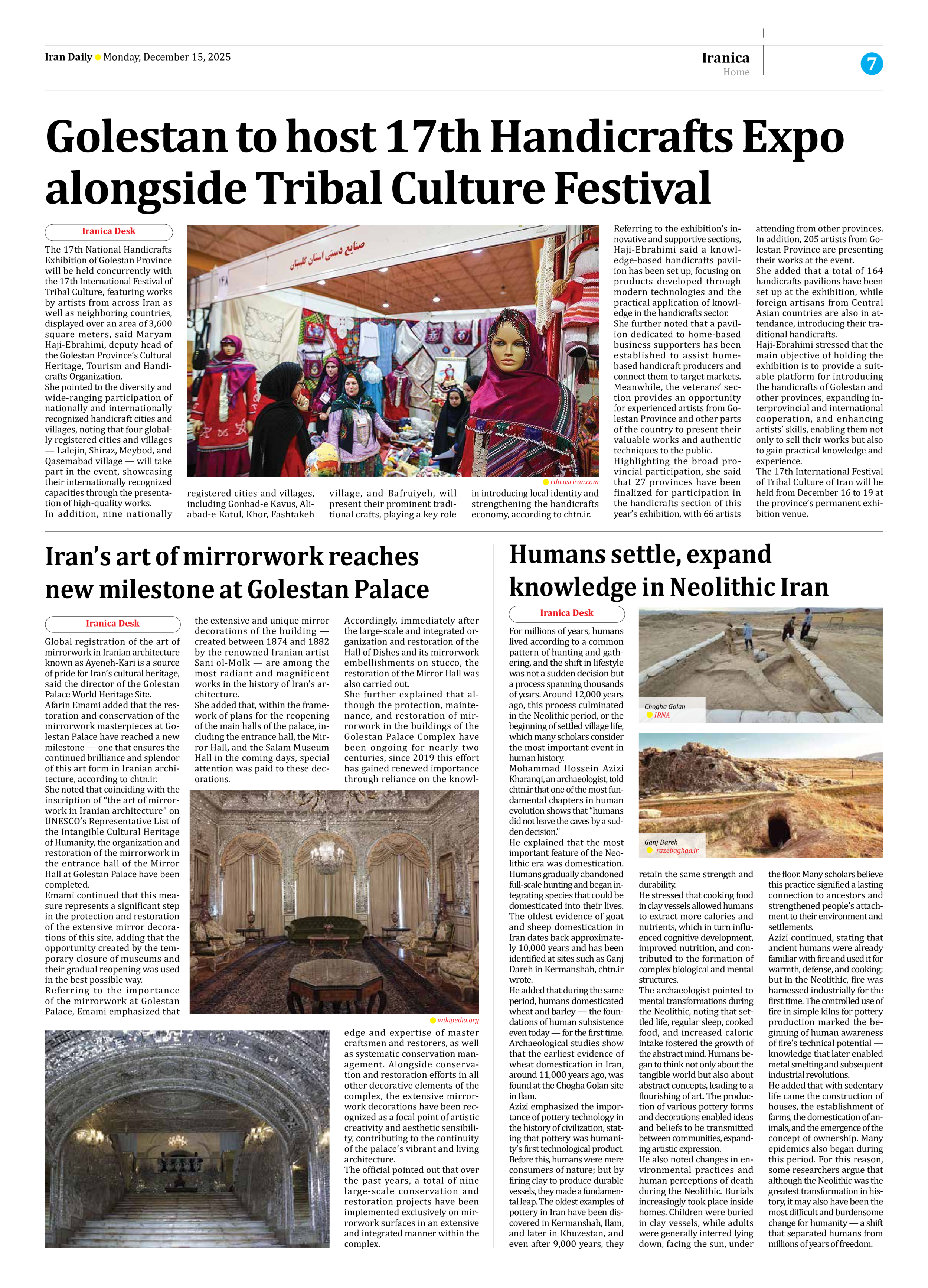
He explained that the most important feature of the Neolithic era was domestication. Humans gradually abandoned full-scale hunting and began integrating species that could be domesticated into their lives. The oldest evidence of goat and sheep domestication in Iran dates back approximately 10,000 years and has been identified at sites such as Ganj Dareh in Kermanshah, chtn.ir wrote.
He added that during the same period, humans domesticated wheat and barley — the foundations of human subsistence even today — for the first time. Archaeological studies show that the earliest evidence of wheat domestication in Iran, around 11,000 years ago, was found at the Chogha Golan site in Ilam.
Azizi emphasized the importance of pottery technology in the history of civilization, stating that pottery was humanity’s first technological product. Before this, humans were mere consumers of nature; but by firing clay to produce durable vessels, they made a fundamental leap. The oldest examples of pottery in Iran have been discovered in Kermanshah, Ilam, and later in Khuzestan, and even after 9,000 years, they retain the same strength and durability.
He stressed that cooking food in clay vessels allowed humans to extract more calories and nutrients, which in turn influenced cognitive development, improved nutrition, and contributed to the formation of complex biological and mental structures.
The archaeologist pointed to mental transformations during the Neolithic, noting that settled life, regular sleep, cooked food, and increased caloric intake fostered the growth of the abstract mind. Humans began to think not only about the tangible world but also about abstract concepts, leading to a flourishing of art. The production of various pottery forms and decorations enabled ideas and beliefs to be transmitted between communities, expanding artistic expression.
He also noted changes in environmental practices and human perceptions of death during the Neolithic. Burials increasingly took place inside homes. Children were buried in clay vessels, while adults were generally interred lying down, facing the sun, under the floor. Many scholars believe this practice signified a lasting connection to ancestors and strengthened people’s attachment to their environment and settlements.
Azizi continued, stating that ancient humans were already familiar with fire and used it for warmth, defense, and cooking; but in the Neolithic, fire was harnessed industrially for the first time. The controlled use of fire in simple kilns for pottery production marked the beginning of human awareness of fire’s technical potential — knowledge that later enabled metal smelting and subsequent industrial revolutions.
He added that with sedentary life came the construction of houses, the establishment of farms, the domestication of animals, and the emergence of the concept of ownership. Many epidemics also began during this period. For this reason, some researchers argue that although the Neolithic was the greatest transformation in history, it may also have been the most difficult and burdensome change for humanity — a shift that separated humans from millions of years of freedom.