







Copy in clipboard...
Kazakhstan opens first-ever display of Persian manuscripts on Kazakh khanates
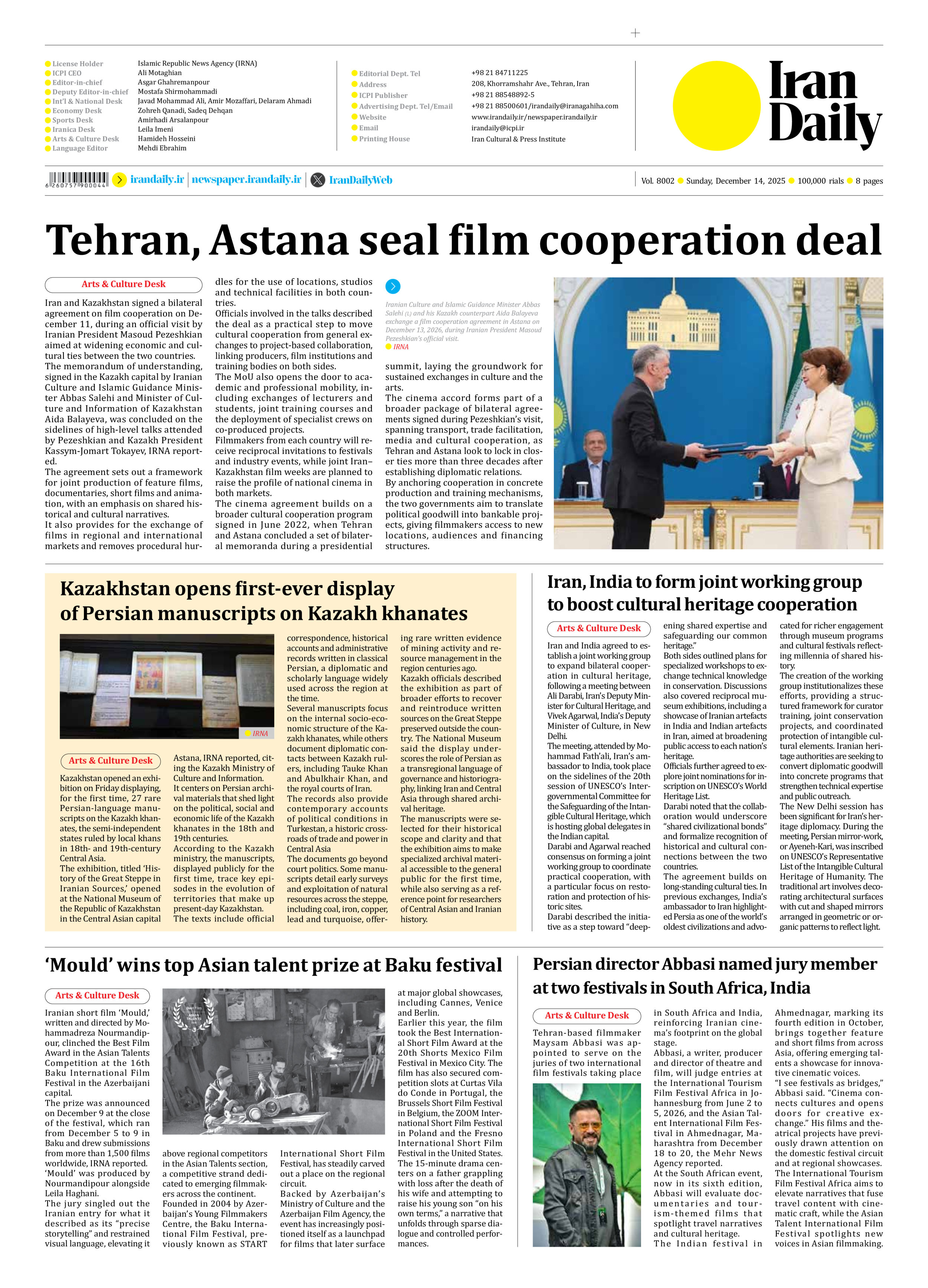
The exhibition, titled ‘History of the Great Steppe in Iranian Sources,’ opened at the National Museum of the Republic of Kazakhstan in the Central Asian capital Astana, IRNA reported, citing the Kazakh Ministry of Culture and Information.
It centers on Persian archival materials that shed light on the political, social and economic life of the Kazakh khanates in the 18th and 19th centuries.
According to the Kazakh ministry, the manuscripts, displayed publicly for the first time, trace key episodes in the evolution of territories that make up present-day Kazakhstan.
The texts include official correspondence, historical accounts and administrative records written in classical Persian, a diplomatic and scholarly language widely used across the region at the time.
Several manuscripts focus on the internal socio-economic structure of the Kazakh khanates, while others document diplomatic contacts between Kazakh rulers, including Tauke Khan and Abulkhair Khan, and the royal courts of Iran.
The records also provide contemporary accounts of political conditions in Turkestan, a historic crossroads of trade and power in Central Asia
The documents go beyond court politics. Some manuscripts detail early surveys and exploitation of natural resources across the steppe, including coal, iron, copper, lead and turquoise, offering rare written evidence of mining activity and resource management in the region centuries ago.
Kazakh officials described the exhibition as part of broader efforts to recover and reintroduce written sources on the Great Steppe preserved outside the country. The National Museum said the display underscores the role of Persian as a transregional language of governance and historiography, linking Iran and Central Asia through shared archival heritage.
The manuscripts were selected for their historical scope and clarity and that the exhibition aims to make specialized archival material accessible to the general public for the first time, while also serving as a reference point for researchers of Central Asian and Iranian history.