







Iran’s cultural diplomacy in Europe
Greece backs Iranian museum show, discusses direct flights
Greece has expressed support for a major exhibition of Iranian artifacts and signaled willingness to discuss easing visas and restoring direct flights, Iran’s minister of Cultural Heritage, Tourism and Handicrafts Reza Salehi-Amiri said in Athens.
The talks also advanced plans for a joint “Persepolis–Acropolis” symphony and a long-term cultural agreement.
Salehi-Amiri, who arrived on December 11 to attend the Ancient Civilizations Forum, said both governments had “a clear path” to improve travel links, IRNA reported.
He added that Athens welcomed Tehran’s proposal to stage the museum show at the Byzantine and Christian Museum and supported the joint symphonic project.
Greek culture minister Lina Mendoni described the cultural ties as “unbreakable” and said she saw no limits to cooperation.
Earlier on Thursday, Salehi-Amiri met Iranian-studies scholars, Greek academics and tourism agencies to press for deeper people-to-people links.
He described Iran as “one of the safest and most attractive” destinations and said visitors return with an image “completely different” from prevailing stereotypes.
He noted that lack of direct flights and visa complexities were “the main obstacles” to higher tourism flows and required bilateral work.
Greek agency managers reiterated these barriers, urging technical coordination to open the route. Cultural figures recommended easier travel, joint research projects, and regular academic exchanges to rebuild connections weakened over recent decades.
Salehi-Amiri said Iran was ready to host Greek artists and craft producers, proposing joint bazaars and exhibitions to showcase both nations’ traditions.
He highlighted Iran’s rich handicrafts sector and said museums, orchestras, and conservation bodies should underpin long-term programs.
He confirmed that Tehran and Athens plan to establish a joint committee to draft a comprehensive cultural and tourism agreement.
Mendoni said the accord could be finalized promptly and asked both sides to work on a tight schedule.
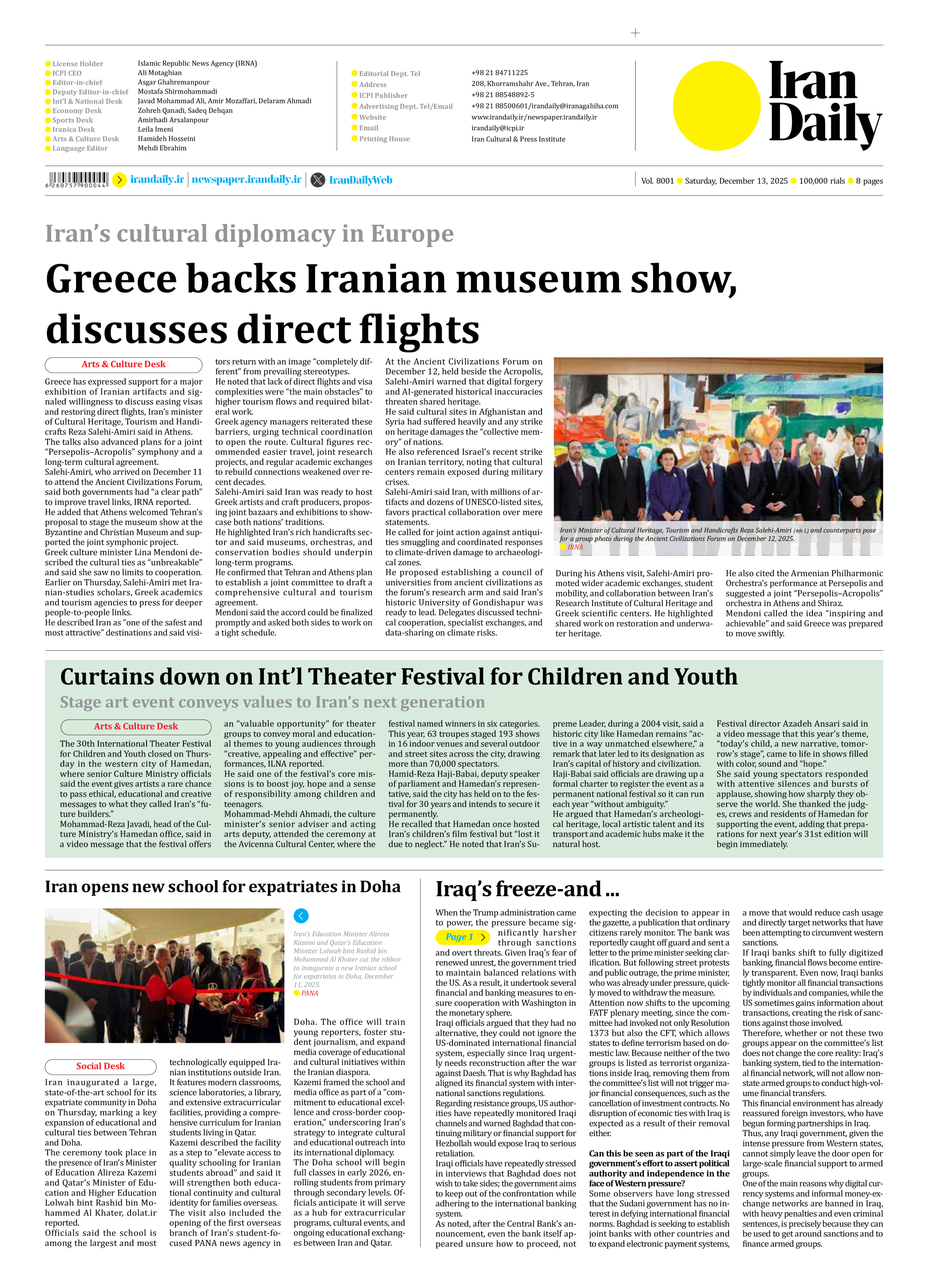
At the Ancient Civilizations Forum on December 12, held beside the Acropolis, Salehi-Amiri warned that digital forgery and AI-generated historical inaccuracies threaten shared heritage.
He said cultural sites in Afghanistan and Syria had suffered heavily and any strike on heritage damages the “collective memory” of nations.
He also referenced Israel’s recent strike on Iranian territory, noting that cultural centers remain exposed during military crises.
Salehi-Amiri said Iran, with millions of artifacts and dozens of UNESCO-listed sites, favors practical collaboration over mere statements.
He called for joint action against antiquities smuggling and coordinated responses to climate-driven damage to archaeological zones.
He proposed establishing a council of universities from ancient civilizations as the forum’s research arm and said Iran’s historic University of Gondishapur was ready to lead. Delegates discussed technical cooperation, specialist exchanges, and data-sharing on climate risks.
During his Athens visit, Salehi-Amiri promoted wider academic exchanges, student mobility, and collaboration between Iran’s Research Institute of Cultural Heritage and Greek scientific centers. He highlighted shared work on restoration and underwater heritage.
He also cited the Armenian Philharmonic Orchestra’s performance at Persepolis and suggested a joint “Persepolis–Acropolis” orchestra in Athens and Shiraz.
Mendoni called the idea “inspiring and achievable” and said Greece was prepared to move swiftly.