





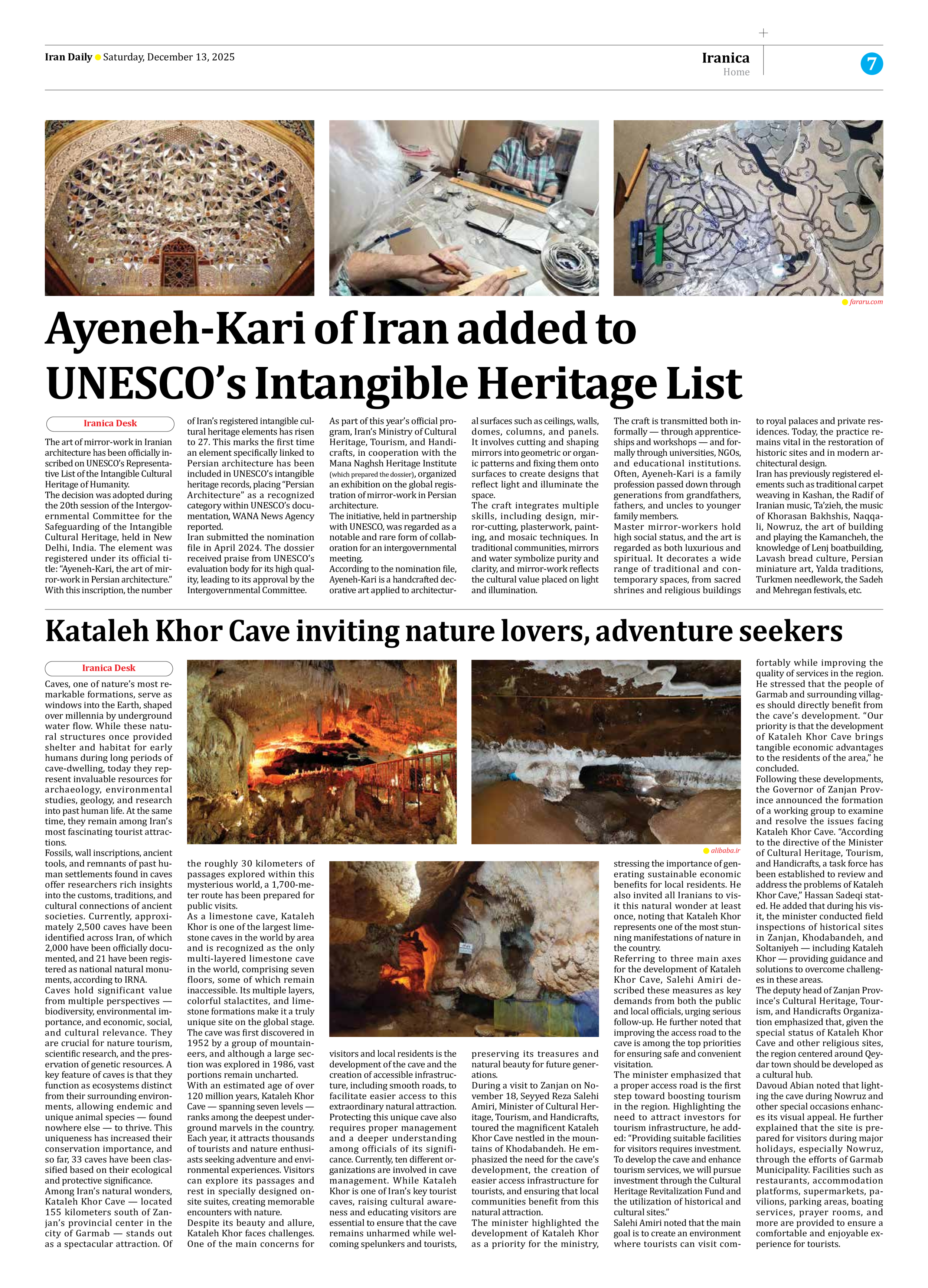


Kataleh Khor Cave inviting nature lovers, adventure seekers
Caves, one of nature’s most remarkable formations, serve as windows into the Earth, shaped over millennia by underground water flow. While these natural structures once provided shelter and habitat for early humans during long periods of cave-dwelling, today they represent invaluable resources for archaeology, environmental studies, geology, and research into past human life. At the same time, they remain among Iran’s most fascinating tourist attractions.
Fossils, wall inscriptions, ancient tools, and remnants of past human settlements found in caves offer researchers rich insights into the customs, traditions, and cultural connections of ancient societies. Currently, approximately 2,500 caves have been identified across Iran, of which 2,000 have been officially documented, and 21 have been registered as national natural monuments, according to IRNA.
Caves hold significant value from multiple perspectives — biodiversity, environmental importance, and economic, social, and cultural relevance. They are crucial for nature tourism, scientific research, and the preservation of genetic resources. A key feature of caves is that they function as ecosystems distinct from their surrounding environments, allowing endemic and unique animal species — found nowhere else — to thrive. This uniqueness has increased their conservation importance, and so far, 33 caves have been classified based on their ecological and protective significance.
Among Iran’s natural wonders, Kataleh Khor Cave — located 155 kilometers south of Zanjan’s provincial center in the city of Garmab — stands out as a spectacular attraction. Of the roughly 30 kilometers of passages explored within this mysterious world, a 1,700-meter route has been prepared for public visits.
As a limestone cave, Kataleh Khor is one of the largest limestone caves in the world by area and is recognized as the only multi-layered limestone cave in the world, comprising seven floors, some of which remain inaccessible. Its multiple layers, colorful stalactites, and limestone formations make it a truly unique site on the global stage. The cave was first discovered in 1952 by a group of mountaineers, and although a large section was explored in 1986, vast portions remain uncharted.
With an estimated age of over 120 million years, Kataleh Khor Cave — spanning seven levels — ranks among the deepest underground marvels in the country. Each year, it attracts thousands of tourists and nature enthusiasts seeking adventure and environmental experiences. Visitors can explore its passages and rest in specially designed on-site suites, creating memorable encounters with nature.
Despite its beauty and allure, Kataleh Khor faces challenges. One of the main concerns for visitors and local residents is the development of the cave and the creation of accessible infrastructure, including smooth roads, to facilitate easier access to this extraordinary natural attraction.
Protecting this unique cave also requires proper management and a deeper understanding among officials of its significance. Currently, ten different organizations are involved in cave management. While Kataleh Khor is one of Iran’s key tourist caves, raising cultural awareness and educating visitors are essential to ensure that the cave remains unharmed while welcoming spelunkers and tourists, preserving its treasures and natural beauty for future generations.
During a visit to Zanjan on November 18, Seyyed Reza Salehi Amiri, Minister of Cultural Heritage, Tourism, and Handicrafts, toured the magnificent Kataleh Khor Cave nestled in the mountains of Khodabandeh. He emphasized the need for the cave’s development, the creation of easier access infrastructure for tourists, and ensuring that local communities benefit from this natural attraction.
The minister highlighted the development of Kataleh Khor as a priority for the ministry, stressing the importance of generating sustainable economic benefits for local residents. He also invited all Iranians to visit this natural wonder at least once, noting that Kataleh Khor represents one of the most stunning manifestations of nature in the country.
Referring to three main axes for the development of Kataleh Khor Cave, Salehi Amiri described these measures as key demands from both the public and local officials, urging serious follow-up. He further noted that improving the access road to the cave is among the top priorities for ensuring safe and convenient visitation.
The minister emphasized that a proper access road is the first step toward boosting tourism in the region. Highlighting the need to attract investors for tourism infrastructure, he added: “Providing suitable facilities for visitors requires investment. To develop the cave and enhance tourism services, we will pursue investment through the Cultural Heritage Revitalization Fund and the utilization of historical and cultural sites.”
Salehi Amiri noted that the main goal is to create an environment where tourists can visit comfortably while improving the quality of services in the region. He stressed that the people of Garmab and surrounding villages should directly benefit from the cave’s development. “Our priority is that the development of Kataleh Khor Cave brings tangible economic advantages to the residents of the area,” he concluded.
Following these developments, the Governor of Zanjan Province announced the formation of a working group to examine and resolve the issues facing Kataleh Khor Cave. “According to the directive of the Minister of Cultural Heritage, Tourism, and Handicrafts, a task force has been established to review and address the problems of Kataleh Khor Cave,” Hassan Sadeqi stated. He added that during his visit, the minister conducted field inspections of historical sites in Zanjan, Khodabandeh, and Soltaniyeh — including Kataleh Khor — providing guidance and solutions to overcome challenges in these areas.
The deputy head of Zanjan Province’s Cultural Heritage, Tourism, and Handicrafts Organization emphasized that, given the special status of Kataleh Khor Cave and other religious sites, the region centered around Qeydar town should be developed as a cultural hub.
Davoud Abian noted that lighting the cave during Nowruz and other special occasions enhances its visual appeal. He further explained that the site is prepared for visitors during major holidays, especially Nowruz, through the efforts of Garmab Municipality. Facilities such as restaurants, accommodation platforms, supermarkets, pavilions, parking areas, boating services, prayer rooms, and more are provided to ensure a comfortable and enjoyable experience for tourists.