







Volleyball yielded most team-sport success for Iran in 2025: IRIVF chief
Volleyball brought Iran “more international success in 2025 than any other team sport,” insists Milad Taqavi, chairman of the country’s Volleyball Federation (IRIVF).
“It was an exceptionally hectic international season for us. We fielded Iranian teams in 37 tournaments across the globe, involving roughly 750 athletes,” the head of the sport’s national governing body told Mehr News Agency.
“Our competition schedule spanned over the entire year – 377 days of matches against 476 different teams – which is remarkable in itself. Securing even a single medal in team sports is a formidable challenge, yet this year we won 10 gold, two silver, and three bronze medals across various age and gender categories,” Taqavi added.
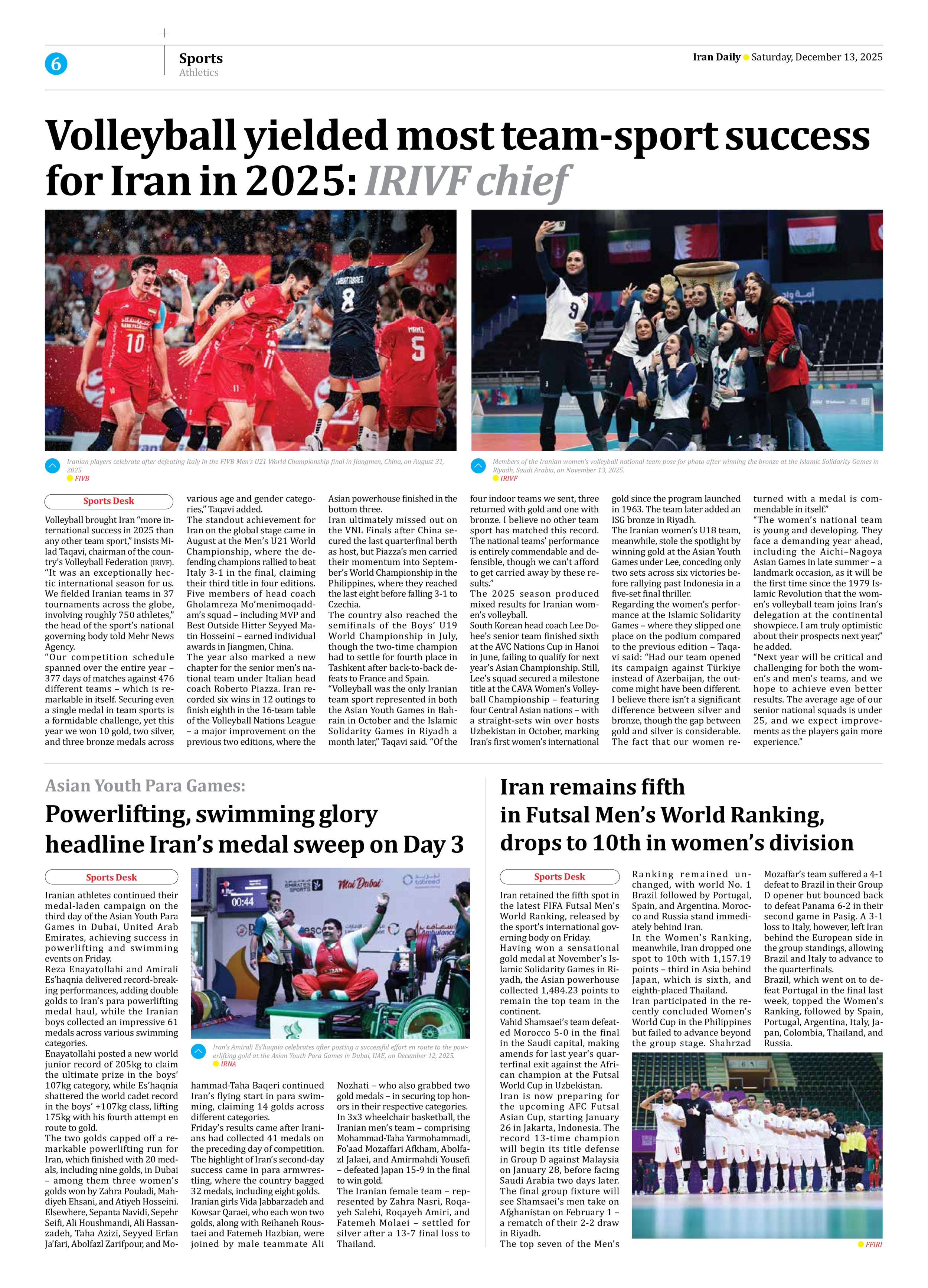
The standout achievement for Iran on the global stage came in August at the Men’s U21 World Championship, where the defending champions rallied to beat Italy 3-1 in the final, claiming their third title in four editions. Five members of head coach Gholamreza Mo’menimoqaddam’s squad – including MVP and Best Outside Hitter Seyyed Matin Hosseini – earned individual awards in Jiangmen, China.
The year also marked a new chapter for the senior men’s national team under Italian head coach Roberto Piazza. Iran recorded six wins in 12 outings to finish eighth in the 16-team table of the Volleyball Nations League – a major improvement on the previous two editions, where the Asian powerhouse finished in the bottom three.
Iran ultimately missed out on the VNL Finals after China secured the last quarterfinal berth as host, but Piazza’s men carried their momentum into September’s World Championship in the Philippines, where they reached the last eight before falling 3-1 to Czechia.
The country also reached the semifinals of the Boys’ U19 World Championship in July, though the two-time champion had to settle for fourth place in Tashkent after back-to-back defeats to France and Spain.
“Volleyball was the only Iranian team sport represented in both the Asian Youth Games in Bahrain in October and the Islamic Solidarity Games in Riyadh a month later,” Taqavi said. “Of the four indoor teams we sent, three returned with gold and one with bronze. I believe no other team sport has matched this record. The national teams’ performance is entirely commendable and defensible, though we can’t afford to get carried away by these results.”
The 2025 season produced mixed results for Iranian women’s volleyball.
South Korean head coach Lee Do-hee’s senior team finished sixth at the AVC Nations Cup in Hanoi in June, failing to qualify for next year’s Asian Championship. Still, Lee’s squad secured a milestone title at the CAVA Women’s Volleyball Championship – featuring four Central Asian nations – with a straight-sets win over hosts Uzbekistan in October, marking Iran’s first women’s international gold since the program launched in 1963. The team later added an ISG bronze in Riyadh.
The Iranian women’s U18 team, meanwhile, stole the spotlight by winning gold at the Asian Youth Games under Lee, conceding only two sets across six victories before rallying past Indonesia in a five-set final thriller.
Regarding the women’s performance at the Islamic Solidarity Games – where they slipped one place on the podium compared to the previous edition – Taqavi said: “Had our team opened its campaign against Türkiye instead of Azerbaijan, the outcome might have been different. I believe there isn’t a significant difference between silver and bronze, though the gap between gold and silver is considerable. The fact that our women returned with a medal is commendable in itself.”
“The women’s national team is young and developing. They face a demanding year ahead, including the Aichi–Nagoya Asian Games in late summer – a landmark occasion, as it will be the first time since the 1979 Islamic Revolution that the women’s volleyball team joins Iran’s delegation at the continental showpiece. I am truly optimistic about their prospects next year,” he added.
“Next year will be critical and challenging for both the women’s and men’s teams, and we hope to achieve even better results. The average age of our senior national squads is under 25, and we expect improvements as the players gain more experience.”