





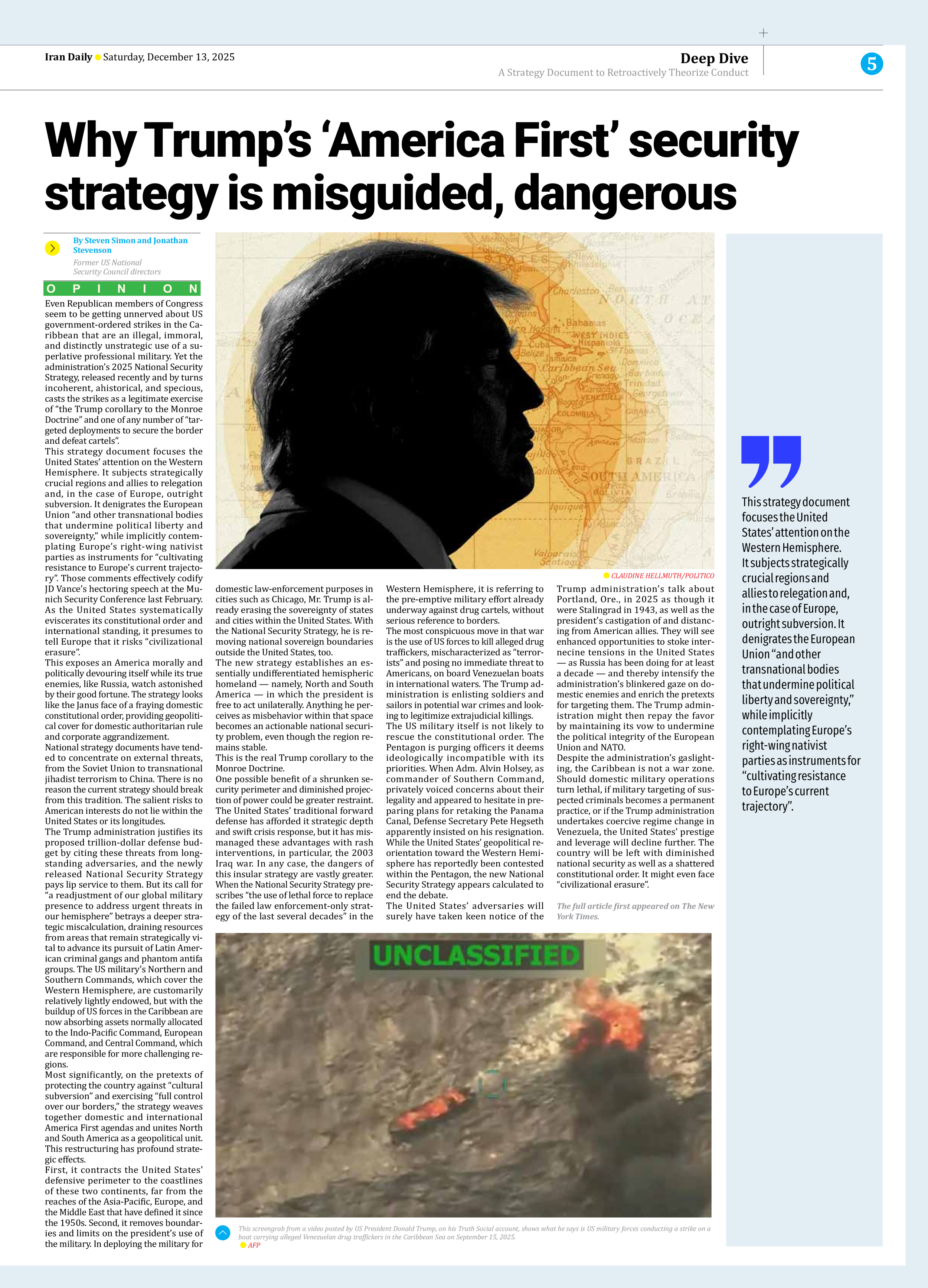


Why Trump’s ‘America First’ security strategy is misguided, dangerous
By Steven Simon and Jonathan Stevenson
Former US National
Security Council directors
Even Republican members of Congress seem to be getting unnerved about US government-ordered strikes in the Caribbean that are an illegal, immoral, and distinctly unstrategic use of a superlative professional military. Yet the administration’s 2025 National Security Strategy, released recently and by turns incoherent, ahistorical, and specious, casts the strikes as a legitimate exercise of “the Trump corollary to the Monroe Doctrine” and one of any number of “targeted deployments to secure the border and defeat cartels”.
This strategy document focuses the United States’ attention on the Western Hemisphere. It subjects strategically crucial regions and allies to relegation and, in the case of Europe, outright subversion. It denigrates the European Union “and other transnational bodies that undermine political liberty and sovereignty,” while implicitly contemplating Europe’s right-wing nativist parties as instruments for “cultivating resistance to Europe’s current trajectory”. Those comments effectively codify JD Vance’s hectoring speech at the Munich Security Conference last February. As the United States systematically eviscerates its constitutional order and international standing, it presumes to tell Europe that it risks “civilizational erasure”.
This exposes an America morally and politically devouring itself while its true enemies, like Russia, watch astonished by their good fortune. The strategy looks like the Janus face of a fraying domestic constitutional order, providing geopolitical cover for domestic authoritarian rule and corporate aggrandizement.
National strategy documents have tended to concentrate on external threats, from the Soviet Union to transnational jihadist terrorism to China. There is no reason the current strategy should break from this tradition. The salient risks to American interests do not lie within the United States or its longitudes.
The Trump administration justifies its proposed trillion-dollar defense budget by citing these threats from longstanding adversaries, and the newly released National Security Strategy pays lip service to them. But its call for “a readjustment of our global military presence to address urgent threats in our hemisphere” betrays a deeper strategic miscalculation, draining resources from areas that remain strategically vital to advance its pursuit of Latin American criminal gangs and phantom antifa groups. The US military’s Northern and Southern Commands, which cover the Western Hemisphere, are customarily relatively lightly endowed, but with the buildup of US forces in the Caribbean are now absorbing assets normally allocated to the Indo-Pacific Command, European Command, and Central Command, which are responsible for more challenging regions.
Most significantly, on the pretexts of protecting the country against “cultural subversion” and exercising “full control over our borders,” the strategy weaves together domestic and international America First agendas and unites North and South America as a geopolitical unit. This restructuring has profound strategic effects.
First, it contracts the United States’ defensive perimeter to the coastlines of these two continents, far from the reaches of the Asia-Pacific, Europe, and the Middle East that have defined it since the 1950s. Second, it removes boundaries and limits on the president’s use of the military. In deploying the military for domestic law-enforcement purposes in cities such as Chicago, Mr. Trump is already erasing the sovereignty of states and cities within the United States. With the National Security Strategy, he is removing national sovereign boundaries outside the United States, too.
The new strategy establishes an essentially undifferentiated hemispheric homeland — namely, North and South America — in which the president is free to act unilaterally. Anything he perceives as misbehavior within that space becomes an actionable national security problem, even though the region remains stable.
This is the real Trump corollary to the Monroe Doctrine.
One possible benefit of a shrunken security perimeter and diminished projection of power could be greater restraint. The United States’ traditional forward defense has afforded it strategic depth and swift crisis response, but it has mismanaged these advantages with rash interventions, in particular, the 2003 Iraq war. In any case, the dangers of this insular strategy are vastly greater. When the National Security Strategy prescribes “the use of lethal force to replace the failed law enforcement-only strategy of the last several decades” in the Western Hemisphere, it is referring to the pre-emptive military effort already underway against drug cartels, without serious reference to borders.
The most conspicuous move in that war is the use of US forces to kill alleged drug traffickers, mischaracterized as “terrorists” and posing no immediate threat to Americans, on board Venezuelan boats in international waters. The Trump administration is enlisting soldiers and sailors in potential war crimes and looking to legitimize extrajudicial killings.
The US military itself is not likely to rescue the constitutional order. The Pentagon is purging officers it deems ideologically incompatible with its priorities. When Adm. Alvin Holsey, as commander of Southern Command, privately voiced concerns about their legality and appeared to hesitate in preparing plans for retaking the Panama Canal, Defense Secretary Pete Hegseth apparently insisted on his resignation. While the United States’ geopolitical reorientation toward the Western Hemisphere has reportedly been contested within the Pentagon, the new National Security Strategy appears calculated to end the debate.
The United States’ adversaries will surely have taken keen notice of the Trump administration’s talk about Portland, Ore., in 2025 as though it were Stalingrad in 1943, as well as the president’s castigation of and distancing from American allies. They will see enhanced opportunities to stoke internecine tensions in the United States — as Russia has been doing for at least a decade — and thereby intensify the administration’s blinkered gaze on domestic enemies and enrich the pretexts for targeting them. The Trump administration might then repay the favor by maintaining its vow to undermine the political integrity of the European Union and NATO.
Despite the administration’s gaslighting, the Caribbean is not a war zone. Should domestic military operations turn lethal, if military targeting of suspected criminals becomes a permanent practice, or if the Trump administration undertakes coercive regime change in Venezuela, the United States’ prestige and leverage will decline further. The country will be left with diminished national security as well as a shattered constitutional order. It might even face “civilizational erasure”.
The full article first appeared on The New York Times.