





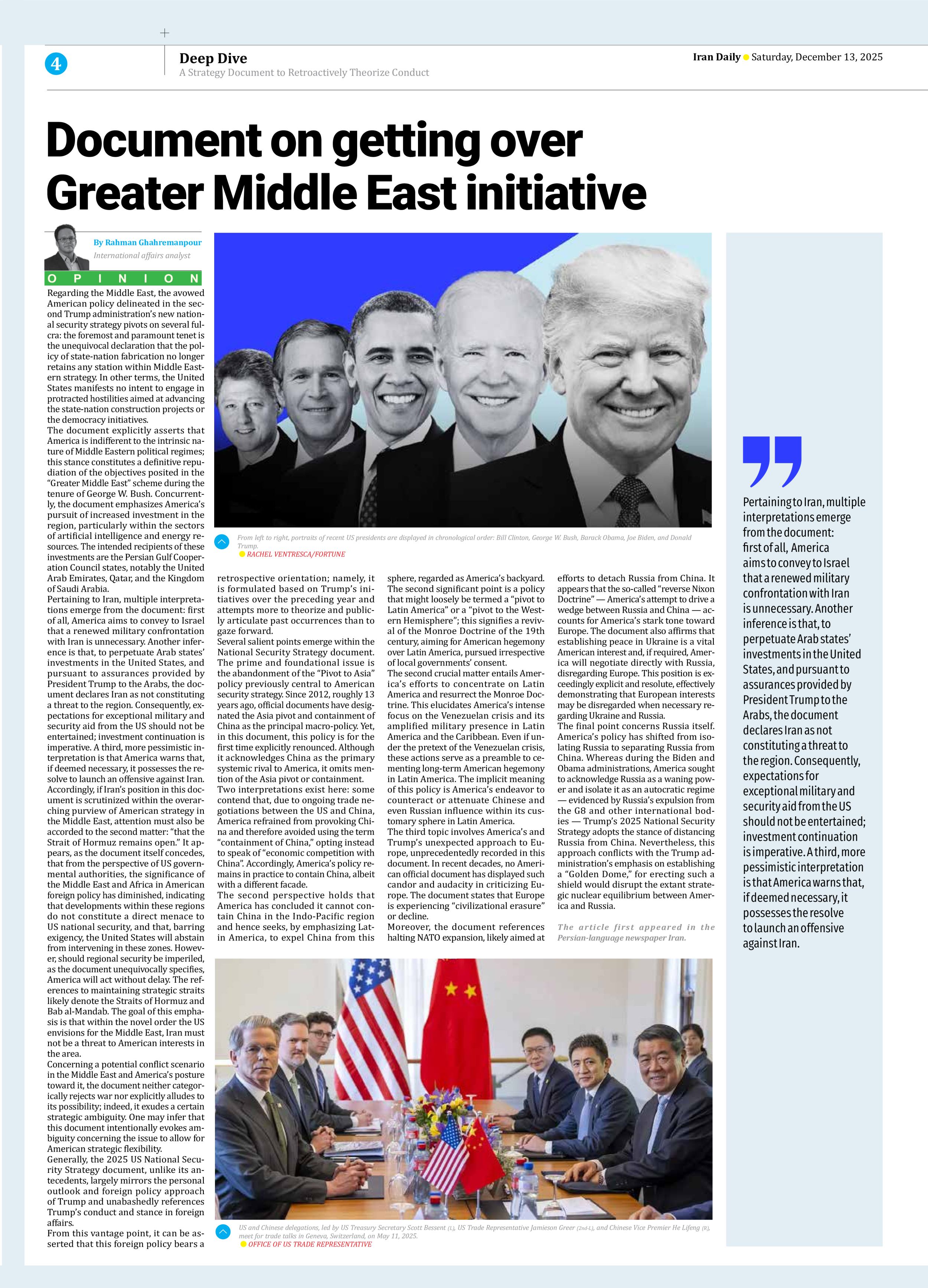


Document on getting over Greater Middle East initiative
By Rahman Ghahremanpour
International affairs analyst
Regarding the Middle East, the avowed American policy delineated in the second Trump administration’s new national security strategy pivots on several fulcra: the foremost and paramount tenet is the unequivocal declaration that the policy of state-nation fabrication no longer retains any station within Middle Eastern strategy. In other terms, the United States manifests no intent to engage in protracted hostilities aimed at advancing the state-nation construction projects or the democracy initiatives.
The document explicitly asserts that America is indifferent to the intrinsic nature of Middle Eastern political regimes; this stance constitutes a definitive repudiation of the objectives posited in the “Greater Middle East” scheme during the tenure of George W. Bush. Concurrently, the document emphasizes America’s pursuit of increased investment in the region, particularly within the sectors of artificial intelligence and energy resources. The intended recipients of these investments are the Persian Gulf Cooperation Council states, notably the United Arab Emirates, Qatar, and the Kingdom of Saudi Arabia.
Pertaining to Iran, multiple interpretations emerge from the document: first of all, America aims to convey to Israel that a renewed military confrontation with Iran is unnecessary. Another inference is that, to perpetuate Arab states’ investments in the United States, and pursuant to assurances provided by President Trump to the Arabs, the document declares Iran as not constituting a threat to the region. Consequently, expectations for exceptional military and security aid from the US should not be entertained; investment continuation is imperative. A third, more pessimistic interpretation is that America warns that, if deemed necessary, it possesses the resolve to launch an offensive against Iran.
Accordingly, if Iran’s position in this document is scrutinized within the overarching purview of American strategy in the Middle East, attention must also be accorded to the second matter: “that the Strait of Hormuz remains open.” It appears, as the document itself concedes, that from the perspective of US governmental authorities, the significance of the Middle East and Africa in American foreign policy has diminished, indicating that developments within these regions do not constitute a direct menace to US national security, and that, barring exigency, the United States will abstain from intervening in these zones. However, should regional security be imperiled, as the document unequivocally specifies, America will act without delay. The references to maintaining strategic straits likely denote the Straits of Hormuz and Bab al-Mandab. The goal of this emphasis is that within the novel order the US envisions for the Middle East, Iran must not be a threat to American interests in the area.
Concerning a potential conflict scenario in the Middle East and America’s posture toward it, the document neither categorically rejects war nor explicitly alludes to its possibility; indeed, it exudes a certain strategic ambiguity. One may infer that this document intentionally evokes ambiguity concerning the issue to allow for American strategic flexibility.
Generally, the 2025 US National Security Strategy document, unlike its antecedents, largely mirrors the personal outlook and foreign policy approach of Trump and unabashedly references Trump’s conduct and stance in foreign affairs.
From this vantage point, it can be asserted that this foreign policy bears a retrospective orientation; namely, it is formulated based on Trump’s initiatives over the preceding year and attempts more to theorize and publicly articulate past occurrences than to gaze forward.
Several salient points emerge within the National Security Strategy document. The prime and foundational issue is the abandonment of the “Pivot to Asia” policy previously central to American security strategy. Since 2012, roughly 13 years ago, official documents have designated the Asia pivot and containment of China as the principal macro-policy. Yet, in this document, this policy is for the first time explicitly renounced. Although it acknowledges China as the primary systemic rival to America, it omits mention of the Asia pivot or containment.
Two interpretations exist here: some contend that, due to ongoing trade negotiations between the US and China, America refrained from provoking China and therefore avoided using the term “containment of China,” opting instead to speak of “economic competition with China”. Accordingly, America’s policy remains in practice to contain China, albeit with a different facade.
The second perspective holds that America has concluded it cannot contain China in the Indo-Pacific region and hence seeks, by emphasizing Latin America, to expel China from this sphere, regarded as America’s backyard. The second significant point is a policy that might loosely be termed a “pivot to Latin America” or a “pivot to the Western Hemisphere”; this signifies a revival of the Monroe Doctrine of the 19th century, aiming for American hegemony over Latin America, pursued irrespective of local governments’ consent.
The second crucial matter entails America’s efforts to concentrate on Latin America and resurrect the Monroe Doctrine. This elucidates America’s intense focus on the Venezuelan crisis and its amplified military presence in Latin America and the Caribbean. Even if under the pretext of the Venezuelan crisis, these actions serve as a preamble to cementing long-term American hegemony in Latin America. The implicit meaning of this policy is America’s endeavor to counteract or attenuate Chinese and even Russian influence within its customary sphere in Latin America.
The third topic involves America’s and Trump’s unexpected approach to Europe, unprecedentedly recorded in this document. In recent decades, no American official document has displayed such candor and audacity in criticizing Europe. The document states that Europe is experiencing “civilizational erasure” or decline.
Moreover, the document references halting NATO expansion, likely aimed at efforts to detach Russia from China. It appears that the so-called “reverse Nixon Doctrine” — America’s attempt to drive a wedge between Russia and China — accounts for America’s stark tone toward Europe. The document also affirms that establishing peace in Ukraine is a vital American interest and, if required, America will negotiate directly with Russia, disregarding Europe. This position is exceedingly explicit and resolute, effectively demonstrating that European interests may be disregarded when necessary regarding Ukraine and Russia.
The final point concerns Russia itself. America’s policy has shifted from isolating Russia to separating Russia from China. Whereas during the Biden and Obama administrations, America sought to acknowledge Russia as a waning power and isolate it as an autocratic regime — evidenced by Russia’s expulsion from the G8 and other international bodies — Trump’s 2025 National Security Strategy adopts the stance of distancing Russia from China. Nevertheless, this approach conflicts with the Trump administration’s emphasis on establishing a “Golden Dome,” for erecting such a shield would disrupt the extant strategic nuclear equilibrium between America and Russia.
The article first appeared in the
Persian-language newspaper Iran.