







Copy in clipboard...
Pezeshkian slams world powers for granting Israel ‘special right’ for aggression
Iran, Russia stress implementation of strategic partnership pact
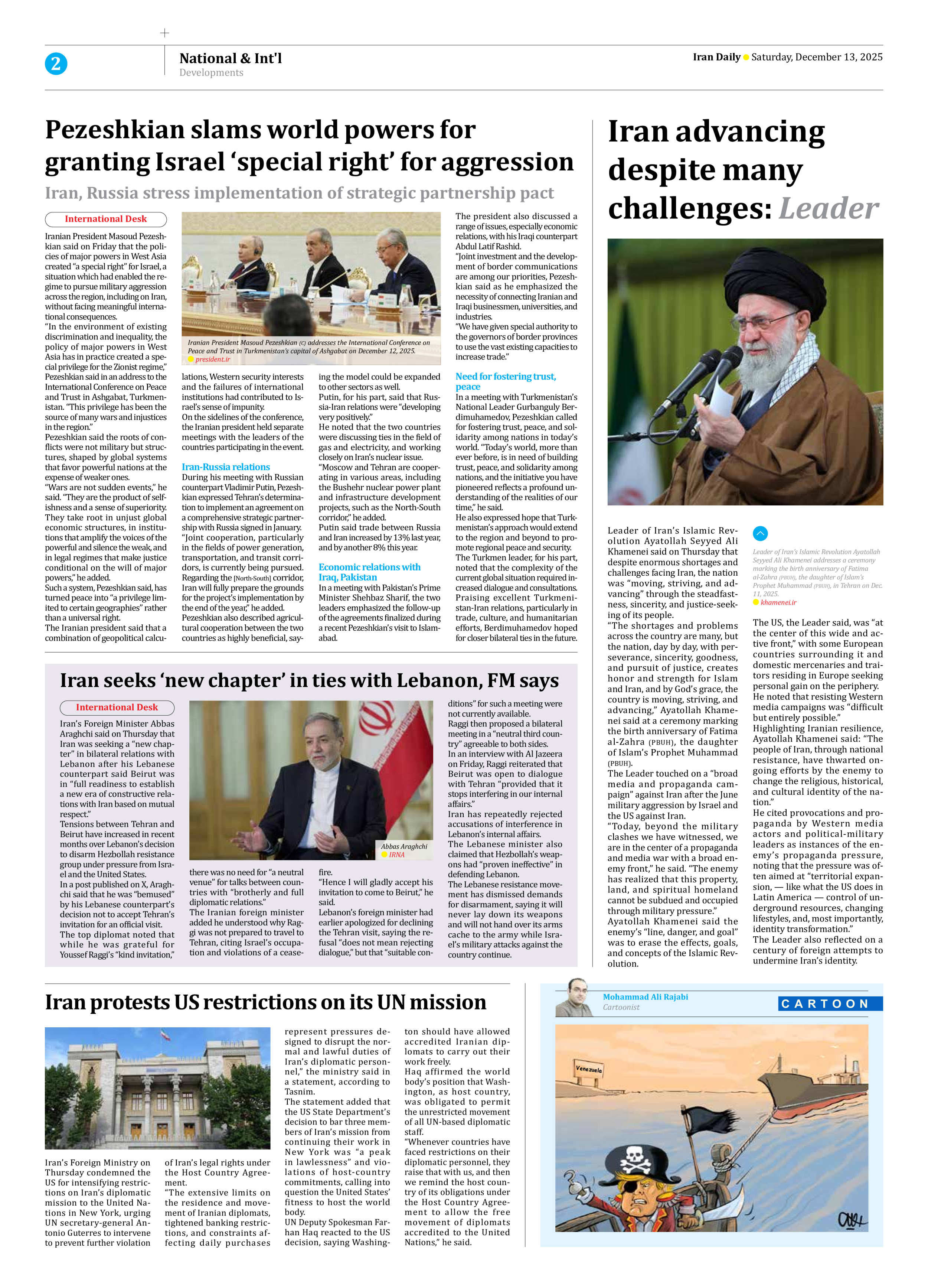
Iranian President Masoud Pezeshkian said on Friday that the policies of major powers in West Asia created “a special right” for Israel, a situation which had enabled the regime to pursue military aggression across the region, including on Iran, without facing meaningful international consequences.
“In the environment of existing discrimination and inequality, the policy of major powers in West Asia has in practice created a special privilege for the Zionist regime,” Pezeshkian said in an address to the International Conference on Peace and Trust in Ashgabat, Turkmenistan. “This privilege has been the source of many wars and injustices in the region.”
Pezeshkian said the roots of conflicts were not military but structures, shaped by global systems that favor powerful nations at the expense of weaker ones.
“Wars are not sudden events,” he said. “They are the product of selfishness and a sense of superiority. They take root in unjust global economic structures, in institutions that amplify the voices of the powerful and silence the weak, and in legal regimes that make justice conditional on the will of major powers,” he added.
Such a system, Pezeshkian said, has turned peace into “a privilege limited to certain geographies” rather than a universal right.
The Iranian president said that a combination of geopolitical calculations, Western security interests and the failures of international institutions had contributed to Israel’s sense of impunity.
On the sidelines of the conference, the Iranian president held separate meetings with the leaders of the countries participating in the event.
Iran-Russia relations
During his meeting with Russian counterpart Vladimir Putin, Pezeshkian expressed Tehran’s determination to implement an agreement on a comprehensive strategic partnership with Russia signed in January.
“Joint cooperation, particularly in the fields of power generation, transportation, and transit corridors, is currently being pursued. Regarding the [North-South] corridor, Iran will fully prepare the grounds for the project’s implementation by the end of the year,” he added.
Pezeshkian also described agricultural cooperation between the two countries as highly beneficial, saying the model could be expanded to other sectors as well.
Putin, for his part, said that Russia-Iran relations were “developing very positively.”
He noted that the two countries were discussing ties in the field of gas and electricity, and working closely on Iran’s nuclear issue.
“Moscow and Tehran are cooperating in various areas, including the Bushehr nuclear power plant and infrastructure development projects, such as the North-South corridor,” he added.
Putin said trade between Russia and Iran increased by 13% last year, and by another 8% this year.
Economic relations with Iraq, Pakistan
In a meeting with Pakistan’s Prime Minister Shehbaz Sharif, the two leaders emphasized the follow-up of the agreements finalized during a recent Pezeshkian’s visit to Islamabad.
The president also discussed a range of issues, especially economic relations, with his Iraqi counterpart Abdul Latif Rashid.
“Joint investment and the development of border communications are among our priorities, Pezeshkian said as he emphasized the necessity of connecting Iranian and Iraqi businessmen, universities, and industries.
“We have given special authority to the governors of border provinces to use the vast existing capacities to increase trade.”
Need for fostering trust, peace
In a meeting with Turkmenistan’s National Leader Gurbanguly Berdimuhamedov, Pezeshkian called for fostering trust, peace, and solidarity among nations in today’s world. “Today’s world, more than ever before, is in need of building trust, peace, and solidarity among nations, and the initiative you have pioneered reflects a profound understanding of the realities of our time,” he said.
He also expressed hope that Turkmenistan’s approach would extend to the region and beyond to promote regional peace and security.
The Turkmen leader, for his part, noted that the complexity of the current global situation required increased dialogue and consultations.
Praising excellent Turkmenistan-Iran relations, particularly in trade, culture, and humanitarian efforts, Berdimuhamedov hoped for closer bilateral ties in the future.