







Iranian isles in Persian Gulf not up for negotiation: Former envoy
Preserving Tehran’s vigilance in region necessary
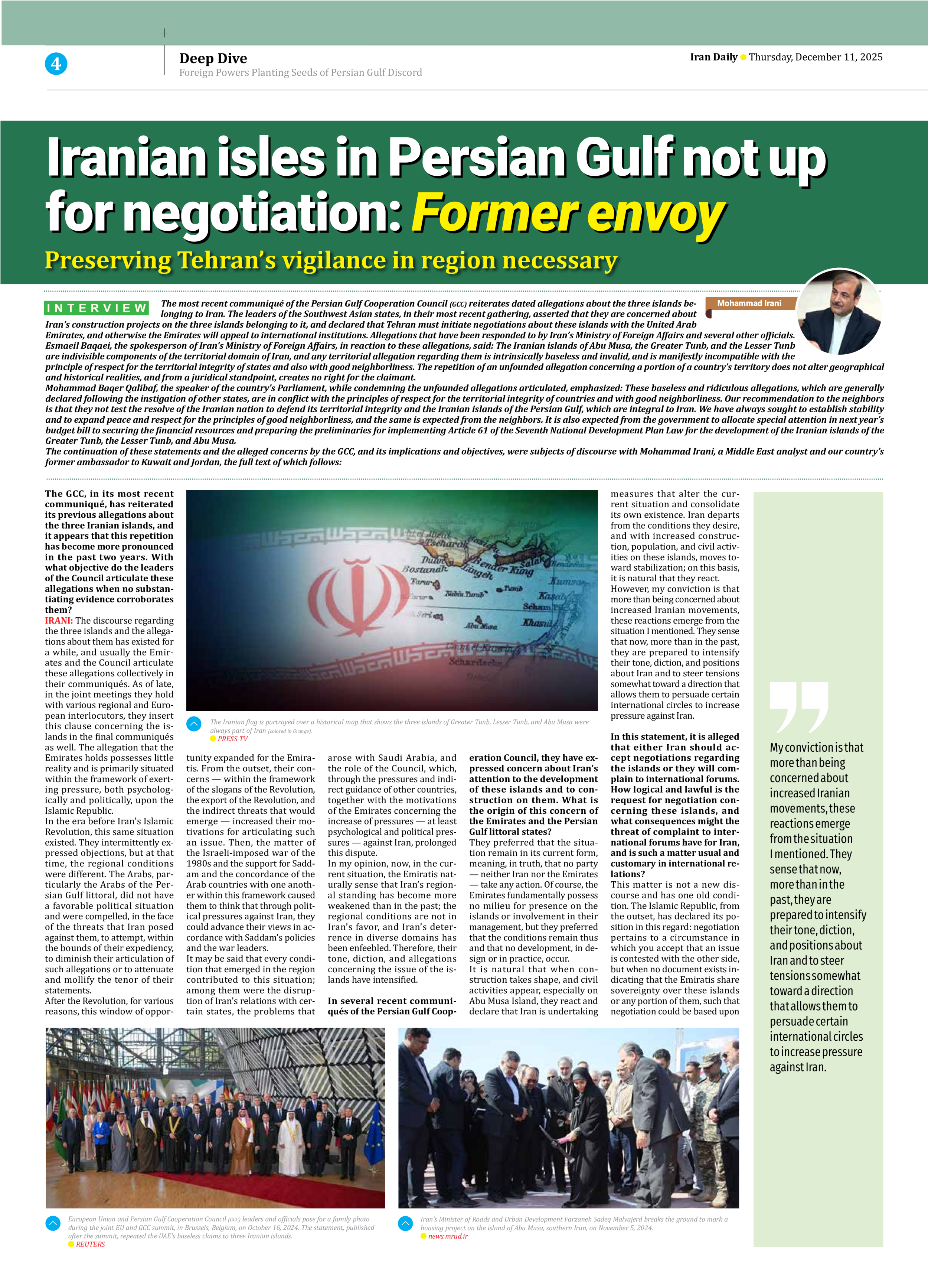
The most recent communiqué of the Persian Gulf Cooperation Council (GCC) reiterates dated allegations about the three islands belonging to Iran. The leaders of the Southwest Asian states, in their most recent gathering, asserted that they are concerned about Iran’s construction projects on the three islands belonging to it, and declared that Tehran must initiate negotiations about these islands with the United Arab Emirates, and otherwise the Emirates will appeal to international institutions. Allegations that have been responded to by Iran’s Ministry of Foreign Affairs and several other officials. Esmaeil Baqaei, the spokesperson of Iran’s Ministry of Foreign Affairs, in reaction to these allegations, said: The Iranian islands of Abu Musa, the Greater Tunb, and the Lesser Tunb are indivisible components of the territorial domain of Iran, and any territorial allegation regarding them is intrinsically baseless and invalid, and is manifestly incompatible with the principle of respect for the territorial integrity of states and also with good neighborliness. The repetition of an unfounded allegation concerning a portion of a country’s territory does not alter geographical and historical realities, and from a juridical standpoint, creates no right for the claimant. Mohammad Baqer Qalibaf, the speaker of the country’s Parliament, while condemning the unfounded allegations articulated, emphasized: These baseless and ridiculous allegations, which are generally declared following the instigation of other states, are in conflict with the principles of respect for the territorial integrity of countries and with good neighborliness. Our recommendation to the neighbors is that they not test the resolve of the Iranian nation to defend its territorial integrity and the Iranian islands of the Persian Gulf, which are integral to Iran. We have always sought to establish stability and to expand peace and respect for the principles of good neighborliness, and the same is expected from the neighbors. It is also expected from the government to allocate special attention in next year’s budget bill to securing the financial resources and preparing the preliminaries for implementing Article 61 of the Seventh National Development Plan Law for the development of the Iranian islands of the Greater Tunb, the Lesser Tunb, and Abu Musa. The continuation of these statements and the alleged concerns by the GCC, and its implications and objectives, were subjects of discourse with Mohammad Irani, a Middle East analyst and our country’s former ambassador to Kuwait and Jordan, the full text of which follows:
The GCC, in its most recent communiqué, has reiterated its previous allegations about the three Iranian islands, and it appears that this repetition has become more pronounced in the past two years. With what objective do the leaders of the Council articulate these allegations when no substantiating evidence corroborates them?
IRANI: The discourse regarding the three islands and the allegations about them has existed for a while, and usually the Emirates and the Council articulate these allegations collectively in their communiqués. As of late, in the joint meetings they hold with various regional and European interlocutors, they insert this clause concerning the islands in the final communiqués as well. The allegation that the Emirates holds possesses little reality and is primarily situated within the framework of exerting pressure, both psychologically and politically, upon the Islamic Republic.
In the era before Iran’s Islamic Revolution, this same situation existed. They intermittently expressed objections, but at that time, the regional conditions were different. The Arabs, particularly the Arabs of the Persian Gulf littoral, did not have a favorable political situation and were compelled, in the face of the threats that Iran posed against them, to attempt, within the bounds of their expediency, to diminish their articulation of such allegations or to attenuate and mollify the tenor of their statements.
After the Revolution, for various reasons, this window of opportunity expanded for the Emiratis. From the outset, their concerns — within the framework of the slogans of the Revolution, the export of the Revolution, and the indirect threats that would emerge — increased their motivations for articulating such an issue. Then, the matter of the Israeli-imposed war of the 1980s and the support for Saddam and the concordance of the Arab countries with one another within this framework caused them to think that through political pressures against Iran, they could advance their views in accordance with Saddam’s policies and the war leaders.
It may be said that every condition that emerged in the region contributed to this situation; among them were the disruption of Iran’s relations with certain states, the problems that arose with Saudi Arabia, and the role of the Council, which, through the pressures and indirect guidance of other countries, together with the motivations of the Emirates concerning the increase of pressures — at least psychological and political pressures — against Iran, prolonged this dispute.
In my opinion, now, in the current situation, the Emiratis naturally sense that Iran’s regional standing has become more weakened than in the past; the regional conditions are not in Iran’s favor, and Iran’s deterrence in diverse domains has been enfeebled. Therefore, their tone, diction, and allegations concerning the issue of the islands have intensified.
In several recent communiqués of the Persian Gulf Cooperation Council, they have expressed concern about Iran’s attention to the development of these islands and to construction on them. What is the origin of this concern of the Emirates and the Persian Gulf littoral states?
They preferred that the situation remain in its current form, meaning, in truth, that no party — neither Iran nor the Emirates — take any action. Of course, the Emirates fundamentally possess no milieu for presence on the islands or involvement in their management, but they preferred that the conditions remain thus and that no development, in design or in practice, occur.
It is natural that when construction takes shape, and civil activities appear, especially on Abu Musa Island, they react and declare that Iran is undertaking measures that alter the current situation and consolidate its own existence. Iran departs from the conditions they desire, and with increased construction, population, and civil activities on these islands, moves toward stabilization; on this basis, it is natural that they react.
However, my conviction is that more than being concerned about increased Iranian movements, these reactions emerge from the situation I mentioned. They sense that now, more than in the past, they are prepared to intensify their tone, diction, and positions about Iran and to steer tensions somewhat toward a direction that allows them to persuade certain international circles to increase pressure against Iran.
In this statement, it is alleged that either Iran should accept negotiations regarding the islands or they will complain to international forums. How logical and lawful is the request for negotiation concerning these islands, and what consequences might the threat of complaint to international forums have for Iran, and is such a matter usual and customary in international relations?
This matter is not a new discourse and has one old condition. The Islamic Republic, from the outset, has declared its position in this regard: negotiation pertains to a circumstance in which you accept that an issue is contested with the other side, but when no document exists indicating that the Emiratis share sovereignty over these islands or any portion of them, such that negotiation could be based upon it, negotiation is nullified. This has always been Iran’s condition.
This position is important because some insist that if Iran is indeed rightful, it should negotiate with the other side and convince it, but Iran will not negotiate concerning any matter in which it sees absolutely no dispute and is unequivocally certain that the islands belong to Iran and the other side has no share in them. Essentially, participating in any meeting for resolving this issue confers upon the other side the right and the impression that, in any case, these allegations hold some weight. Therefore, this matter of negotiation is nullified in essence.
The discourse concerning tribunals or complaints to various international courts is treated likewise. All international adjudicatory institutions that examine such cases must possess the consent of both parties. The Emiratis are entirely aware that as long as Iran is not willing and does not desire to introduce this matter in international forums, and fundamentally holds no belief in raising this matter, their complaint will not advance. Therefore, it is predominantly the same rhetorical discourse that has been articulated in recent communiqués.
Some analysts, in the dispute between Iran and the Emirates over the islands, do not consider even the possibility of military conflict improbable. How probable is the occurrence of such an event?
It does not appear that the Emiratis are in a condition to possess the capability for military conflict with Iran over the islands. They know that they are far more vulnerable to enter into such a conflict with Iran. Because when conflict begins, the issue is not merely the islands; when two sides enter war, all capabilities of both sides are exposed to threat, and the side more exposed to peril is the Emirates. Therefore, I find it improbable that they would enter such a situation.
On the other hand, if they desire to rely on international powers, including, for instance, the United States of America, it does not appear that the Americans wish to endanger their own interests in the region because of an outdated issue. Their own perception is that these islands have no connection to the Emirates and that the matter is more political. This is because the discourse is exceedingly dated and has been discussed repeatedly in American juridical and political circles; it has been examined in tribunals and various institutions outside the region, both in Europe and in America. The Emiratis are not in a condition that enables them to impose their position upon Iran. I do not believe that either the Emiratis or the Americans now possess any motivation to enter a stage of military interference and military conflict.
Among your remarks, you indicated that the United States and certain other powers are truly cognizant that this matter is political and that these islands belong to Iran. What is the reason that, in recent years and concurrently with the articulation of these allegations by the Emirates, certain states support them?
In certain instances, the matter certainly revolves around putting pressure upon Iran. Ultimately, they possess the allegation and the belief that Iran has exerted a series of threats against the Arab states in the region. So, they support their positions in this manner. But certainly, this matter is political.
However, in certain instances, the reasons are not merely related to pressure upon Iran; other reasons exist, among them political relations, broader economic relations with the Emirates, and also the interests and expediencies that various parties pursue. They sometimes, without regard to the matter of their relations with Iran and even, perhaps, by placing both sides on the scales and assessing expediency, reach the conclusion that relations with the Emirates are of greater importance for them. Therefore, they attempt to support Abu Dhabi’s view, and solely to the extent of a communiqué. Although for us, even this much is unacceptable. No patriotic person in Iran will accept that, for example, Russia or China or certain parties that have close relations with Iran sign a joint communiqué within the same framework that the Emiratis desire.
How should Tehran’s reaction in the face of these allegations and actions be so that the least harm is inflicted upon national interests?
In my opinion, we must not exhibit a passive posture concerning this matter. After every communiqué of theirs, Iran usually immediately issues a communiqué and refutes and rejects their positions, and this condition has persisted thus for years. When they intensified their actions with the assistance of other regional and international interlocutors and in the form of issuing communiqués, the Islamic Republic of Iran also undertook practical measures within the islands. Therefore, in my opinion, this time, as well, the situation proceeds thus and is repeated. The Emiratis themselves had declared in the past that they are following this pattern and issued these communiqués symbolically, and the Iranians, in relation to this matter, provided the requisite response.
At present, I do not observe an alarming situation, but Iran’s vigilance must increase so that extra-regional parties do not interfere and do not enter this affair. Because, in any case, the conditions are not such that we can obtain assistance from the international environment for this important matter. Therefore, when the conflict is a political conflict between two sides, we must attempt to ensure that extra-regional parties, meaning those outside this framework of the Council, do not enter into this tension between the Iranian and Emirati sides.
The interview first appeared in Persian on IRNA.