





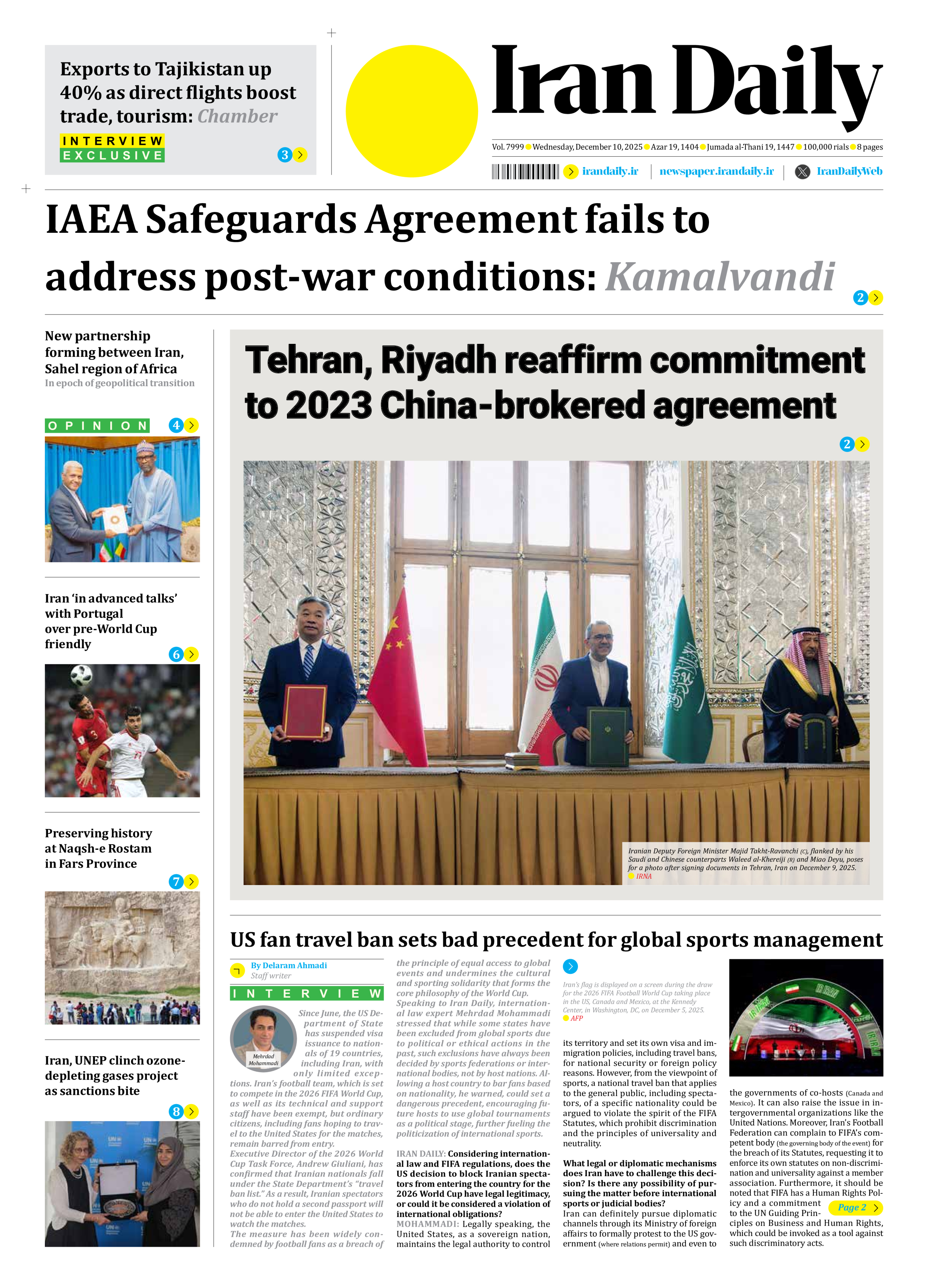


US fan travel ban sets bad precedent for global sports management
By Delaram Ahmadi
Staff writer
Since June, the US Department of State has suspended visa issuance to nationals of 19 countries, including Iran, with only limited exceptions. Iran’s football team, which is set to compete in the 2026 FIFA World Cup, as well as its technical and support staff have been exempt, but ordinary citizens, including fans hoping to travel to the United States for the matches, remain barred from entry.
Executive Director of the 2026 World Cup Task Force, Andrew Giuliani, has confirmed that Iranian nationals fall under the State Department’s “travel ban list.” As a result, Iranian spectators who do not hold a second passport will not be able to enter the United States to watch the matches.
The measure has been widely condemned by football fans as a breach of the principle of equal access to global events and undermines the cultural and sporting solidarity that forms the core philosophy of the World Cup.
Speaking to Iran Daily, international law expert Mehrdad Mohammadi stressed that while some states have been excluded from global sports due to political or ethical actions in the past, such exclusions have always been decided by sports federations or international bodies, not by host nations. Allowing a host country to bar fans based on nationality, he warned, could set a dangerous precedent, encouraging future hosts to use global tournaments as a political stage, further fueling the politicization of international sports.
IRAN DAILY: Considering international law and FIFA regulations, does the US decision to block Iranian spectators from entering the country for the 2026 World Cup have legal legitimacy, or could it be considered a violation of international obligations?
MOHAMMADI: Legally speaking, the United States, as a sovereign nation, maintains the legal authority to control its territory and set its own visa and immigration policies, including travel bans, for national security or foreign policy reasons. However, from the viewpoint of sports, a national travel ban that applies to the general public, including spectators, of a specific nationality could be argued to violate the spirit of the FIFA Statutes, which prohibit discrimination and the principles of universality and neutrality.
What legal or diplomatic mechanisms does Iran have to challenge this decision? Is there any possibility of pursuing the matter before international sports or judicial bodies?
Iran can definitely pursue diplomatic channels through its Ministry of foreign affairs to formally protest to the US government (where relations permit) and even to the governments of co-hosts (Canada and Mexico). It can also raise the issue in intergovernmental organizations like the United Nations. Moreover, Iran’s Football Federation can complain to FIFA’s competent body (the governing body of the event) for the breach of its Statutes, requesting it to enforce its own statutes on non-discrimination and universality against a member association. Furthermore, it should be noted that FIFA has a Human Rights Policy and a commitment to the UN Guiding Principles on Business and Human Rights, which could be invoked as a tool against such discriminatory acts.
Page 2