







Asian trajectory of Iran
Capacities of SCO in redefinition of national security, economy
By Hajar Asghari
Researcher on economic affairs
The contemporary world, more than at any previous juncture, is exposed to geopolitical and geoeconomic metamorphoses; metamorphoses that not only have confronted the traditional Western powers with extensive predicaments, but also have furnished unprecedented opportunities for the ascendance of novel initiatives in Asia and Eurasia. The gradual disintegration of the West-centric consensus, the structural fatigue of NATO, the crisis in the global economy, regional wars, and the emergence of medium and major Asian powers have situated the international constellation in a fluid condition.
In such circumstances, the countries that can utilize this fluidity in order to construct a new equilibrium, diversify their foreign relations, and elevate national resilience will attain a determinative position in the forthcoming decades. For Iran, which has endured four decades of pressure, threat, sanctions, and structural isolation, such a global transition constitutes a strategic opportunity for the redefinition of the trajectories through which its national interests are pursued.
Within this very framework, the permanent membership of the Islamic Republic of Iran in the Shanghai Cooperation Organization (SCO) is not a mere diplomatic gesture; rather, it is one of the most consequential structural transformations in Iranian foreign policy during recent years. The SCO, contrary to superficial interpretations, is a multifunctional organization with a composite of security, economic, institutional, and identity-laden functions that, throughout the past two decades, has become one of the determinative actors in Asian equations.
This organization, at present with eight permanent members, encompasses an aggregate of 3.2 billion individuals (approximately 40 percent of the global population) and 34 million square kilometers of territory (approximately 22 percent of the world’s landmass), and, according to the data of the Shanghai Cooperation Organization and the International Monetary Fund, it comprises approximately 25 to 30 percent of global GDP based on purchasing-power parity.
This organization is neither a military pact, nor a complete economic union, nor merely a dialogue-centered forum; rather, it is a composite mechanism that China and Russia, as two great powers of the world, have designed for the management of regional security, the development of geoeconomic cooperation, and the creation of shared standards in Central Asia and beyond.
For Iran, ingress into such an arena signifies connection to a multilayered network of security and economic collaborations that can transfer the country’s position from Western-imposed isolation to the centrality of Asian interactions. Iran, throughout recent years, because of Western political and economic pressure, has been more in need than ever of diversifying its pathways for securing security, trade, energy, and technology. The SCO furnishes this opportunity.
Iran, in its regional environment, is confronted by a constellation of intricate security threats. Chronic insecurity in Afghanistan, the reemergence and eventual collapse of extremist groups, the activities of IS-Khorasan, narcotics and human trafficking, instability on the eastern borders, the rivalry of Saudi Arabia and the United Arab Emirates in the Persian Gulf, the military presence of the United States in the region, and the geopolitical transformations of the South Caucasus are all among the multifaceted threats whose management is arduous and costly for Iran. The SHANGHAI Cooperation Organization, from its inception, was established with the objective of confronting such threats.
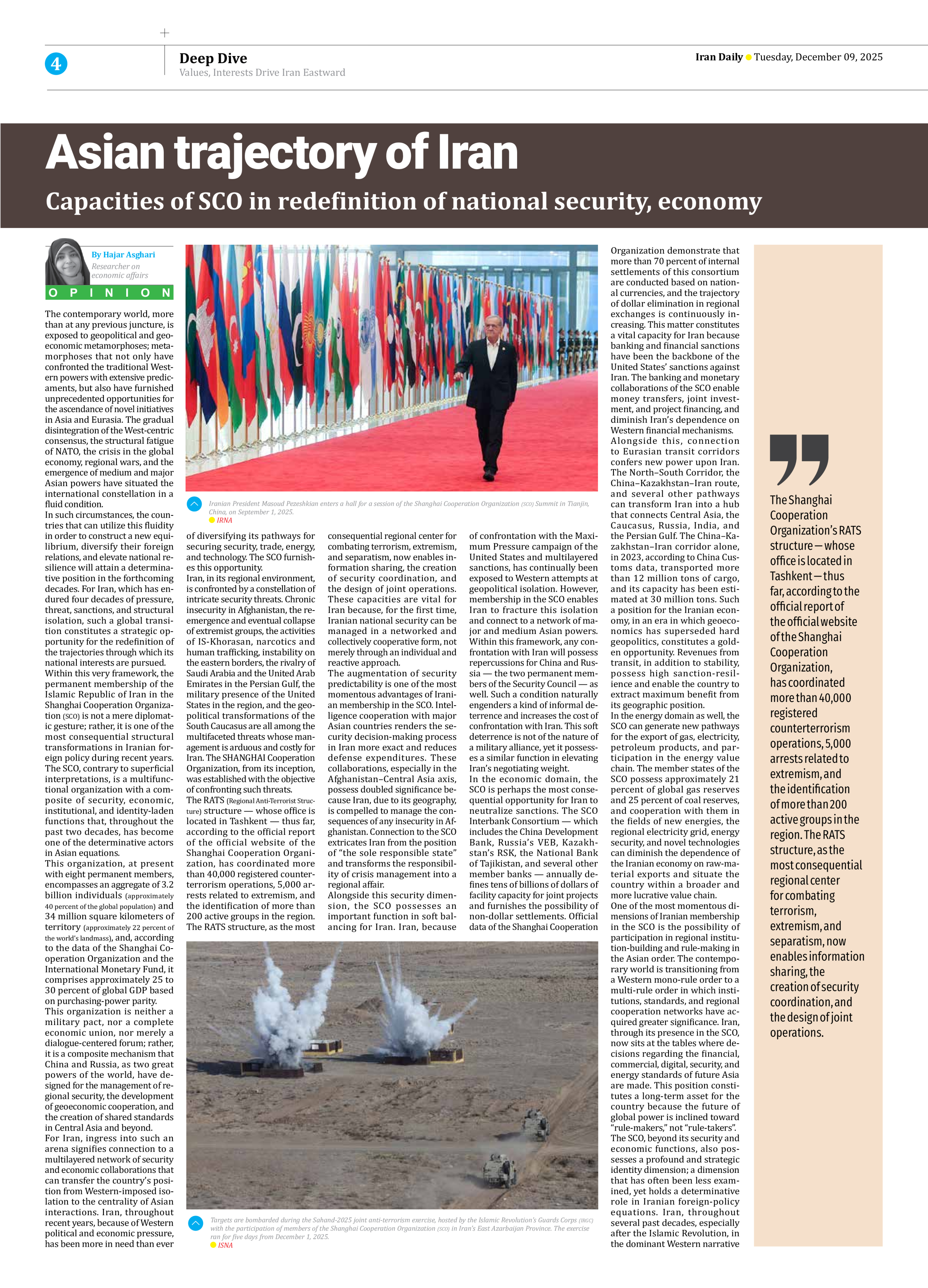
The RATS (Regional Anti-Terrorist Structure) structure — whose office is located in Tashkent — thus far, according to the official report of the official website of the Shanghai Cooperation Organization, has coordinated more than 40,000 registered counterterrorism operations, 5,000 arrests related to extremism, and the identification of more than 200 active groups in the region. The RATS structure, as the most consequential regional center for combating terrorism, extremism, and separatism, now enables information sharing, the creation of security coordination, and the design of joint operations. These capacities are vital for Iran because, for the first time, Iranian national security can be managed in a networked and collectively cooperative form, not merely through an individual and reactive approach.
The augmentation of security predictability is one of the most momentous advantages of Iranian membership in the SCO. Intelligence cooperation with major Asian countries renders the security decision-making process in Iran more exact and reduces defense expenditures. These collaborations, especially in the Afghanistan–Central Asia axis, possess doubled significance because Iran, due to its geography, is compelled to manage the consequences of any insecurity in Afghanistan. Connection to the SCO extricates Iran from the position of “the sole responsible state” and transforms the responsibility of crisis management into a regional affair.
Alongside this security dimension, the SCO possesses an important function in soft balancing for Iran. Iran, because of confrontation with the Maximum Pressure campaign of the United States and multilayered sanctions, has continually been exposed to Western attempts at geopolitical isolation. However, membership in the SCO enables Iran to fracture this isolation and connect to a network of major and medium Asian powers. Within this framework, any confrontation with Iran will possess repercussions for China and Russia — the two permanent members of the Security Council — as well. Such a condition naturally engenders a kind of informal deterrence and increases the cost of confrontation with Iran. This soft deterrence is not of the nature of a military alliance, yet it possesses a similar function in elevating Iran’s negotiating weight.
In the economic domain, the SCO is perhaps the most consequential opportunity for Iran to neutralize sanctions. The SCO Interbank Consortium — which includes the China Development Bank, Russia’s VEB, Kazakhstan’s RSK, the National Bank of Tajikistan, and several other member banks — annually defines tens of billions of dollars of facility capacity for joint projects and furnishes the possibility of non-dollar settlements. Official data of the Shanghai Cooperation Organization demonstrate that more than 70 percent of internal settlements of this consortium are conducted based on national currencies, and the trajectory of dollar elimination in regional exchanges is continuously increasing. This matter constitutes a vital capacity for Iran because banking and financial sanctions have been the backbone of the United States’ sanctions against Iran. The banking and monetary collaborations of the SCO enable money transfers, joint investment, and project financing, and diminish Iran’s dependence on Western financial mechanisms.
Alongside this, connection to Eurasian transit corridors confers new power upon Iran. The North–South Corridor, the China–Kazakhstan–Iran route, and several other pathways can transform Iran into a hub that connects Central Asia, the Caucasus, Russia, India, and the Persian Gulf. The China–Kazakhstan–Iran corridor alone, in 2023, according to China Customs data, transported more than 12 million tons of cargo, and its capacity has been estimated at 30 million tons. Such a position for the Iranian economy, in an era in which geoeconomics has superseded hard geopolitics, constitutes a golden opportunity. Revenues from transit, in addition to stability, possess high sanction-resilience and enable the country to extract maximum benefit from its geographic position.
In the energy domain as well, the SCO can generate new pathways for the export of gas, electricity, petroleum products, and participation in the energy value chain. The member states of the SCO possess approximately 21 percent of global gas reserves and 25 percent of coal reserves, and cooperation with them in the fields of new energies, the regional electricity grid, energy security, and novel technologies can diminish the dependence of the Iranian economy on raw-material exports and situate the country within a broader and more lucrative value chain.
One of the most momentous dimensions of Iranian membership in the SCO is the possibility of participation in regional institution-building and rule-making in the Asian order. The contemporary world is transitioning from a Western mono-rule order to a multi-rule order in which institutions, standards, and regional cooperation networks have acquired greater significance. Iran, through its presence in the SCO, now sits at the tables where decisions regarding the financial, commercial, digital, security, and energy standards of future Asia are made. This position constitutes a long-term asset for the country because the future of global power is inclined toward “rule-makers,” not “rule-takers”.
The SCO, beyond its security and economic functions, also possesses a profound and strategic identity dimension; a dimension that has often been less examined, yet holds a determinative role in Iranian foreign-policy equations. Iran, throughout several past decades, especially after the Islamic Revolution, in the dominant Western narrative and lexicon, has often been represented as an “isolated actor,” “unpredictable,” or “severed from international cooperation networks”. This image-construction, primarily the product of sanction policies, media operations, and structural attempts to constrain Iran at the margin of the international system, has not only diminished global perception of Iran but also has had direct consequences for the country’s economic, diplomatic, and even foreign-investment relations.
With membership in the Shanghai Cooperation Organization, this dominant narrative underwent a fissure and metamorphosis. The official presence of Iran in an institution whose members include China, Russia, India, Pakistan, and a constellation of important Asian countries, transferred Iran from a position that, based on the Western narrative, was situated at “the margin,” to the center of a burgeoning Asian bloc. This bloc, which in total possesses more than $500 billion of internal trade, and in which the volume of exchanges among some of its members (such as China and Central Asia) increases annually with double-digit growth, will play a determinative role in the future Asian order. This transfer is not merely symbolic; rather, it reflects the transformation of Iran’s perceptual position in the minds of regional and global actors. The SCO enabled Iran to present itself as an active, responsible, and potential partner in major Asian security and economic projects.
This identity metamorphosis possesses multilayered effects. First, the confidence of Asian and Eurasian investors in Iran increased because membership in the SCO is a signifier of relative stability, collaborative capability, and access to an expansive network of regional markets and infrastructures. Second, Iran’s diplomatic weight in regional and international dialogues was fortified because its presence alongside major Asian powers elevates Iran’s strategic position and enhances its negotiating capacity. Third, the perceptual isolation of Iran — which the West had reproduced for years through media and public diplomacy — has been markedly reduced. Iran is now viewed within a framework that includes more than half of the global population and a significant portion of global production.
In other words, Iran’s membership in the SCO, from an identity perspective, has engendered a kind of self-redefinition in a world in transition; a self-redefinition that has liberated Iran from a constrained, threat-centered, and isolated image and has situated it as a natural and credible actor in the new Asian order. This transformation, if actively managed, can leave a lasting impact on all dimensions of Iranian national interests — from the economy and security to foreign policy and development.
In sum, the Shanghai Cooperation Organization, for Iran, is not merely a cooperation institution, but rather a new pathway for the pursuit of national interests in the domains of security, economy, politics, and identity. This organization renders Iran’s security networked, detaches the country’s economy from sanction-susceptible pathways, stabilizes Iran’s position in the future Asian order, and amplifies the country’s capacity for active agency in a multipolar world.
If Iran can utilize these capacities with an active, coordinated, and forward-looking approach, the SCO can become the backbone of Iran’s Asian strategy. This trajectory transfers Iran from a reactive condition to an active-agent condition, and relocates national interests from a narrow and constrained framework to a multidimensional, stable, and future-oriented framework. In a world in which the center of gravity of power is transferring toward Asia, Iranian presence in the SCO is not merely a tactical choice, but a strategic necessity for guaranteeing the security and prosperity of future generations.
The article was first published in Persian by the Center for Middle East Strategic Studies.