







Only 5% of Urmia Lake’s water remaining: Expert
Yet we ‘set records’ in export of water-intensive products
Urmia Lake, the azure gem of northwestern Iran and the greatest hypersaline lake of the Middle East, which once, with an expanse of approximately 5,000 square kilometers and a volume surpassing 30 billion cubic meters of water, cultivated a unique ecosystem within the province of Azerbaijan, today, subsists within the most arduous days of its existence. For more than a decade, this aqueous expanse has metamorphosed into a seasonal and fragmented lake and has forfeited its fundamental vital functions, from the regulation of the local climate to the habitat of migratory birds, and it stands upon the precipice of absolute annihilation. Estimates indicate that a mere 5% to 6% of the water remains within the body of the lake, and its current volume has been reported as less than 40 million cubic meters; a figure that, in actuality, signifies total desiccation. At present, only a tenuous and dispersed stratum of water is visible in certain regions of the lake. Years of endeavor to revive the lake, from cloud seeding and deep-water extraction to inter-basin water transfer, have not borne fruit because they centered upon the production of water instead of the management of consumption. Experts warn that, without immediate rectification of consumption patterns, modern agriculture, alternative livelihoods, and transparent public communication, the lake shall, in the near future, stand upon the threshold of complete annihilation and effacement from the map of Iran. According to the president of the Urmia Lake Research Institute, this catastrophe, transcending a local environmental issue, constitutes an emblem of the paradox of water governance in Iran; while the lake’s watershed experiences the most severe drought years of the past 50 years and precipitation has precipitously diminished, the unrestrained expansion of agricultural lands and the establishment of water-intensive industries such as steel and water-intensive orchards persist. Urban water consumption, at three to seven times the global standard, the unregulated extraction of strategic subterranean reserves, and land subsidence delineate an image of the absence of integrated management of water and soil resources. The persistence of such a condition not only seals all apertures of hope for the revival of Urmia Lake but also engenders consequences such as saline dust storms, the proliferation of diseases, mass migrations, and even security threats. Below is the full exclusive interview of Iran Daily with Kamran Zeinalzadeh, president of the Urmia Lake Research Institute at the University of Urmia, regarding the origins, determinants, and consequences of the desiccation of Lake Urmia and the remaining paths for its salvation:
By Sadeq
Dehqan
Staff writer
IRAN DAILY: First, tell us about the condition of Urmia Lake; the news is disquieting. Does any hope for the lake’s revival still remain?
ZEINALZADEH: Urmia Lake has, for more than a decade, in actuality, become a seasonal lake, and its initial functions have either been forfeited or subjected to grave threat, to the extent that the lake now endures its toughest days.
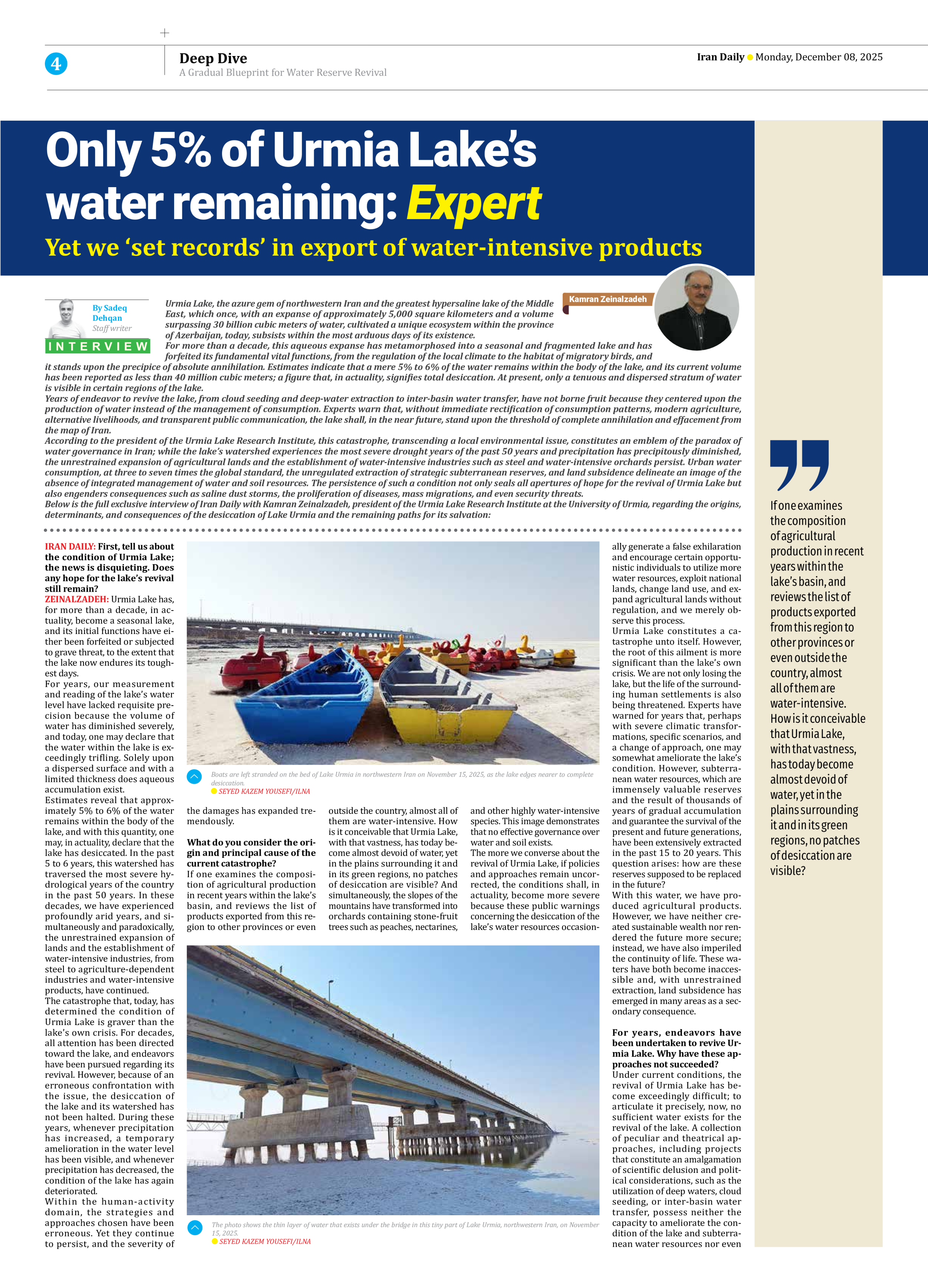
For years, our measurement and reading of the lake’s water level have lacked requisite precision because the volume of water has diminished severely, and today, one may declare that the water within the lake is exceedingly trifling. Solely upon a dispersed surface and with a limited thickness does aqueous accumulation exist.
Estimates reveal that approximately 5% to 6% of the water remains within the body of the lake, and with this quantity, one may, in actuality, declare that the lake has desiccated. In the past 5 to 6 years, this watershed has traversed the most severe hydrological years of the country in the past 50 years. In these decades, we have experienced profoundly arid years, and simultaneously and paradoxically, the unrestrained expansion of lands and the establishment of water-intensive industries, from steel to agriculture-dependent industries and water-intensive products, have continued.
The catastrophe that, today, has determined the condition of Urmia Lake is graver than the lake’s own crisis. For decades, all attention has been directed toward the lake, and endeavors have been pursued regarding its revival. However, because of an erroneous confrontation with the issue, the desiccation of the lake and its watershed has not been halted. During these years, whenever precipitation has increased, a temporary amelioration in the water level has been visible, and whenever precipitation has decreased, the condition of the lake has again deteriorated.
Within the human-activity domain, the strategies and approaches chosen have been erroneous. Yet they continue to persist, and the severity of the damages has expanded tremendously.
What do you consider the origin and principal cause of the current catastrophe?
If one examines the composition of agricultural production in recent years within the lake’s basin, and reviews the list of products exported from this region to other provinces or even outside the country, almost all of them are water-intensive. How is it conceivable that Urmia Lake, with that vastness, has today become almost devoid of water, yet in the plains surrounding it and in its green regions, no patches of desiccation are visible? And simultaneously, the slopes of the mountains have transformed into orchards containing stone-fruit trees such as peaches, nectarines, and other highly water-intensive species. This image demonstrates that no effective governance over water and soil exists.
The more we converse about the revival of Urmia Lake, if policies and approaches remain uncorrected, the conditions shall, in actuality, become more severe because these public warnings concerning the desiccation of the lake’s water resources occasionally generate a false exhilaration and encourage certain opportunistic individuals to utilize more water resources, exploit national lands, change land use, and expand agricultural lands without regulation, and we merely observe this process.
Urmia Lake constitutes a catastrophe unto itself. However, the root of this ailment is more significant than the lake’s own crisis. We are not only losing the lake, but the life of the surrounding human settlements is also being threatened. Experts have warned for years that, perhaps with severe climatic transformations, specific scenarios, and a change of approach, one may somewhat ameliorate the lake’s condition. However, subterranean water resources, which are immensely valuable reserves and the result of thousands of years of gradual accumulation and guarantee the survival of the present and future generations, have been extensively extracted in the past 15 to 20 years. This question arises: how are these reserves supposed to be replaced in the future?
With this water, we have produced agricultural products. However, we have neither created sustainable wealth nor rendered the future more secure; instead, we have also imperiled the continuity of life. These waters have both become inaccessible and, with unrestrained extraction, land subsidence has emerged in many areas as a secondary consequence.
For years, endeavors have been undertaken to revive Urmia Lake. Why have these approaches not succeeded?
Under current conditions, the revival of Urmia Lake has become exceedingly difficult; to articulate it precisely, now, no sufficient water exists for the revival of the lake. A collection of peculiar and theatrical approaches, including projects that constitute an amalgamation of scientific delusion and political considerations, such as the utilization of deep waters, cloud seeding, or inter-basin water transfer, possess neither the capacity to ameliorate the condition of the lake and subterranean water resources nor even a guarantee to halt the process of degradation and depletion of these resources. As long as water-consumption management remains unrectified, no sustainable path stands before us.
Today, no water exists for the revival of the lake; the lake has lost most, and perhaps all, of its water. Even for agriculture, no sufficient water exists, and beyond all, in certain regions, even for potable water supply, we confront grave limitations. Water management and its consumption pattern have remained neglected for years, and unsustainable development, without attention to the climatic capacities of the region, has pursued its course. On one side, we confront the reality of climate transformation and a drastic decline in precipitation, and on the other side, we confront an explosion in water consumption in all sectors.
For several years, the subterranean reserves of the lake’s watershed have diminished. However, simultaneously, agricultural lands continue to expand. In such conditions, this fundamental question arises: when water resources have drastically declined, how is this expansion of farms and orchards justified? How are water-intensive products such as sugar beet, alfalfa, fodder, watermelon, vegetables, and tomatoes produced and even exported? This contradiction delineates a lucid image of a profound paradox in water governance: a basin that suffers from extreme water scarcity possesses limitations even for the potable water of its inhabitants. However, simultaneously, it becomes a record-holder in the production and exportation of water-intensive products.
The watershed of Urmia Lake constitutes only one example of water-resource management at the national level. Today, Tehran is situated within even more catastrophic conditions, and many basins in the west and east of the country confront analogous conditions. Urban water consumption is at least three times the global standard; in some cities, this number has been reported as high as six or seven times, although the share of potable water in comparison with the total renewable resources is minimal. These numbers demonstrate that a large portion of the inhabitants of these regions remain unaware of the depth of the catastrophe and continue to live with the same consumption pattern of 50 or 60 years ago.
If no water exists for the revival of the lake, for agriculture, and even for potable water, how does this level of consumption continue? From where is this water supplied? The answer is clear: a significant portion of this demand is supplied from non-renewable and strategic reserves; reserves that must be utilized only under ultra-critical conditions and for minimal potable needs. However, they are extracted continuously without oversight or prudence. For this reason, in appearance, green landscapes and cultivated lands are still visible, while in reality, we have approached the end of the reserves, and now we witness that, in actuality, no water remains within the lake, and sooner or later, the announcement of the exhaustion of subterranean water reserves shall be formally declared.
Thus, may one declare that grave negligence has occurred in the domain of water-resource management?
What we observe today, more than mere negligence, constitutes a sign of the absence of effective governance over water and soil. Integrated management of water and soil resources, in practice, does not exist, and the perspective of officials regarding this domain still resembles that of 60 or 70 years ago. The colossal edifices of the related ministries, from the Ministry of Agriculture to the Ministry of Energy, and the multitude of universities and scientific institutions, have not yet culminated in practical and effective management of water and soil, and the systematic utilization of international experience is also exceedingly limited. In practice, things have been abandoned, with the justification that perhaps such temporary abandonment reduces livelihood and economic pressures, while this approach has not only failed to produce any meaningful improvement in livelihoods, but has also exposed the environmental and economic structures of the country to irreparable damage and may even constitute a source of security threats in the near future.
A significant portion of today’s water problems, of course, originates in global-scale climate change. However, the reality is that a lake with an expanse of approximately 5,000 square kilometers and a volume of approximately 30 billion cubic meters of water has transformed into a desiccated desert. This transformation, unequivocally, influences the local and regional climate, wind patterns, hazes, and the health of inhabitants, and it may result in the emergence of diverse diseases. Simultaneously, the same destructive pattern that has brought the lake to this condition is being repeated today regarding subterranean water resources, and the precipitous depletion of these resources shall render the future of water management far more arduous.
As the Director of the Urmia Lake Studies Research Institute, who has worked and researched in this domain for years, what solution do you propose for saving the lake?
The principal solution constitutes a global and well-tested one; contrary to certain presumptions, the issue of saving the lake is not resolved through the production of water or resorting to extravagant and peculiar technological approaches. The reality is that we consume water far beyond ecological capacity, and no resource exists to replace this magnitude of consumption. Therefore, we must, with speed, rectify the consumption pattern and place demand management at the forefront. Our development trajectory must not advance by relying upon traditional and expansive agriculture, but must move toward modern agriculture.
This transformation signifies the restriction and diminution of agricultural lands and, in contrast, the enhancement of productivity per unit area. At present, not only is water consumption several times beyond the actual need and possesses low efficiency, but the unrestrained usage of fertilizer and pesticide has also produced extensive environmental contamination. The transition to modern and intelligent agriculture, accompanied by the development of other economic spheres such as ecotourism, more sustainable utilization of border potentials, and the creation of alternative livelihoods that require little water yet are highly productive, may delineate a more sustainable trajectory for the region.
If this change of approach does not occur and public participation is not secured, the catastrophe shall reach an irreversible point. Perhaps the first essential step constitutes transparent and sincere communication regarding the true dimensions of the catastrophe. Today, neither the public nor even a segment of officials possesses an understanding proportionate to the depth of the catastrophic condition, and everyday thinking dominates decision-making. Through the augmentation of public awareness, the attraction of local participation, targeted investment in the rectification of agricultural patterns, support for alternative livelihoods, and the decisive reduction of water consumption, we must act before we reach an irreversible point. Under such conditions, with reliance upon societal cooperation and, naturally, a relative improvement in precipitation, one may maintain hope for amelioration.
So, we have not yet reached an irreversible stage; is that correct? And with consumption management, the rectification of the agricultural sector, and reliance upon precipitation, may one hope for the lake’s revival?
The reality is that, simultaneously with the catastrophe of the lake, we confront a greater catastrophe in the domain of subterranean water resources, and the danger of this second catastrophe is nearer and more immediate. Prior to experiencing all the consequences of the lake’s desiccation, we shall confront the repercussions of extensive subterranean water depletion. The origin of both catastrophes is identical, and if the principal factor — the erroneous pattern of exploitation and water governance — is not controlled, both shall propel us toward a form of hydrological bankruptcy.
From the perspective of one who, for years, alongside other specialists, has expended time and energy upon Urmia Lake, the principal anxiety today concerns, more than the lake itself, the precipitous and unregulated depletion of subterranean water resources and the unauthorized extraction of surface resources. If this process continues, it shall reach an irreversible point, such that even the occurrence of great precipitation and large floods shall not be capable of restoring the subsided lands to their previous condition. In truth, today, Urmia Lake, with its desiccation and its ensuing repercussions, has manifested its reaction to these imprudences.
Now, we witness the uprising of particulates from the bed of the lake in the form of hazes, perceptible transformations in the local climate, and the gradual expansion of problems. In actuality, we remain at the inception of the consequences. Perhaps, by conveying a minimal quantity of water to the bed of the lake and maintaining it in a moist condition, one may control a portion of the severe consequences.
Watersheds exist around the region. However, because of decreased precipitation and unrestrained extraction, no water remains behind the dams to be released toward the lake. The Headquarters for the Revival of Lake Urmia, under current conditions, continues its efforts. However, their unavoidable priority constitutes the provision of potable water and sanitation for the region, and, given the limitation of resources, no share remains for the lake.
If, in the forthcoming years, precipitation improves and, simultaneously, through cohesive management, one can halt unrestrained extraction and even allocate a minimal quantity of water to keep the bed of the lake moist, one may control certain consequences such as hazes. Nevertheless, if the depletion of subterranean waters and land subsidence continue, even under a scenario of the return of high-precipitation periods, the possibility of restoring the land to its previous condition shall not exist. This reality must be considered within all forms of planning.