







Installing small solar farms in urban spaces could help supply clean energy
By Reza Yari
Renewable energy researcher
Renewables play a vital role in the economic, social and environmental activities of every country, as the limitations of fossil-fuel resources and the global warming caused by greenhouse-gas emissions are forcing policymakers and planners to grapple with new and rapidly evolving economic realities. For this reason, economic strategies built on the assumption of unlimited and cheap fossil-fuel supplies can no longer sustain economic growth as they once did—nor for very long in the future. The interplay of factors such as rising energy consumption, increasing energy prices, dwindling resource availability, climate change and the declining capacity of ecosystems to provide essential services has heightened vulnerability and introduced major environmental, economic and social uncertainties.
According to expert assessments, global energy demand will increase by around 60% over the next 25 years. In addition, thermal power plants remain among the key sources of air pollution in both quantitative and qualitative terms. Given the high volume of converted energy and the considerable energy losses across thermal power plants, shifting attention to renewable sources can lead to substantial fuel savings and meaningful reductions in environmental pollutants.
In Iran, a large portion of the country’s electricity is generated by fossil-fuel power plants. Increasing the use of renewable-energy plants as an alternative to fossil-fuel facilities can prevent power outages and reduce other damages caused by reliance on fossil fuels. Solar power is one of the most important renewable resources, though solar irradiation levels vary across different parts of the world; the highest levels lie along the Earth’s solar belt. Iran is in high-irradiation zones, and studies show that through innovative ideas, modern technologies and mobile mechanical structures that track sunlight at the time of panel installation and during energy generation, a considerable share of the country’s power needs could be supplied.
Iran enjoys more than 300 sunny days in more than two-thirds of its territory, with an average solar irradiation of 4.5–5.5 kWh per square meter per day, placing it among countries with strong solar potential. The metropolis of Tehran lies between 51°17′ to 51°33′ E longitude and 35°36′ to 35°44′ N latitude, at an elevation range of 900 to 1,800 meters above sea level. According to the latest official census conducted in 2006, Tehran had a population of 8,694,000. In this context, meeting part of Tehran’s electricity demand through renewable sources is of great importance.
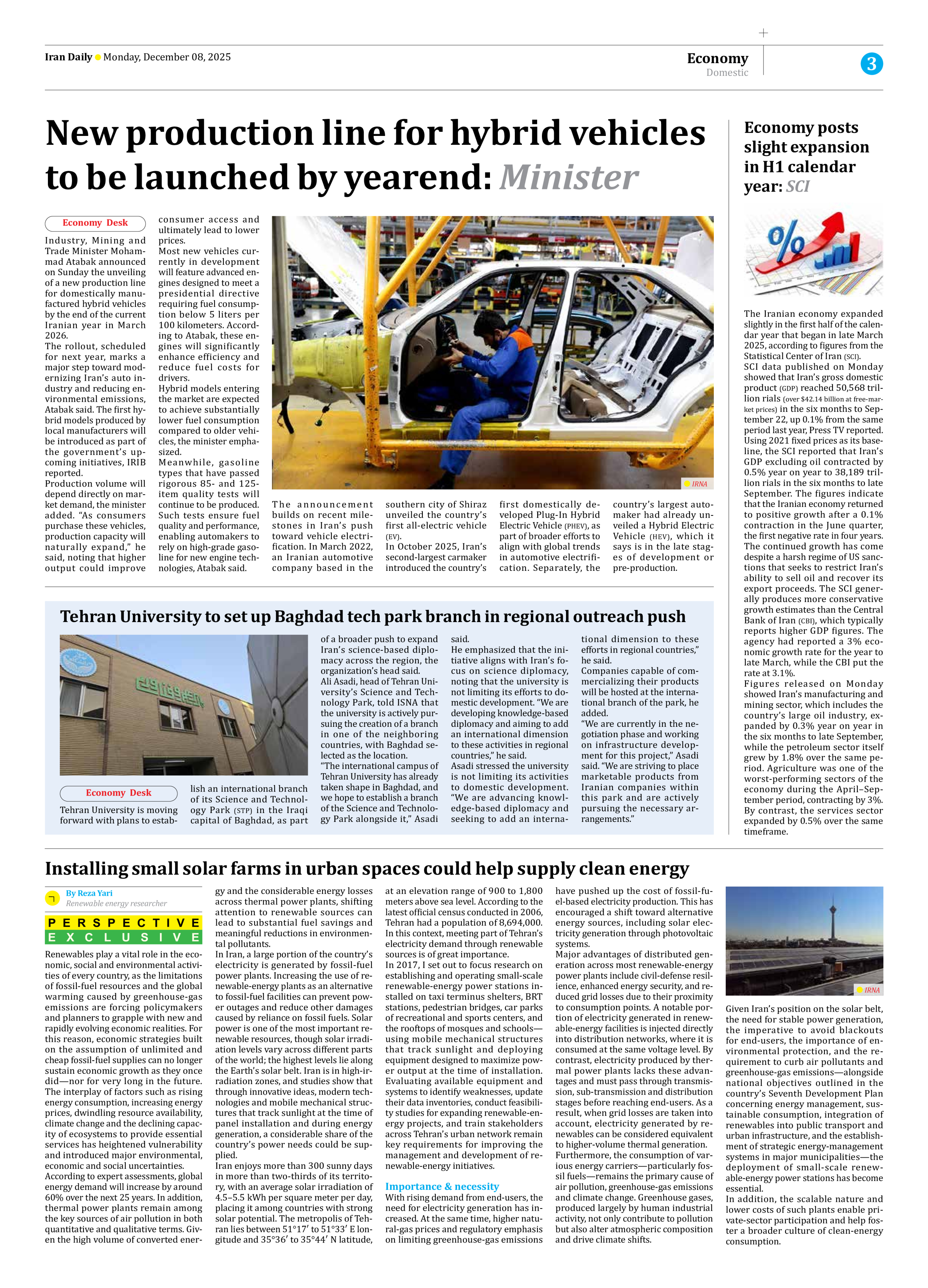
In 2017, I set out to focus research on establishing and operating small-scale renewable-energy power stations installed on taxi terminus shelters, BRT stations, pedestrian bridges, car parks of recreational and sports centers, and the rooftops of mosques and schools—using mobile mechanical structures that track sunlight and deploying equipment designed to maximize power output at the time of installation. Evaluating available equipment and systems to identify weaknesses, update their data inventories, conduct feasibility studies for expanding renewable-energy projects, and train stakeholders across Tehran’s urban network remain key requirements for improving the management and development of renewable-energy initiatives.
Importance & necessity
With rising demand from end-users, the need for electricity generation has increased. At the same time, higher natural-gas prices and regulatory emphasis on limiting greenhouse-gas emissions have pushed up the cost of fossil-fuel-based electricity production. This has encouraged a shift toward alternative energy sources, including solar electricity generation through photovoltaic systems.
Major advantages of distributed generation across most renewable-energy power plants include civil-defense resilience, enhanced energy security, and reduced grid losses due to their proximity to consumption points. A notable portion of electricity generated in renewable-energy facilities is injected directly into distribution networks, where it is consumed at the same voltage level. By contrast, electricity produced by thermal power plants lacks these advantages and must pass through transmission, sub-transmission and distribution stages before reaching end-users. As a result, when grid losses are taken into account, electricity generated by renewables can be considered equivalent to higher-volume thermal generation.
Furthermore, the consumption of various energy carriers—particularly fossil fuels—remains the primary cause of air pollution, greenhouse-gas emissions and climate change. Greenhouse gases, produced largely by human industrial activity, not only contribute to pollution but also alter atmospheric composition and drive climate shifts.
Given Iran’s position on the solar belt, the need for stable power generation, the imperative to avoid blackouts for end-users, the importance of environmental protection, and the requirement to curb air pollutants and greenhouse-gas emissions—alongside national objectives outlined in the country’s Seventh Development Plan concerning energy management, sustainable consumption, integration of renewables into public transport and urban infrastructure, and the establishment of strategic energy-management systems in major municipalities—the deployment of small-scale renewable-energy power stations has become essential.
In addition, the scalable nature and lower costs of such plants enable private-sector participation and help foster a broader culture of clean-energy consumption.