







Copy in clipboard...
ECO puts Aras in frame for future tourism capital slot
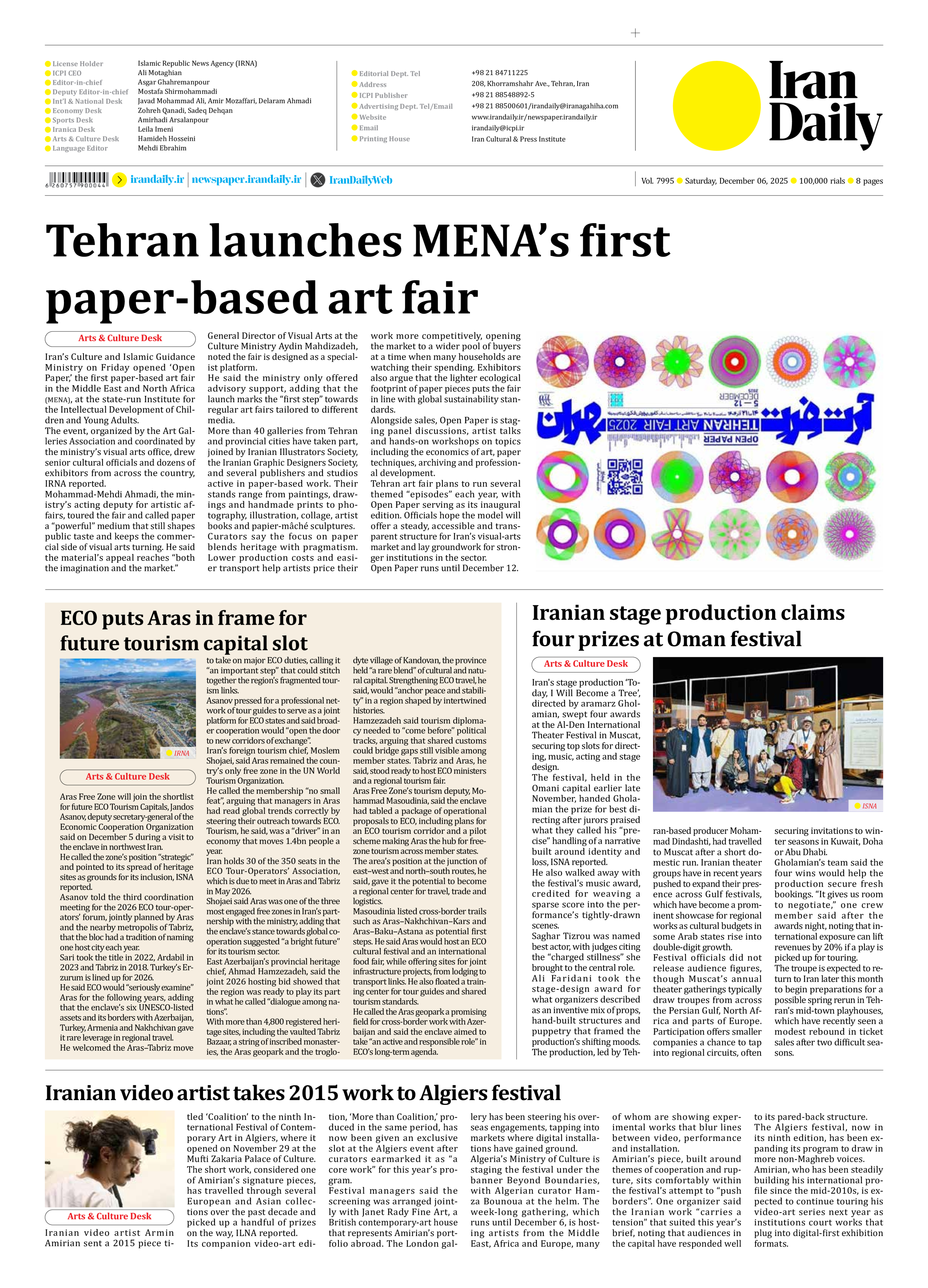
He called the zone’s position “strategic” and pointed to its spread of heritage sites as grounds for its inclusion, ISNA reported.
Asanov told the third coordination meeting for the 2026 ECO tour-operators’ forum, jointly planned by Aras and the nearby metropolis of Tabriz, that the bloc had a tradition of naming one host city each year.
Sari took the title in 2022, Ardabil in 2023 and Tabriz in 2018. Turkey’s Erzurum is lined up for 2026.
He said ECO would “seriously examine” Aras for the following years, adding that the enclave’s six UNESCO-listed assets and its borders with Azerbaijan, Turkey, Armenia and Nakhchivan gave it rare leverage in regional travel.
He welcomed the Aras–Tabriz move to take on major ECO duties, calling it “an important step” that could stitch together the region’s fragmented tourism links.
Asanov pressed for a professional network of tour guides to serve as a joint platform for ECO states and said broader cooperation would “open the door to new corridors of exchange”.
Iran’s foreign tourism chief, Moslem Shojaei, said Aras remained the country’s only free zone in the UN World Tourism Organization.
He called the membership “no small feat”, arguing that managers in Aras had read global trends correctly by steering their outreach towards ECO. Tourism, he said, was a “driver” in an economy that moves 1.4bn people a year.
Iran holds 30 of the 350 seats in the ECO Tour-Operators’ Association, which is due to meet in Aras and Tabriz in May 2026.
Shojaei said Aras was one of the three most engaged free zones in Iran’s partnership with the ministry, adding that the enclave’s stance towards global cooperation suggested “a bright future” for its tourism sector.
East Azerbaijan’s provincial heritage chief, Ahmad Hamzezadeh, said the joint 2026 hosting bid showed that the region was ready to play its part in what he called “dialogue among nations”.
With more than 4,800 registered heritage sites, including the vaulted Tabriz Bazaar, a string of inscribed monasteries, the Aras geopark and the troglodyte village of Kandovan, the province held “a rare blend” of cultural and natural capital. Strengthening ECO travel, he said, would “anchor peace and stability” in a region shaped by intertwined histories.
Hamzezadeh said tourism diplomacy needed to “come before” political tracks, arguing that shared customs could bridge gaps still visible among member states. Tabriz and Aras, he said, stood ready to host ECO ministers and a regional tourism fair.
Aras Free Zone’s tourism deputy, Mohammad Masoudinia, said the enclave had tabled a package of operational proposals to ECO, including plans for an ECO tourism corridor and a pilot scheme making Aras the hub for free-zone tourism across member states.
The area’s position at the junction of east–west and north–south routes, he said, gave it the potential to become a regional center for travel, trade and logistics.
Masoudinia listed cross-border trails such as Aras–Nakhchivan–Kars and Aras–Baku–Astana as potential first steps. He said Aras would host an ECO cultural festival and an international food fair, while offering sites for joint infrastructure projects, from lodging to transport links. He also floated a training center for tour guides and shared tourism standards.
He called the Aras geopark a promising field for cross-border work with Azerbaijan and said the enclave aimed to take “an active and responsible role” in ECO’s long-term agenda.