







Weaving identity through Lor traditional attire
Traditional clothing is more than just fabric and patterns; it is a living document of a nation’s identity, cultural memory, and social history.
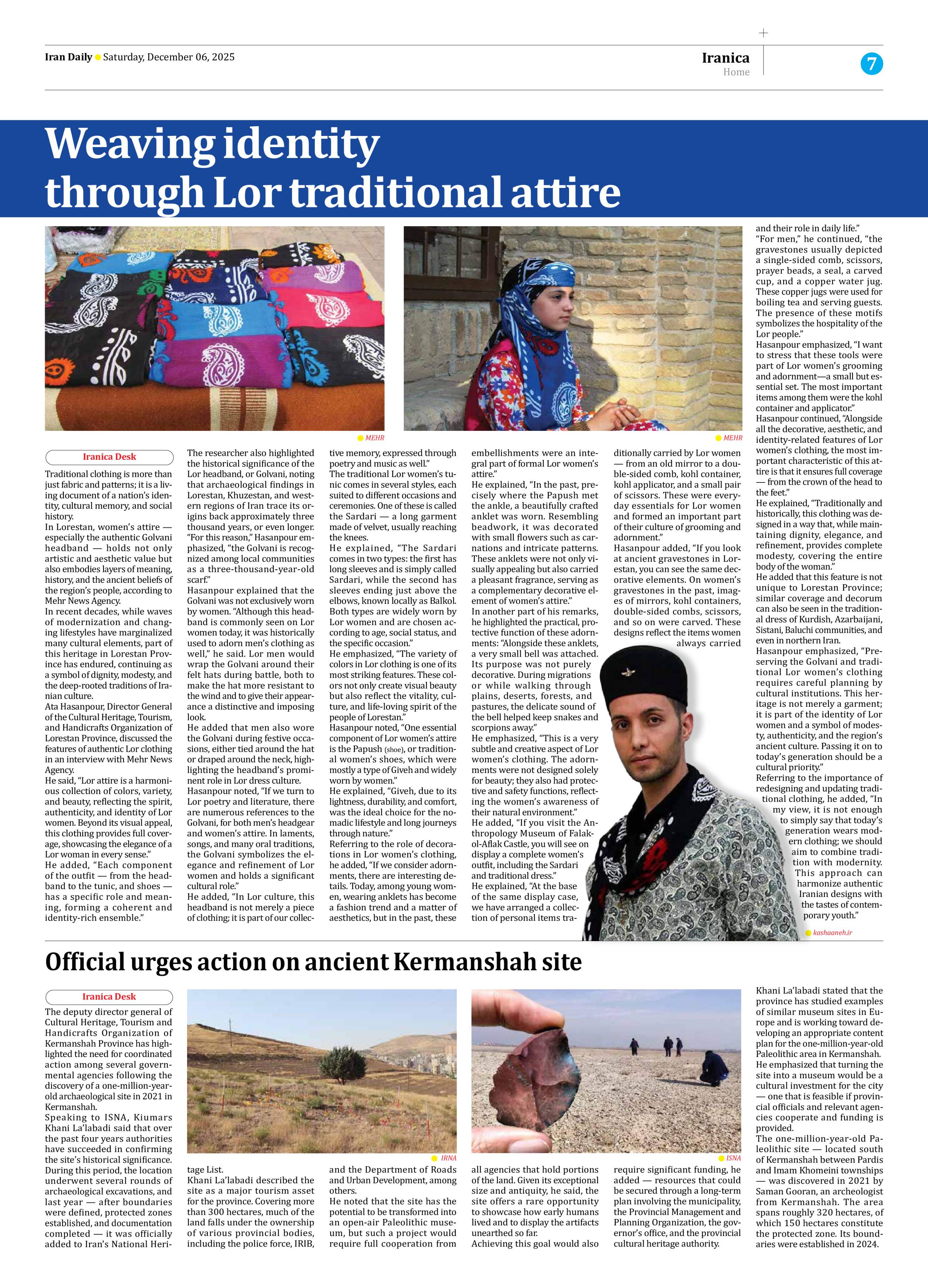
In Lorestan, women’s attire — especially the authentic Golvani headband — holds not only artistic and aesthetic value but also embodies layers of meaning, history, and the ancient beliefs of the region’s people, according to Mehr News Agency.
In recent decades, while waves of modernization and changing lifestyles have marginalized many cultural elements, part of this heritage in Lorestan Province has endured, continuing as a symbol of dignity, modesty, and the deep-rooted traditions of Iranian culture.
Ata Hasanpour, Director General of the Cultural Heritage, Tourism, and Handicrafts Organization of Lorestan Province, discussed the features of authentic Lor clothing in an interview with Mehr News Agency.
He said, “Lor attire is a harmonious collection of colors, variety, and beauty, reflecting the spirit, authenticity, and identity of Lor women. Beyond its visual appeal, this clothing provides full coverage, showcasing the elegance of a Lor woman in every sense.”
He added, “Each component of the outfit — from the headband to the tunic, and shoes — has a specific role and meaning, forming a coherent and identity-rich ensemble.”
The researcher also highlighted the historical significance of the Lor headband, or Golvani, noting that archaeological findings in Lorestan, Khuzestan, and western regions of Iran trace its origins back approximately three thousand years, or even longer. “For this reason,” Hasanpour emphasized, “the Golvani is recognized among local communities as a three-thousand-year-old scarf.”
Hasanpour explained that the Golvani was not exclusively worn by women. “Although this headband is commonly seen on Lor women today, it was historically used to adorn men’s clothing as well,” he said. Lor men would wrap the Golvani around their felt hats during battle, both to make the hat more resistant to the wind and to give their appearance a distinctive and imposing look.
He added that men also wore the Golvani during festive occasions, either tied around the hat or draped around the neck, highlighting the headband’s prominent role in Lor dress culture.
Hasanpour noted, “If we turn to Lor poetry and literature, there are numerous references to the Golvani, for both men’s headgear and women’s attire. In laments, songs, and many oral traditions, the Golvani symbolizes the elegance and refinement of Lor women and holds a significant cultural role.”
He added, “In Lor culture, this headband is not merely a piece of clothing; it is part of our collective memory, expressed through poetry and music as well.”
The traditional Lor women’s tunic comes in several styles, each suited to different occasions and ceremonies. One of these is called the Sardari — a long garment made of velvet, usually reaching the knees.
He explained, “The Sardari comes in two types: the first has long sleeves and is simply called Sardari, while the second has sleeves ending just above the elbows, known locally as Balkol. Both types are widely worn by Lor women and are chosen according to age, social status, and the specific occasion.”
He emphasized, “The variety of colors in Lor clothing is one of its most striking features. These colors not only create visual beauty but also reflect the vitality, culture, and life-loving spirit of the people of Lorestan.”
Hasanpour noted, “One essential component of Lor women’s attire is the Papush (shoe), or traditional women’s shoes, which were mostly a type of Giveh and widely worn by women.”
He explained, “Giveh, due to its lightness, durability, and comfort, was the ideal choice for the nomadic lifestyle and long journeys through nature.”
Referring to the role of decorations in Lor women’s clothing, he added, “If we consider adornments, there are interesting details. Today, among young women, wearing anklets has become a fashion trend and a matter of aesthetics, but in the past, these embellishments were an integral part of formal Lor women’s attire.”
He explained, “In the past, precisely where the Papush met the ankle, a beautifully crafted anklet was worn. Resembling beadwork, it was decorated with small flowers such as carnations and intricate patterns. These anklets were not only visually appealing but also carried a pleasant fragrance, serving as a complementary decorative element of women’s attire.”
In another part of his remarks, he highlighted the practical, protective function of these adornments: “Alongside these anklets, a very small bell was attached. Its purpose was not purely decorative. During migrations or while walking through plains, deserts, forests, and pastures, the delicate sound of the bell helped keep snakes and scorpions away.”
He emphasized, “This is a very subtle and creative aspect of Lor women’s clothing. The adornments were not designed solely for beauty; they also had protective and safety functions, reflecting the women’s awareness of their natural environment.”
He added, “If you visit the Anthropology Museum of Falak-ol-Aflak Castle, you will see on display a complete women’s outfit, including the Sardari and traditional dress.”
He explained, “At the base of the same display case, we have arranged a collection of personal items traditionally carried by Lor women — from an old mirror to a double-sided comb, kohl container, kohl applicator, and a small pair of scissors. These were everyday essentials for Lor women and formed an important part of their culture of grooming and adornment.”
Hasanpour added, “If you look at ancient gravestones in Lorestan, you can see the same decorative elements. On women’s gravestones in the past, images of mirrors, kohl containers, double-sided combs, scissors, and so on were carved. These designs reflect the items women always carried and their role in daily life.”
“For men,” he continued, “the gravestones usually depicted a single-sided comb, scissors, prayer beads, a seal, a carved cup, and a copper water jug. These copper jugs were used for boiling tea and serving guests. The presence of these motifs symbolizes the hospitality of the Lor people.”
Hasanpour emphasized, “I want to stress that these tools were part of Lor women’s grooming and adornment—a small but essential set. The most important items among them were the kohl container and applicator.”
Hasanpour continued, “Alongside all the decorative, aesthetic, and identity-related features of Lor women’s clothing, the most important characteristic of this attire is that it ensures full coverage — from the crown of the head to the feet.”
He explained, “Traditionally and historically, this clothing was designed in a way that, while maintaining dignity, elegance, and refinement, provides complete modesty, covering the entire body of the woman.”
He added that this feature is not unique to Lorestan Province; similar coverage and decorum can also be seen in the traditional dress of Kurdish, Azarbaijani, Sistani, Baluchi communities, and even in northern Iran.
Hasanpour emphasized, “Preserving the Golvani and traditional Lor women’s clothing requires careful planning by cultural institutions. This heritage is not merely a garment; it is part of the identity of Lor women and a symbol of modesty, authenticity, and the region’s ancient culture. Passing it on to today’s generation should be a cultural priority.”
Referring to the importance of redesigning and updating traditional clothing, he added, “In my view, it is not enough to simply say that today’s generation wears modern clothing; we should aim to combine tradition with modernity. This approach can harmonize authentic Iranian designs with the tastes of contemporary youth.”