







Tehran-Ankara cooperation paradigm during transition of Mideast order
By Samira Karim Shahi
Researcher on Turkish affairs
The recent visit of Hakan Fidan, the Turkish foreign minister, to Iran, within the framework of consultation concerning bilateral cooperation and regional dossiers, once again reminds us of the importance of the condition of relations between the two neighbors in the regional structure. The fluid developments of Middle East, the elevated dynamism and the displacement of equations in the post-October 7 period, have placed the process of transformation of the regional order on an accelerated trajectory, so that the principal actors in determining the paradigm of bilateral and multilateral relations maintain a long-term vision toward their strategic plan, in order to consolidate their position in the forthcoming order.
Amid this situation, Iran and Turkey are among these cardinal actors whose competition-cooperation paradigm, according to their geopolitical capacities and geography, gains significance under the management of conflicting interests and the reinforcement of commonalities.
According to the official announcement, the developments of Syria and the cease-fire of Gaza will be the two regional pivotal subjects that, during Fidan’s visit to Tehran, were to be discussed. The consultation of the Turkish foreign minister with Iranian officials occurred during the anniversary of the fall of Damascus. Last year, during such days, Fidan transformed his expansive diplomatic dynamism, especially with Tehran and Moscow, into an advantageous asset in his foreign policy dossier.
He claimed in numerous interviews that he had succeeded in persuading Tehran and Moscow, as the most significant supporters of the Assad government, that continued support for him would no longer secure their interests. Fidan even criticized Iran’s regional policies, especially in Syria, and believed it was now the time for Iran, by accepting the necessity of altering its approach, to join cooperation for the days of peace and stability in Syria.
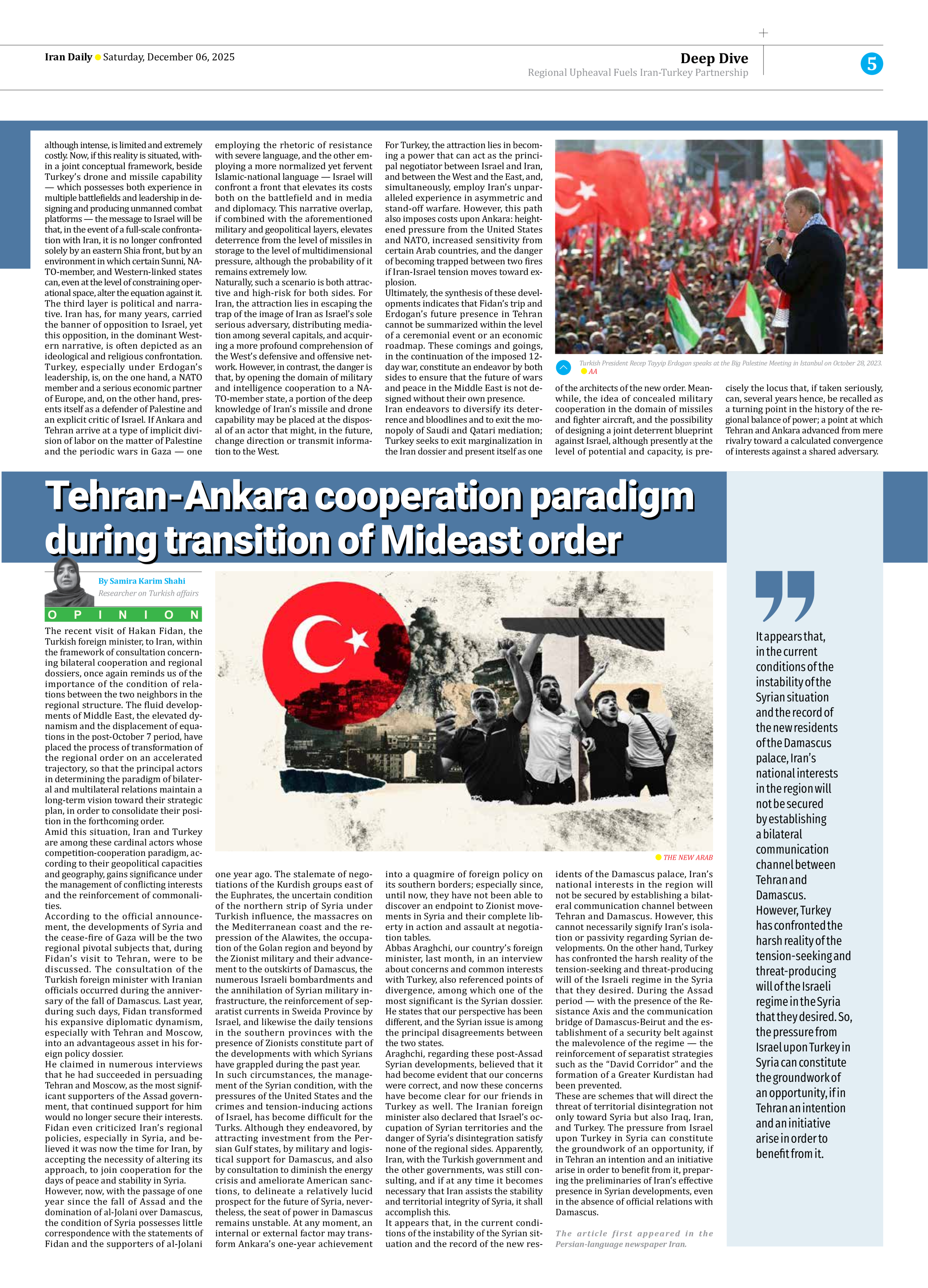
However, now, with the passage of one year since the fall of Assad and the domination of al-Jolani over Damascus, the condition of Syria possesses little correspondence with the statements of Fidan and the supporters of al-Jolani one year ago. The stalemate of negotiations of the Kurdish groups east of the Euphrates, the uncertain condition of the northern strip of Syria under Turkish influence, the massacres on the Mediterranean coast and the repression of the Alawites, the occupation of the Golan region and beyond by the Zionist military and their advancement to the outskirts of Damascus, the numerous Israeli bombardments and the annihilation of Syrian military infrastructure, the reinforcement of separatist currents in Sweida Province by Israel, and likewise the daily tensions in the southern provinces with the presence of Zionists constitute part of the developments with which Syrians have grappled during the past year.
In such circumstances, the management of the Syrian condition, with the pressures of the United States and the crimes and tension-inducing actions of Israel, has become difficult for the Turks. Although they endeavored, by attracting investment from the Persian Gulf states, by military and logistical support for Damascus, and also by consultation to diminish the energy crisis and ameliorate American sanctions, to delineate a relatively lucid prospect for the future of Syria, nevertheless, the seat of power in Damascus remains unstable. At any moment, an internal or external factor may transform Ankara’s one-year achievement into a quagmire of foreign policy on its southern borders; especially since, until now, they have not been able to discover an endpoint to Zionist movements in Syria and their complete liberty in action and assault at negotiation tables.
Abbas Araghchi, our country’s foreign minister, last month, in an interview about concerns and common interests with Turkey, also referenced points of divergence, among which one of the most significant is the Syrian dossier. He states that our perspective has been different, and the Syrian issue is among the principal disagreements between the two states.
Araghchi, regarding these post-Assad Syrian developments, believed that it had become evident that our concerns were correct, and now these concerns have become clear for our friends in Turkey as well. The Iranian foreign minister also declared that Israel’s occupation of Syrian territories and the danger of Syria’s disintegration satisfy none of the regional sides. Apparently, Iran, with the Turkish government and the other governments, was still consulting, and if at any time it becomes necessary that Iran assists the stability and territorial integrity of Syria, it shall accomplish this.
It appears that, in the current conditions of the instability of the Syrian situation and the record of the new residents of the Damascus palace, Iran’s national interests in the region will not be secured by establishing a bilateral communication channel between Tehran and Damascus. However, this cannot necessarily signify Iran’s isolation or passivity regarding Syrian developments. On the other hand, Turkey has confronted the harsh reality of the tension-seeking and threat-producing will of the Israeli regime in the Syria that they desired. During the Assad period — with the presence of the Resistance Axis and the communication bridge of Damascus-Beirut and the establishment of a security belt against the malevolence of the regime — the reinforcement of separatist strategies such as the “David Corridor” and the formation of a Greater Kurdistan had been prevented.
These are schemes that will direct the threat of territorial disintegration not only toward Syria but also Iraq, Iran, and Turkey. The pressure from Israel upon Turkey in Syria can constitute the groundwork of an opportunity, if in Tehran an intention and an initiative arise in order to benefit from it, preparing the preliminaries of Iran’s effective presence in Syrian developments, even in the absence of official relations with Damascus.
The article first appeared in the
Persian-language newspaper Iran.