







Quiet cooperation, colossal consequences
Why Iran-Turkey alignment is determinative for region
By Mohammad-Ali Ghanamizadeh Fallahi
Expert on international affairs
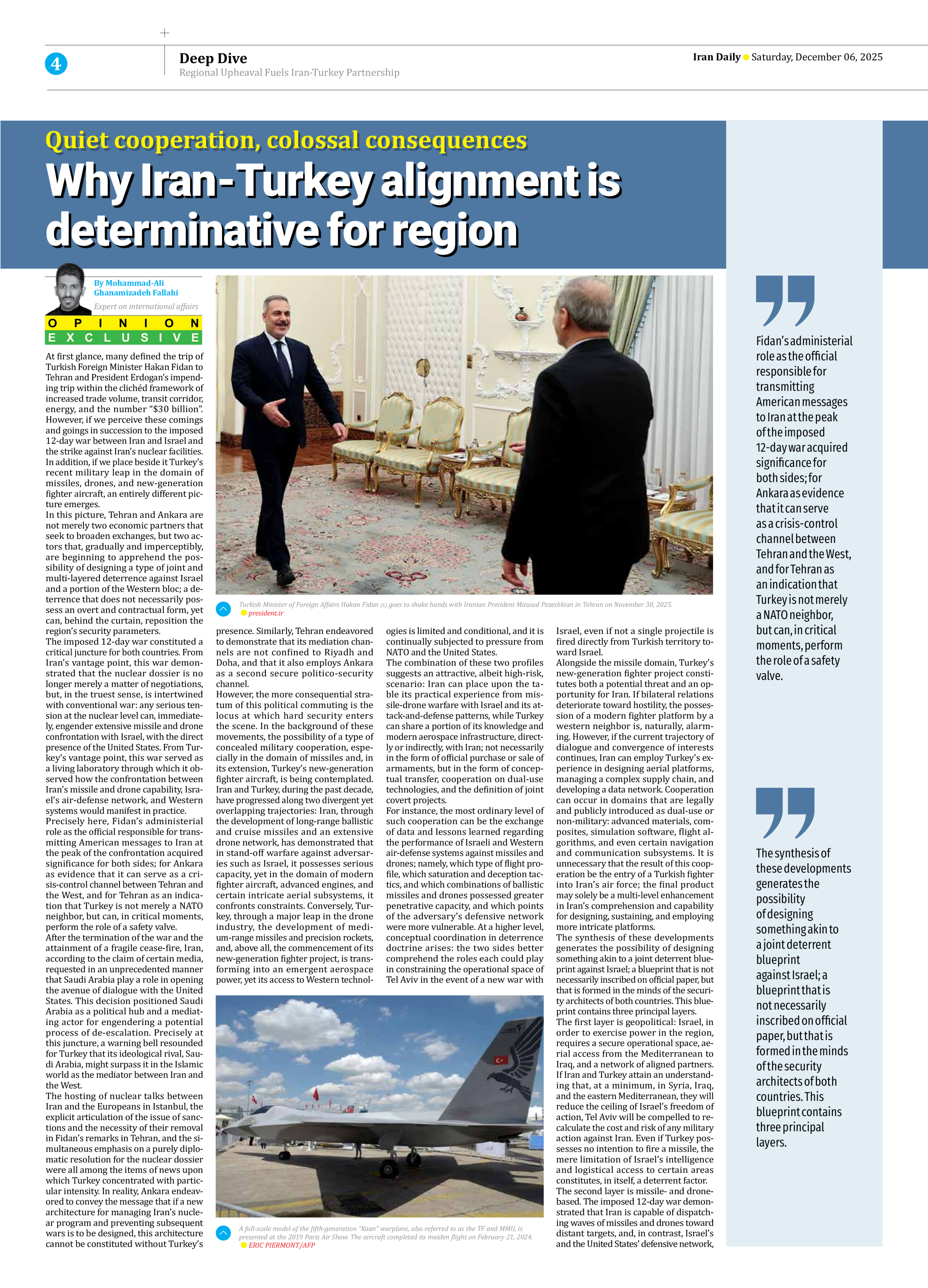
At first glance, many defined the trip of Turkish Foreign Minister Hakan Fidan to Tehran and President Erdogan’s impending trip within the clichéd framework of increased trade volume, transit corridor, energy, and the number “$30 billion”. However, if we perceive these comings and goings in succession to the imposed 12-day war between Iran and Israel and the strike against Iran’s nuclear facilities. In addition, if we place beside it Turkey’s recent military leap in the domain of missiles, drones, and new-generation fighter aircraft, an entirely different picture emerges.
In this picture, Tehran and Ankara are not merely two economic partners that seek to broaden exchanges, but two actors that, gradually and imperceptibly, are beginning to apprehend the possibility of designing a type of joint and multi-layered deterrence against Israel and a portion of the Western bloc; a deterrence that does not necessarily possess an overt and contractual form, yet can, behind the curtain, reposition the region’s security parameters.
The imposed 12-day war constituted a critical juncture for both countries. From Iran’s vantage point, this war demonstrated that the nuclear dossier is no longer merely a matter of negotiations, but, in the truest sense, is intertwined with conventional war: any serious tension at the nuclear level can, immediately, engender extensive missile and drone confrontation with Israel, with the direct presence of the United States. From Turkey’s vantage point, this war served as a living laboratory through which it observed how the confrontation between Iran’s missile and drone capability, Israel’s air-defense network, and Western systems would manifest in practice.
Precisely here, Fidan’s administerial role as the official responsible for transmitting American messages to Iran at the peak of the confrontation acquired significance for both sides; for Ankara as evidence that it can serve as a crisis-control channel between Tehran and the West, and for Tehran as an indication that Turkey is not merely a NATO neighbor, but can, in critical moments, perform the role of a safety valve.
After the termination of the war and the attainment of a fragile cease-fire, Iran, according to the claim of certain media, requested in an unprecedented manner that Saudi Arabia play a role in opening the avenue of dialogue with the United States. This decision positioned Saudi Arabia as a political hub and a mediating actor for engendering a potential process of de-escalation. Precisely at this juncture, a warning bell resounded for Turkey that its ideological rival, Saudi Arabia, might surpass it in the Islamic world as the mediator between Iran and the West.
The hosting of nuclear talks between Iran and the Europeans in Istanbul, the explicit articulation of the issue of sanctions and the necessity of their removal in Fidan’s remarks in Tehran, and the simultaneous emphasis on a purely diplomatic resolution for the nuclear dossier were all among the items of news upon which Turkey concentrated with particular intensity. In reality, Ankara endeavored to convey the message that if a new architecture for managing Iran’s nuclear program and preventing subsequent wars is to be designed, this architecture cannot be constituted without Turkey’s presence. Similarly, Tehran endeavored to demonstrate that its mediation channels are not confined to Riyadh and Doha, and that it also employs Ankara as a second secure politico-security channel.
However, the more consequential stratum of this political commuting is the locus at which hard security enters the scene. In the background of these movements, the possibility of a type of concealed military cooperation, especially in the domain of missiles and, in its extension, Turkey’s new-generation fighter aircraft, is being contemplated. Iran and Turkey, during the past decade, have progressed along two divergent yet overlapping trajectories: Iran, through the development of long-range ballistic and cruise missiles and an extensive drone network, has demonstrated that in stand-off warfare against adversaries such as Israel, it possesses serious capacity, yet in the domain of modern fighter aircraft, advanced engines, and certain intricate aerial subsystems, it confronts constraints. Conversely, Turkey, through a major leap in the drone industry, the development of medium-range missiles and precision rockets, and, above all, the commencement of its new-generation fighter project, is transforming into an emergent aerospace power, yet its access to Western technologies is limited and conditional, and it is continually subjected to pressure from NATO and the United States.
The combination of these two profiles suggests an attractive, albeit high-risk, scenario: Iran can place upon the table its practical experience from missile-drone warfare with Israel and its attack-and-defense patterns, while Turkey can share a portion of its knowledge and modern aerospace infrastructure, directly or indirectly, with Iran; not necessarily in the form of official purchase or sale of armaments, but in the form of conceptual transfer, cooperation on dual-use technologies, and the definition of joint covert projects.
For instance, the most ordinary level of such cooperation can be the exchange of data and lessons learned regarding the performance of Israeli and Western air-defense systems against missiles and drones; namely, which type of flight profile, which saturation and deception tactics, and which combinations of ballistic missiles and drones possessed greater penetrative capacity, and which points of the adversary’s defensive network were more vulnerable. At a higher level, conceptual coordination in deterrence doctrine arises: the two sides better comprehend the roles each could play in constraining the operational space of Tel Aviv in the event of a new war with Israel, even if not a single projectile is fired directly from Turkish territory toward Israel.
Alongside the missile domain, Turkey’s new-generation fighter project constitutes both a potential threat and an opportunity for Iran. If bilateral relations deteriorate toward hostility, the possession of a modern fighter platform by a western neighbor is, naturally, alarming. However, if the current trajectory of dialogue and convergence of interests continues, Iran can employ Turkey’s experience in designing aerial platforms, managing a complex supply chain, and developing a data network. Cooperation can occur in domains that are legally and publicly introduced as dual-use or non-military: advanced materials, composites, simulation software, flight algorithms, and even certain navigation and communication subsystems. It is unnecessary that the result of this cooperation be the entry of a Turkish fighter into Iran’s air force; the final product may solely be a multi-level enhancement in Iran’s comprehension and capability for designing, sustaining, and employing more intricate platforms.
The synthesis of these developments generates the possibility of designing something akin to a joint deterrent blueprint against Israel; a blueprint that is not necessarily inscribed on official paper, but that is formed in the minds of the security architects of both countries. This blueprint contains three principal layers.
The first layer is geopolitical: Israel, in order to exercise power in the region, requires a secure operational space, aerial access from the Mediterranean to Iraq, and a network of aligned partners. If Iran and Turkey attain an understanding that, at a minimum, in Syria, Iraq, and the eastern Mediterranean, they will reduce the ceiling of Israel’s freedom of action, Tel Aviv will be compelled to recalculate the cost and risk of any military action against Iran. Even if Turkey possesses no intention to fire a missile, the mere limitation of Israel’s intelligence and logistical access to certain areas constitutes, in itself, a deterrent factor.
The second layer is missile- and drone-based. The imposed 12-day war demonstrated that Iran is capable of dispatching waves of missiles and drones toward distant targets, and, in contrast, Israel’s and the United States’ defensive network, although intense, is limited and extremely costly. Now, if this reality is situated, within a joint conceptual framework, beside Turkey’s drone and missile capability — which possesses both experience in multiple battlefields and leadership in designing and producing unmanned combat platforms — the message to Israel will be that, in the event of a full-scale confrontation with Iran, it is no longer confronted solely by an eastern Shia front, but by an environment in which certain Sunni, NATO-member, and Western-linked states can, even at the level of constraining operational space, alter the equation against it.
The third layer is political and narrative. Iran has, for many years, carried the banner of opposition to Israel, yet this opposition, in the dominant Western narrative, is often depicted as an ideological and religious confrontation. Turkey, especially under Erdogan’s leadership, is, on the one hand, a NATO member and a serious economic partner of Europe, and, on the other hand, presents itself as a defender of Palestine and an explicit critic of Israel. If Ankara and Tehran arrive at a type of implicit division of labor on the matter of Palestine and the periodic wars in Gaza — one employing the rhetoric of resistance with severe language, and the other employing a more normalized yet fervent Islamic-national language — Israel will confront a front that elevates its costs both on the battlefield and in media and diplomacy. This narrative overlap, if combined with the aforementioned military and geopolitical layers, elevates deterrence from the level of missiles in storage to the level of multidimensional pressure, although the probability of it remains extremely low.
Naturally, such a scenario is both attractive and high-risk for both sides. For Iran, the attraction lies in escaping the trap of the image of Iran as Israel’s sole serious adversary, distributing mediation among several capitals, and acquiring a more profound comprehension of the West’s defensive and offensive network. However, in contrast, the danger is that, by opening the domain of military and intelligence cooperation to a NATO-member state, a portion of the deep knowledge of Iran’s missile and drone capability may be placed at the disposal of an actor that might, in the future, change direction or transmit information to the West.
For Turkey, the attraction lies in becoming a power that can act as the principal negotiator between Israel and Iran, and between the West and the East, and, simultaneously, employ Iran’s unparalleled experience in asymmetric and stand-off warfare. However, this path also imposes costs upon Ankara: heightened pressure from the United States and NATO, increased sensitivity from certain Arab countries, and the danger of becoming trapped between two fires if Iran-Israel tension moves toward explosion.
Ultimately, the synthesis of these developments indicates that Fidan’s trip and Erdogan’s future presence in Tehran cannot be summarized within the level of a ceremonial event or an economic roadmap. These comings and goings, in the continuation of the imposed 12-day war, constitute an endeavor by both sides to ensure that the future of wars and peace in the Middle East is not designed without their own presence.
Iran endeavors to diversify its deterrence and bloodlines and to exit the monopoly of Saudi and Qatari mediation; Turkey seeks to exit marginalization in the Iran dossier and present itself as one of the architects of the new order. Meanwhile, the idea of concealed military cooperation in the domain of missiles and fighter aircraft, and the possibility of designing a joint deterrent blueprint against Israel, although presently at the level of potential and capacity, is precisely the locus that, if taken seriously, can, several years hence, be recalled as a turning point in the history of the regional balance of power; a point at which Tehran and Ankara advanced from mere rivalry toward a calculated convergence of interests against a shared adversary.