





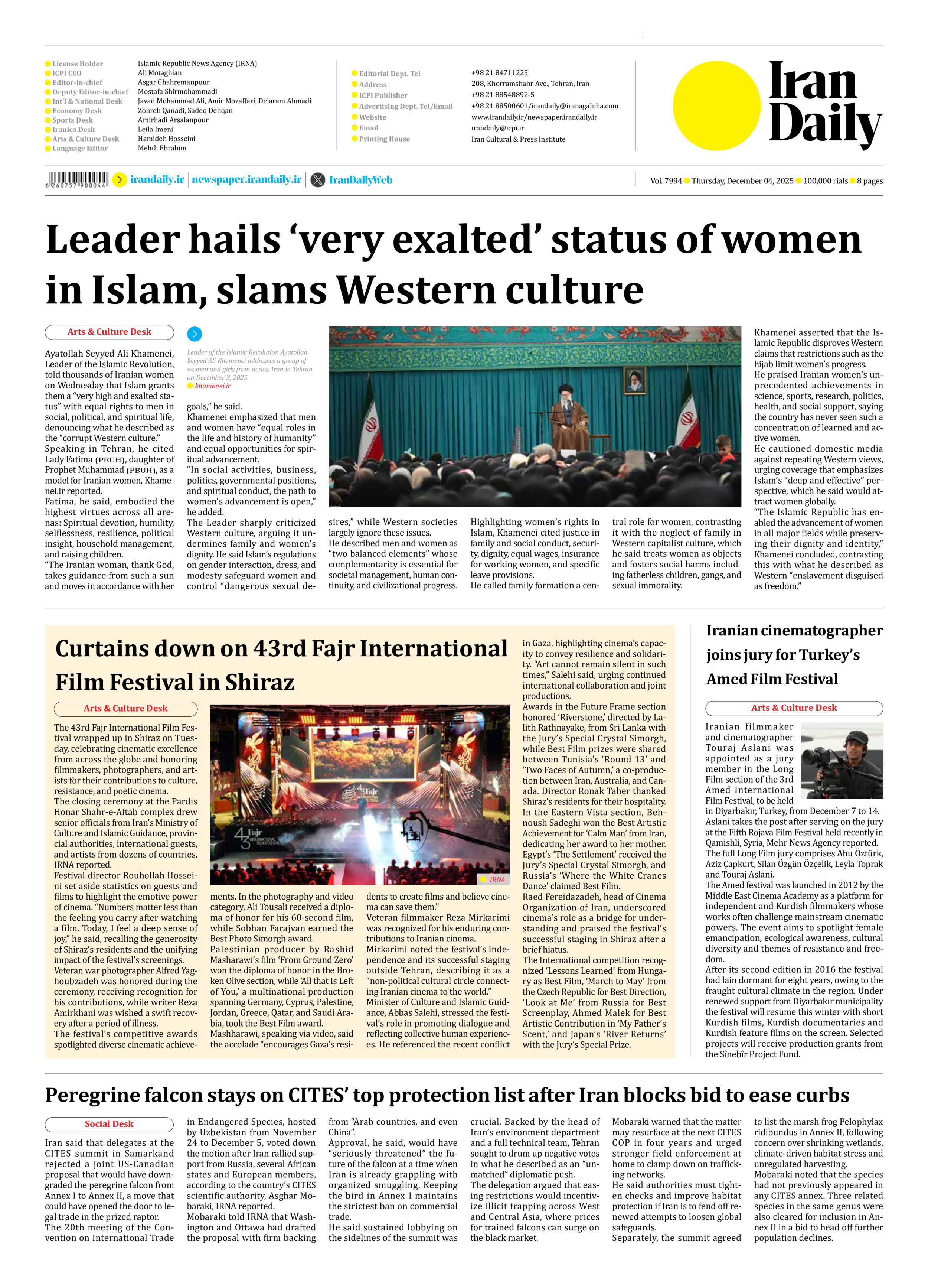


Curtains down on 43rd Fajr International Film Festival in Shiraz
The 43rd Fajr International Film Festival wrapped up in Shiraz on Tuesday, celebrating cinematic excellence from across the globe and honoring filmmakers, photographers, and artists for their contributions to culture, resistance, and poetic cinema.
The closing ceremony at the Pardis Honar Shahr-e-Aftab complex drew senior officials from Iran’s Ministry of Culture and Islamic Guidance, provincial authorities, international guests, and artists from dozens of countries, IRNA reported.
Festival director Rouhollah Hosseini set aside statistics on guests and films to highlight the emotive power of cinema. “Numbers matter less than the feeling you carry after watching a film. Today, I feel a deep sense of joy,” he said, recalling the generosity of Shiraz’s residents and the unifying impact of the festival’s screenings.
Veteran war photographer Alfred Yaghoubzadeh was honored during the ceremony, receiving recognition for his contributions, while writer Reza Amirkhani was wished a swift recovery after a period of illness.
The festival’s competitive awards spotlighted diverse cinematic achievements. In the photography and video category, Ali Tousali received a diploma of honor for his 60-second film, while Sobhan Farajvan earned the Best Photo Simorgh award.
Palestinian producer by Rashid Masharawi’s film ‘From Ground Zero’ won the diploma of honor in the Broken Olive section, while ‘All that Is Left of You,’ a multinational production spanning Germany, Cyprus, Palestine, Jordan, Greece, Qatar, and Saudi Arabia, took the Best Film award.
Mashharawi, speaking via video, said the accolade “encourages Gaza’s residents to create films and believe cinema can save them.”
Veteran filmmaker Reza Mirkarimi was recognized for his enduring contributions to Iranian cinema.
Mirkarimi noted the festival’s independence and its successful staging outside Tehran, describing it as a “non-political cultural circle connecting Iranian cinema to the world.”
Minister of Culture and Islamic Guidance, Abbas Salehi, stressed the festival’s role in promoting dialogue and reflecting collective human experiences. He referenced the recent conflict in Gaza, highlighting cinema’s capacity to convey resilience and solidarity. “Art cannot remain silent in such times,” Salehi said, urging continued international collaboration and joint productions.
Awards in the Future Frame section honored ‘Riverstone,’ directed by Lalith Rathnayake, from Sri Lanka with the Jury’s Special Crystal Simorgh, while Best Film prizes were shared between Tunisia’s ‘Round 13’ and ‘Two Faces of Autumn,’ a co-production between Iran, Australia, and Canada. Director Ronak Taher thanked Shiraz’s residents for their hospitality.
In the Eastern Vista section, Behnoush Sadeghi won the Best Artistic Achievement for ‘Calm Man’ from Iran, dedicating her award to her mother. Egypt’s ‘The Settlement’ received the Jury’s Special Crystal Simorgh, and Russia’s ‘Where the White Cranes Dance’ claimed Best Film.
Raed Fereidazadeh, head of Cinema Organization of Iran, underscored cinema’s role as a bridge for understanding and praised the festival’s successful staging in Shiraz after a brief hiatus.
The International competition recognized ‘Lessons Learned’ from Hungary as Best Film, ‘March to May’ from the Czech Republic for Best Direction, ‘Look at Me’ from Russia for Best Screenplay, Ahmed Malek for Best Artistic Contribution in ‘My Father’s Scent,’ and Japan’s ‘River Returns’ with the Jury’s Special Prize.