





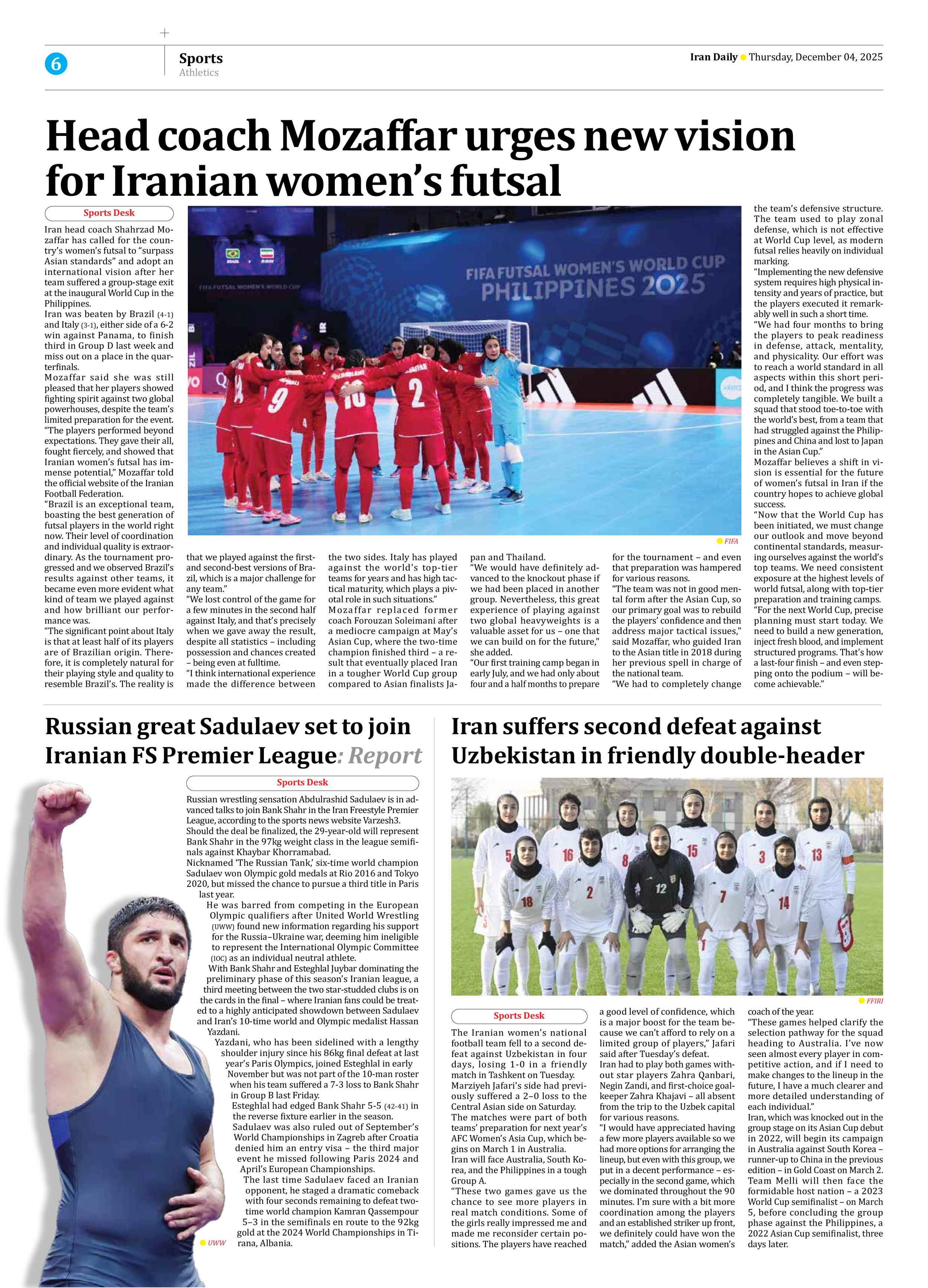


Head coach Mozaffar urges new vision for Iranian women’s futsal
Iran head coach Shahrzad Mozaffar has called for the country’s women’s futsal to “surpass Asian standards” and adopt an international vision after her team suffered a group-stage exit at the inaugural World Cup in the Philippines.
Iran was beaten by Brazil (4-1) and Italy (3-1), either side of a 6-2 win against Panama, to finish third in Group D last week and miss out on a place in the quarterfinals.
Mozaffar said she was still pleased that her players showed fighting spirit against two global powerhouses, despite the team’s limited preparation for the event.
“The players performed beyond expectations. They gave their all, fought fiercely, and showed that Iranian women’s futsal has immense potential,” Mozaffar told the official website of the Iranian Football Federation.
“Brazil is an exceptional team, boasting the best generation of futsal players in the world right now. Their level of coordination and individual quality is extraordinary. As the tournament progressed and we observed Brazil’s results against other teams, it became even more evident what kind of team we played against and how brilliant our performance was.
“The significant point about Italy is that at least half of its players are of Brazilian origin. Therefore, it is completely natural for their playing style and quality to resemble Brazil’s. The reality is that we played against the first- and second-best versions of Brazil, which is a major challenge for any team.”
“We lost control of the game for a few minutes in the second half against Italy, and that’s precisely when we gave away the result, despite all statistics – including possession and chances created – being even at fulltime.
“I think international experience made the difference between the two sides. Italy has played against the world’s top-tier teams for years and has high tactical maturity, which plays a pivotal role in such situations.”
Mozaffar replaced former coach Forouzan Soleimani after a mediocre campaign at May’s Asian Cup, where the two-time champion finished third – a result that eventually placed Iran in a tougher World Cup group compared to Asian finalists Japan and Thailand.
“We would have definitely advanced to the knockout phase if we had been placed in another group. Nevertheless, this great experience of playing against two global heavyweights is a valuable asset for us – one that we can build on for the future,” she added.
“Our first training camp began in early July, and we had only about four and a half months to prepare for the tournament – and even that preparation was hampered for various reasons.
“The team was not in good mental form after the Asian Cup, so our primary goal was to rebuild the players’ confidence and then address major tactical issues,” said Mozaffar, who guided Iran to the Asian title in 2018 during her previous spell in charge of the national team.
“We had to completely change the team’s defensive structure. The team used to play zonal defense, which is not effective at World Cup level, as modern futsal relies heavily on individual marking.
“Implementing the new defensive system requires high physical intensity and years of practice, but the players executed it remarkably well in such a short time.
“We had four months to bring the players to peak readiness in defense, attack, mentality, and physicality. Our effort was to reach a world standard in all aspects within this short period, and I think the progress was completely tangible. We built a squad that stood toe-to-toe with the world’s best, from a team that had struggled against the Philippines and China and lost to Japan in the Asian Cup.”
Mozaffar believes a shift in vision is essential for the future of women’s futsal in Iran if the country hopes to achieve global success.
“Now that the World Cup has been initiated, we must change our outlook and move beyond continental standards, measuring ourselves against the world’s top teams. We need consistent exposure at the highest levels of world futsal, along with top-tier preparation and training camps.
“For the next World Cup, precise planning must start today. We need to build a new generation, inject fresh blood, and implement structured programs. That’s how a last-four finish – and even stepping onto the podium – will become achievable.”