







Peace in Ukraine; very near or very far?
By Ali Beman
Eghbali Zarch
Expert on Eurasian affairs
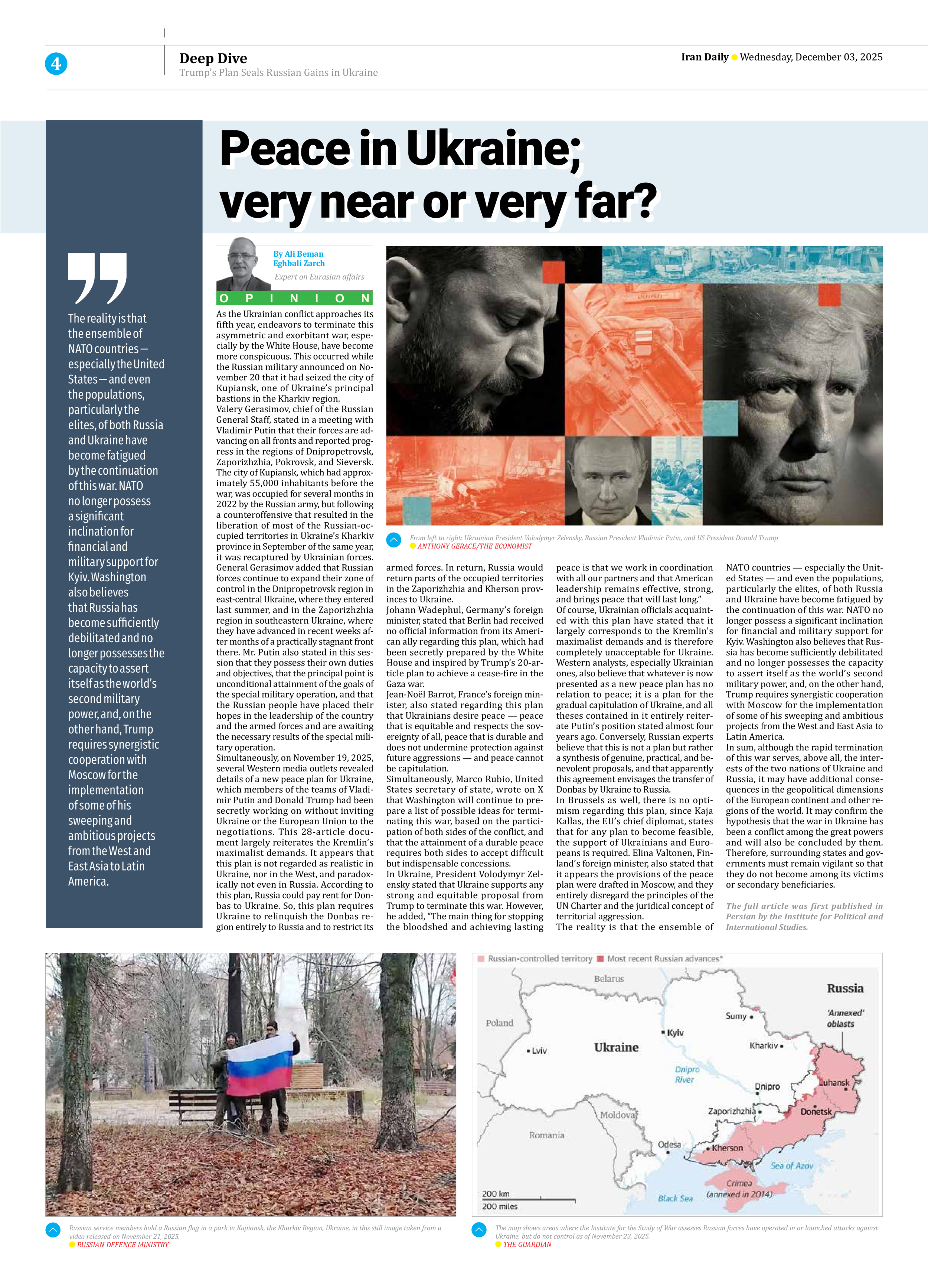
As the Ukrainian conflict approaches its fifth year, endeavors to terminate this asymmetric and exorbitant war, especially by the White House, have become more conspicuous. This occurred while the Russian military announced on November 20 that it had seized the city of Kupiansk, one of Ukraine’s principal bastions in the Kharkiv region.
Valery Gerasimov, chief of the Russian General Staff, stated in a meeting with Vladimir Putin that their forces are advancing on all fronts and reported progress in the regions of Dnipropetrovsk, Zaporizhzhia, Pokrovsk, and Sieversk. The city of Kupiansk, which had approximately 55,000 inhabitants before the war, was occupied for several months in 2022 by the Russian army, but following a counteroffensive that resulted in the liberation of most of the Russian-occupied territories in Ukraine’s Kharkiv province in September of the same year, it was recaptured by Ukrainian forces. General Gerasimov added that Russian forces continue to expand their zone of control in the Dnipropetrovsk region in east-central Ukraine, where they entered last summer, and in the Zaporizhzhia region in southeastern Ukraine, where they have advanced in recent weeks after months of a practically stagnant front there. Mr. Putin also stated in this session that they possess their own duties and objectives, that the principal point is unconditional attainment of the goals of the special military operation, and that the Russian people have placed their hopes in the leadership of the country and the armed forces and are awaiting the necessary results of the special military operation.
Simultaneously, on November 19, 2025, several Western media outlets revealed details of a new peace plan for Ukraine, which members of the teams of Vladimir Putin and Donald Trump had been secretly working on without inviting Ukraine or the European Union to the negotiations. This 28-article document largely reiterates the Kremlin’s maximalist demands. It appears that this plan is not regarded as realistic in Ukraine, nor in the West, and paradoxically not even in Russia. According to this plan, Russia could pay rent for Donbas to Ukraine. So, this plan requires Ukraine to relinquish the Donbas region entirely to Russia and to restrict its armed forces. In return, Russia would return parts of the occupied territories in the Zaporizhzhia and Kherson provinces to Ukraine.
Johann Wadephul, Germany’s foreign minister, stated that Berlin had received no official information from its American ally regarding this plan, which had been secretly prepared by the White House and inspired by Trump’s 20-article plan to achieve a cease-fire in the Gaza war.
Jean-Noël Barrot, France’s foreign minister, also stated regarding this plan that Ukrainians desire peace — peace that is equitable and respects the sovereignty of all, peace that is durable and does not undermine protection against future aggressions — and peace cannot be capitulation.
Simultaneously, Marco Rubio, United States secretary of state, wrote on X that Washington will continue to prepare a list of possible ideas for terminating this war, based on the participation of both sides of the conflict, and that the attainment of a durable peace requires both sides to accept difficult but indispensable concessions.
In Ukraine, President Volodymyr Zelensky stated that Ukraine supports any strong and equitable proposal from Trump to terminate this war. However, he added, “The main thing for stopping the bloodshed and achieving lasting peace is that we work in coordination with all our partners and that American leadership remains effective, strong, and brings peace that will last long.”
Of course, Ukrainian officials acquainted with this plan have stated that it largely corresponds to the Kremlin’s maximalist demands and is therefore completely unacceptable for Ukraine. Western analysts, especially Ukrainian ones, also believe that whatever is now presented as a new peace plan has no relation to peace; it is a plan for the gradual capitulation of Ukraine, and all theses contained in it entirely reiterate Putin’s position stated almost four years ago. Conversely, Russian experts believe that this is not a plan but rather a synthesis of genuine, practical, and benevolent proposals, and that apparently this agreement envisages the transfer of Donbas by Ukraine to Russia.
In Brussels as well, there is no optimism regarding this plan, since Kaja Kallas, the EU’s chief diplomat, states that for any plan to become feasible, the support of Ukrainians and Europeans is required. Elina Valtonen, Finland’s foreign minister, also stated that it appears the provisions of the peace plan were drafted in Moscow, and they entirely disregard the principles of the UN Charter and the juridical concept of territorial aggression.
The reality is that the ensemble of NATO countries — especially the United States — and even the populations, particularly the elites, of both Russia and Ukraine have become fatigued by the continuation of this war. NATO no longer possess a significant inclination for financial and military support for Kyiv. Washington also believes that Russia has become sufficiently debilitated and no longer possesses the capacity to assert itself as the world’s second military power, and, on the other hand, Trump requires synergistic cooperation with Moscow for the implementation of some of his sweeping and ambitious projects from the West and East Asia to Latin America.
In sum, although the rapid termination of this war serves, above all, the interests of the two nations of Ukraine and Russia, it may have additional consequences in the geopolitical dimensions of the European continent and other regions of the world. It may confirm the hypothesis that the war in Ukraine has been a conflict among the great powers and will also be concluded by them. Therefore, surrounding states and governments must remain vigilant so that they do not become among its victims or secondary beneficiaries.
The full article was first published in
Persian by the Institute for Political and International Studies.