





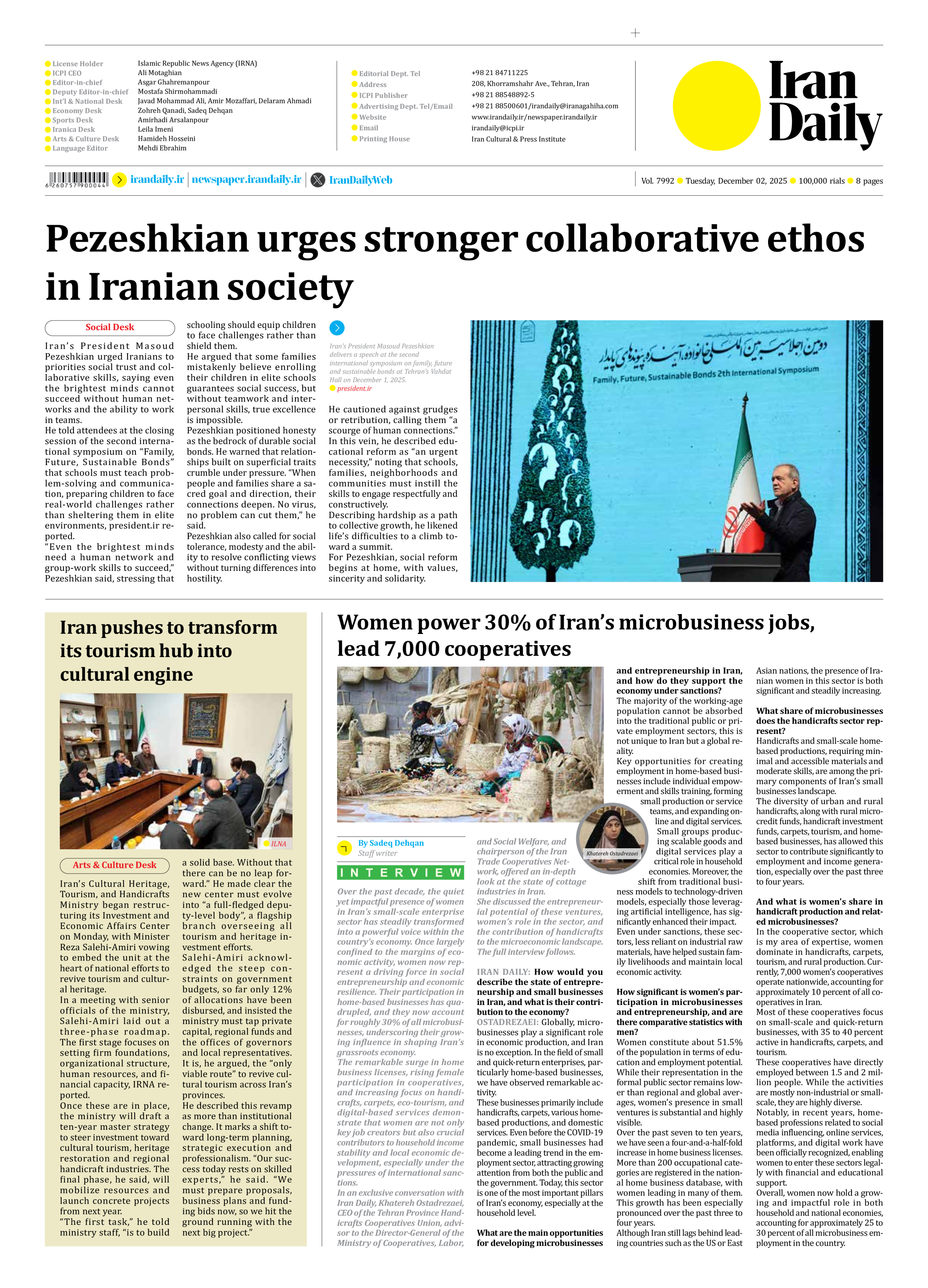


Women power 30% of Iran’s microbusiness jobs, lead 7,000 cooperatives
By Sadeq Dehqan
Staff writer
Over the past decade, the quiet yet impactful presence of women in Iran’s small-scale enterprise sector has steadily transformed into a powerful voice within the country’s economy. Once largely confined to the margins of economic activity, women now represent a driving force in social entrepreneurship and economic resilience. Their participation in home-based businesses has quadrupled, and they now account for roughly 30% of all microbusinesses, underscoring their growing influence in shaping Iran’s grassroots economy.
The remarkable surge in home business licenses, rising female participation in cooperatives, and increasing focus on handicrafts, carpets, eco-tourism, and digital-based services demonstrate that women are not only key job creators but also crucial contributors to household income stability and local economic development, especially under the pressures of international sanctions.
In an exclusive conversation with Iran Daily, Khatereh Ostadrezaei, CEO of the Tehran Province Handicrafts Cooperatives Union, advisor to the Director-General of the Ministry of Cooperatives, Labor, and Social Welfare, and chairperson of the Iran Trade Cooperatives Network, offered an in-depth look at the state of cottage industries in Iran.
She discussed the entrepreneurial potential of these ventures, women’s role in the sector, and the contribution of handicrafts to the microeconomic landscape. The full interview follows.
IRAN DAILY: How would you describe the state of entrepreneurship and small businesses in Iran, and what is their contribution to the economy?
OSTADREZAEI: Globally, microbusinesses play a significant role in economic production, and Iran is no exception. In the field of small and quick-return enterprises, particularly home-based businesses, we have observed remarkable activity.
These businesses primarily include handicrafts, carpets, various home-based productions, and domestic services. Even before the COVID-19 pandemic, small businesses had become a leading trend in the employment sector, attracting growing attention from both the public and the government. Today, this sector is one of the most important pillars of Iran’s economy, especially at the household level.
What are the main opportunities for developing microbusinesses and entrepreneurship in Iran, and how do they support the economy under sanctions?
The majority of the working-age population cannot be absorbed into the traditional public or private employment sectors, this is not unique to Iran but a global reality.
Key opportunities for creating employment in home-based businesses include individual empowerment and skills training, forming small production or service teams, and expanding online and digital services.
Small groups producing scalable goods and digital services play a critical role in household economies. Moreover, the shift from traditional business models to technology-driven models, especially those leveraging artificial intelligence, has significantly enhanced their impact.
Even under sanctions, these sectors, less reliant on industrial raw materials, have helped sustain family livelihoods and maintain local economic activity.
How significant is women’s participation in microbusinesses and entrepreneurship, and are there comparative statistics with men?
Women constitute about 51.5% of the population in terms of education and employment potential. While their representation in the formal public sector remains lower than regional and global averages, women’s presence in small ventures is substantial and highly visible.
Over the past seven to ten years, we have seen a four-and-a-half-fold increase in home business licenses. More than 200 occupational categories are registered in the national home business database, with women leading in many of them. This growth has been especially pronounced over the past three to four years.
Although Iran still lags behind leading countries such as the US or East Asian nations, the presence of Iranian women in this sector is both significant and steadily increasing.
What share of microbusinesses does the handicrafts sector represent?
Handicrafts and small-scale home-based productions, requiring minimal and accessible materials and moderate skills, are among the primary components of Iran’s small businesses landscape.
The diversity of urban and rural handicrafts, along with rural microcredit funds, handicraft investment funds, carpets, tourism, and home-based businesses, has allowed this sector to contribute significantly to employment and income generation, especially over the past three to four years.
And what is women’s share in handicraft production and related microbusinesses?
In the cooperative sector, which is my area of expertise, women dominate in handicrafts, carpets, tourism, and rural production. Currently, 7,000 women’s cooperatives operate nationwide, accounting for approximately 10 percent of all cooperatives in Iran.
Most of these cooperatives focus on small-scale and quick-return businesses, with 35 to 40 percent active in handicrafts, carpets, and tourism.
These cooperatives have directly employed between 1.5 and 2 million people. While the activities are mostly non-industrial or small-scale, they are highly diverse.
Notably, in recent years, home-based professions related to social media influencing, online services, platforms, and digital work have been officially recognized, enabling women to enter these sectors legally with financial and educational support.
Overall, women now hold a growing and impactful role in both household and national economies, accounting for approximately 25 to 30 percent of all microbusiness employment in the country.