







Iran’s performance at COP30; threats and opportunities
By Mohammad-Hossein Emadi
Member of HLPE for UN Committee on World Food Security
The COP30 summit, with a focus on the implementation of the Paris commitments, the triplication of adaptation finance by 2035, the establishment of the “Global Implementation Accelerator,” and the invitation to members to present more exigent national plans in 2025, concluded its proceedings on November 21. Yet its resolutions, akin to previous summits, were accompanied by profound global questions and challenges.
The purpose of this piece is to examine Iran’s performance and positions in the recent conference and the corresponding opportunities and threats. The avoidance of an explicit commitment to the exit from fossil fuels, the financial fissures, and the geopolitical divergences constituted, for Iran — as one of the 10 principal carbon-emitting countries in the world, and a country that procures more than 90 percent of its energy from fossil fuels — not merely a diplomatic event but an immaculate mirror reflecting Iran’s domestic predicaments and its potential international opportunities.
An emphasis on climate justice and on its indirect effects on the economy and environment, as well as the condemnation of sanctions, could have been transmuted into an opportunity for an overhaul in Iran’s future policymaking; yet the faint presence of the Iranian delegation on the one hand, and the contradictions between its international positions and its conduct on the other, converted it into yet another forfeited opportunity.
Iran, with a population exceeding 85 million, is situated in an arid and semi-arid region rendered extraordinarily vulnerable by climate change. The grave peril of a “day zero” for the capital’s water supply, after the desiccation of numerous wetlands and Lake Urmia, continual droughts, dust storms, and rising temperatures, inflicts billions of dollars of damage annually upon Iran’s fragile economy. COP30, with its focus on adaptation and financing, could have constituted a point of departure for Iran’s access to global financial resources, but unilateral sanctions as well as weakness in representation and diplomatic positions circumscribed these opportunities.
Diplomacy in shadow of sanctions
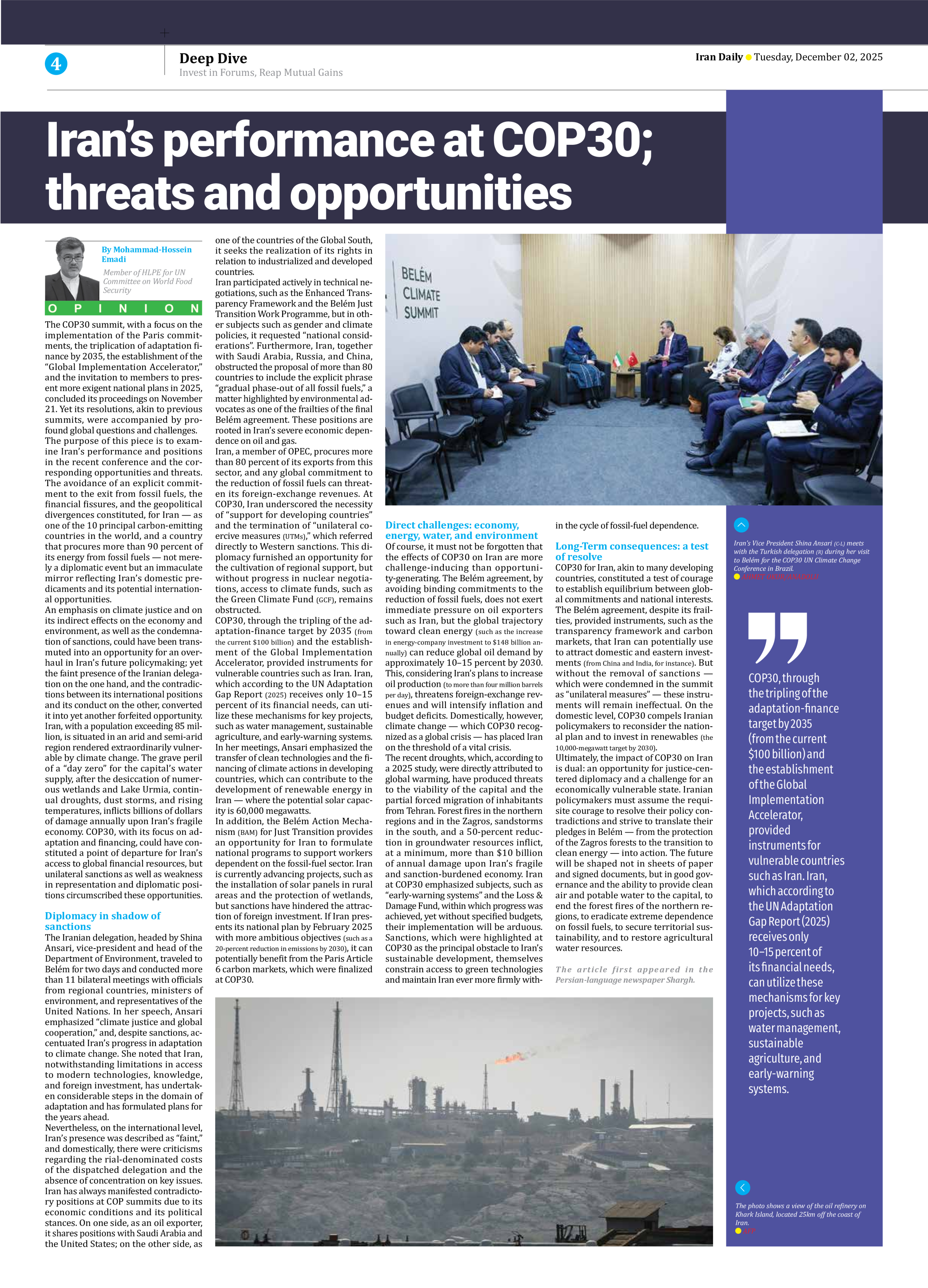
The Iranian delegation, headed by Shina Ansari, vice-president and head of the Department of Environment, traveled to Belém for two days and conducted more than 11 bilateral meetings with officials from regional countries, ministers of environment, and representatives of the United Nations. In her speech, Ansari emphasized “climate justice and global cooperation,” and, despite sanctions, accentuated Iran’s progress in adaptation to climate change. She noted that Iran, notwithstanding limitations in access to modern technologies, knowledge, and foreign investment, has undertaken considerable steps in the domain of adaptation and has formulated plans for the years ahead.
Nevertheless, on the international level, Iran’s presence was described as “faint,” and domestically, there were criticisms regarding the rial-denominated costs of the dispatched delegation and the absence of concentration on key issues. Iran has always manifested contradictory positions at COP summits due to its economic conditions and its political stances. On one side, as an oil exporter, it shares positions with Saudi Arabia and the United States; on the other side, as one of the countries of the Global South, it seeks the realization of its rights in relation to industrialized and developed countries.
Iran participated actively in technical negotiations, such as the Enhanced Transparency Framework and the Belém Just Transition Work Programme, but in other subjects such as gender and climate policies, it requested “national considerations”. Furthermore, Iran, together with Saudi Arabia, Russia, and China, obstructed the proposal of more than 80 countries to include the explicit phrase “gradual phase-out of all fossil fuels,” a matter highlighted by environmental advocates as one of the frailties of the final Belém agreement. These positions are rooted in Iran’s severe economic dependence on oil and gas.
Iran, a member of OPEC, procures more than 80 percent of its exports from this sector, and any global commitment to the reduction of fossil fuels can threaten its foreign-exchange revenues. At COP30, Iran underscored the necessity of “support for developing countries” and the termination of “unilateral coercive measures (UTMs),” which referred directly to Western sanctions. This diplomacy furnished an opportunity for the cultivation of regional support, but without progress in nuclear negotiations, access to climate funds, such as the Green Climate Fund (GCF), remains obstructed.
COP30, through the tripling of the adaptation-finance target by 2035 (from the current $100 billion) and the establishment of the Global Implementation Accelerator, provided instruments for vulnerable countries such as Iran. Iran, which according to the UN Adaptation Gap Report (2025) receives only 10–15 percent of its financial needs, can utilize these mechanisms for key projects, such as water management, sustainable agriculture, and early-warning systems. In her meetings, Ansari emphasized the transfer of clean technologies and the financing of climate actions in developing countries, which can contribute to the development of renewable energy in Iran — where the potential solar capacity is 60,000 megawatts.
In addition, the Belém Action Mechanism (BAM) for Just Transition provides an opportunity for Iran to formulate national programs to support workers dependent on the fossil-fuel sector. Iran is currently advancing projects, such as the installation of solar panels in rural areas and the protection of wetlands, but sanctions have hindered the attraction of foreign investment. If Iran presents its national plan by February 2025 with more ambitious objectives (such as a 20-percent reduction in emissions by 2030), it can potentially benefit from the Paris Article 6 carbon markets, which were finalized at COP30.
Direct challenges: economy, energy, water, and environment
Of course, it must not be forgotten that the effects of COP30 on Iran are more challenge-inducing than opportunity-generating. The Belém agreement, by avoiding binding commitments to the reduction of fossil fuels, does not exert immediate pressure on oil exporters such as Iran, but the global trajectory toward clean energy (such as the increase in energy-company investment to $148 billion annually) can reduce global oil demand by approximately 10–15 percent by 2030. This, considering Iran’s plans to increase oil production (to more than four million barrels per day), threatens foreign-exchange revenues and will intensify inflation and budget deficits. Domestically, however, climate change — which COP30 recognized as a global crisis — has placed Iran on the threshold of a vital crisis.
The recent droughts, which, according to a 2025 study, were directly attributed to global warming, have produced threats to the viability of the capital and the partial forced migration of inhabitants from Tehran. Forest fires in the northern regions and in the Zagros, sandstorms in the south, and a 50-percent reduction in groundwater resources inflict, at a minimum, more than $10 billion of annual damage upon Iran’s fragile and sanction-burdened economy. Iran at COP30 emphasized subjects, such as “early-warning systems” and the Loss & Damage Fund, within which progress was achieved, yet without specified budgets, their implementation will be arduous. Sanctions, which were highlighted at COP30 as the principal obstacle to Iran’s sustainable development, themselves constrain access to green technologies and maintain Iran ever more firmly within the cycle of fossil-fuel dependence.
Long-Term consequences: a test of resolve
COP30 for Iran, akin to many developing countries, constituted a test of courage to establish equilibrium between global commitments and national interests. The Belém agreement, despite its frailties, provided instruments, such as the transparency framework and carbon markets, that Iran can potentially use to attract domestic and eastern investments (from China and India, for instance). But without the removal of sanctions — which were condemned in the summit as “unilateral measures” — these instruments will remain ineffectual. On the domestic level, COP30 compels Iranian policymakers to reconsider the national plan and to invest in renewables (the 10,000-megawatt target by 2030).
Ultimately, the impact of COP30 on Iran is dual: an opportunity for justice-centered diplomacy and a challenge for an economically vulnerable state. Iranian policymakers must assume the requisite courage to resolve their policy contradictions and strive to translate their pledges in Belém — from the protection of the Zagros forests to the transition to clean energy — into action. The future will be shaped not in sheets of paper and signed documents, but in good governance and the ability to provide clean air and potable water to the capital, to end the forest fires of the northern regions, to eradicate extreme dependence on fossil fuels, to secure territorial sustainability, and to restore agricultural water resources.
The article first appeared in the
Persian-language newspaper Shargh.