







Sale of F-35 to Saudi Arabia
From promise to reality
By Jalal Sadatian
Expert on international Affairs
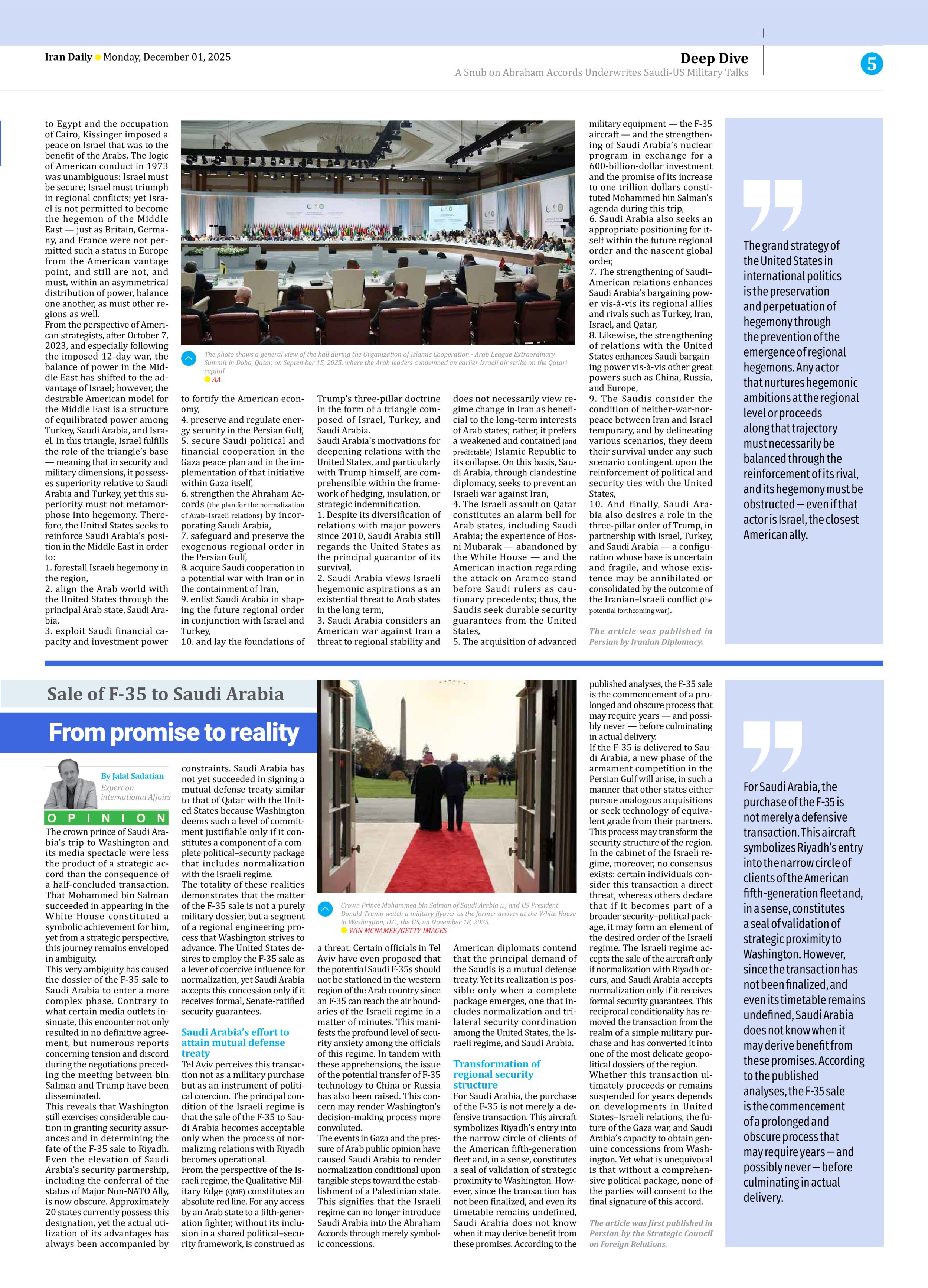
The crown prince of Saudi Arabia’s trip to Washington and its media spectacle were less the product of a strategic accord than the consequence of a half-concluded transaction. That Mohammed bin Salman succeeded in appearing in the White House constituted a symbolic achievement for him, yet from a strategic perspective, this journey remains enveloped in ambiguity.
This very ambiguity has caused the dossier of the F-35 sale to Saudi Arabia to enter a more complex phase. Contrary to what certain media outlets insinuate, this encounter not only resulted in no definitive agreement, but numerous reports concerning tension and discord during the negotiations preceding the meeting between bin Salman and Trump have been disseminated.
This reveals that Washington still exercises considerable caution in granting security assurances and in determining the fate of the F-35 sale to Riyadh. Even the elevation of Saudi Arabia’s security partnership, including the conferral of the status of Major Non-NATO Ally, is now obscure. Approximately 20 states currently possess this designation, yet the actual utilization of its advantages has always been accompanied by constraints. Saudi Arabia has not yet succeeded in signing a mutual defense treaty similar to that of Qatar with the United States because Washington deems such a level of commitment justifiable only if it constitutes a component of a complete political–security package that includes normalization with the Israeli regime.
The totality of these realities demonstrates that the matter of the F-35 sale is not a purely military dossier, but a segment of a regional engineering process that Washington strives to advance. The United States desires to employ the F-35 sale as a lever of coercive influence for normalization, yet Saudi Arabia accepts this concession only if it receives formal, Senate-ratified security guarantees.
Saudi Arabia’s effort to attain mutual defense treaty
Tel Aviv perceives this transaction not as a military purchase but as an instrument of political coercion. The principal condition of the Israeli regime is that the sale of the F-35 to Saudi Arabia becomes acceptable only when the process of normalizing relations with Riyadh becomes operational.
From the perspective of the Israeli regime, the Qualitative Military Edge (QME) constitutes an absolute red line. For any access by an Arab state to a fifth-generation fighter, without its inclusion in a shared political–security framework, is construed as a threat. Certain officials in Tel Aviv have even proposed that the potential Saudi F-35s should not be stationed in the western region of the Arab country since an F-35 can reach the air boundaries of the Israeli regime in a matter of minutes. This manifests the profound level of security anxiety among the officials of this regime. In tandem with these apprehensions, the issue of the potential transfer of F-35 technology to China or Russia has also been raised. This concern may render Washington’s decision-making process more convoluted.
The events in Gaza and the pressure of Arab public opinion have caused Saudi Arabia to render normalization conditional upon tangible steps toward the establishment of a Palestinian state. This signifies that the Israeli regime can no longer introduce Saudi Arabia into the Abraham Accords through merely symbolic concessions.
American diplomats contend that the principal demand of the Saudis is a mutual defense treaty. Yet its realization is possible only when a complete package emerges, one that includes normalization and trilateral security coordination among the United States, the Israeli regime, and Saudi Arabia.
Transformation of regional security structure
For Saudi Arabia, the purchase of the F-35 is not merely a defensive transaction. This aircraft symbolizes Riyadh’s entry into the narrow circle of clients of the American fifth-generation fleet and, in a sense, constitutes a seal of validation of strategic proximity to Washington. However, since the transaction has not been finalized, and even its timetable remains undefined, Saudi Arabia does not know when it may derive benefit from these promises. According to the published analyses, the F-35 sale is the commencement of a prolonged and obscure process that may require years — and possibly never — before culminating in actual delivery.
If the F-35 is delivered to Saudi Arabia, a new phase of the armament competition in the Persian Gulf will arise, in such a manner that other states either pursue analogous acquisitions or seek technology of equivalent grade from their partners. This process may transform the security structure of the region.
In the cabinet of the Israeli regime, moreover, no consensus exists: certain individuals consider this transaction a direct threat, whereas others declare that if it becomes part of a broader security–political package, it may form an element of the desired order of the Israeli regime. The Israeli regime accepts the sale of the aircraft only if normalization with Riyadh occurs, and Saudi Arabia accepts normalization only if it receives formal security guarantees. This reciprocal conditionality has removed the transaction from the realm of a simple military purchase and has converted it into one of the most delicate geopolitical dossiers of the region.
Whether this transaction ultimately proceeds or remains suspended for years depends on developments in United States–Israeli relations, the future of the Gaza war, and Saudi Arabia’s capacity to obtain genuine concessions from Washington. Yet what is unequivocal is that without a comprehensive political package, none of the parties will consent to the final signature of this accord.
The article was first published in Persian by the Strategic Council on Foreign Relations.