







What does West desire from Iran?
By Reza Fazlali
Expert on Middle Eastern affairs
The most fundamental rationale for the establishment of the United Nations was the pursuit of human rights concerns. The Second World War and matters associated with genocide impelled a global consensus to engender a new organ that would avert the recurrence of analogous tragedies in the future. This foundational logic, which entrusted the Security Council with mechanisms to shape a transformed architecture for the future, designated global peace and international security of the human community as its universal referent.
Regrettably, this mechanism demonstrated over time, amid numerous crises, that it lacked the requisite efficacy in practice. Owing to the structure and configuration of the voting rights of the victorious and powerful states of that war, a deliberate or inadvertent conflict between legitimacy and law, on one side, and the extant reality of international interactions, on the other, emerged within this organization, thereby calling into question the sustainable administration of global order and security. To such an extent that if the international order does not conform to the desirable interests of the great powers endowed with voting prerogatives (veto), even if it lacks legitimacy among the public opinion of nations, it will not be affirmed or will not endure, due to various inequitable obstructions, without other states possessing any consequential influence in practice.
Hence, the world sought an alternative trajectory for transformation within the purgatorial condition of the status quo. As James Rosenau asserted, an order exists within disorder, and its reason lies in the conduct and decisions of actors — actors who neither perceive nor heed others. Unfortunately, no rule or functioning system has possessed the capacity to transcend this turbulence and global crisis, at least within the past 25 years.
The event of October 7, 2023, after two years and with an indeterminate agreement, and likewise the assault of Israel and the United States against Iran, revealed with greater clarity the passivity and inaction of global authorities, particularly the United Nations.
Circumstances for Iran after October 7, although perhaps endowed with certain strengths, may simultaneously contain vulnerabilities. Until the position of Iran within Middle-Eastern developments is regulated in a desirable fashion, suitable conditions for the global powers in the region will likewise remain unattainable. I am convinced that at present, the West does not intend to steer Iran toward narratives akin to the collapse of Libya or Syria since Iran’s disarray would engender the diffusion of unrest and tumult into its surroundings and even increase global energy prices. For this reason, although Trump conducts military assaults against Iran and intermittently does not refrain from threats in his rhetoric, he extends, in Sharm el-Sheikh, Egypt, an overt hand of amity toward Iran in a manifest contradiction between the logic of international relations and the logic of international law.
Consequently, I believe the trajectory that has commenced regarding Iran cannot, except in particular unanticipated circumstances, be halted or altered, and international organizations and secondary powers cannot, in practice, effectuate any outcome. Despite the profuse divergences between Europe and the United States (though regarding Iran, they possess no divergence), one of the conditions set by the European powers for delaying the initiation of the snapback mechanism was direct negotiation and agreement with the United States.
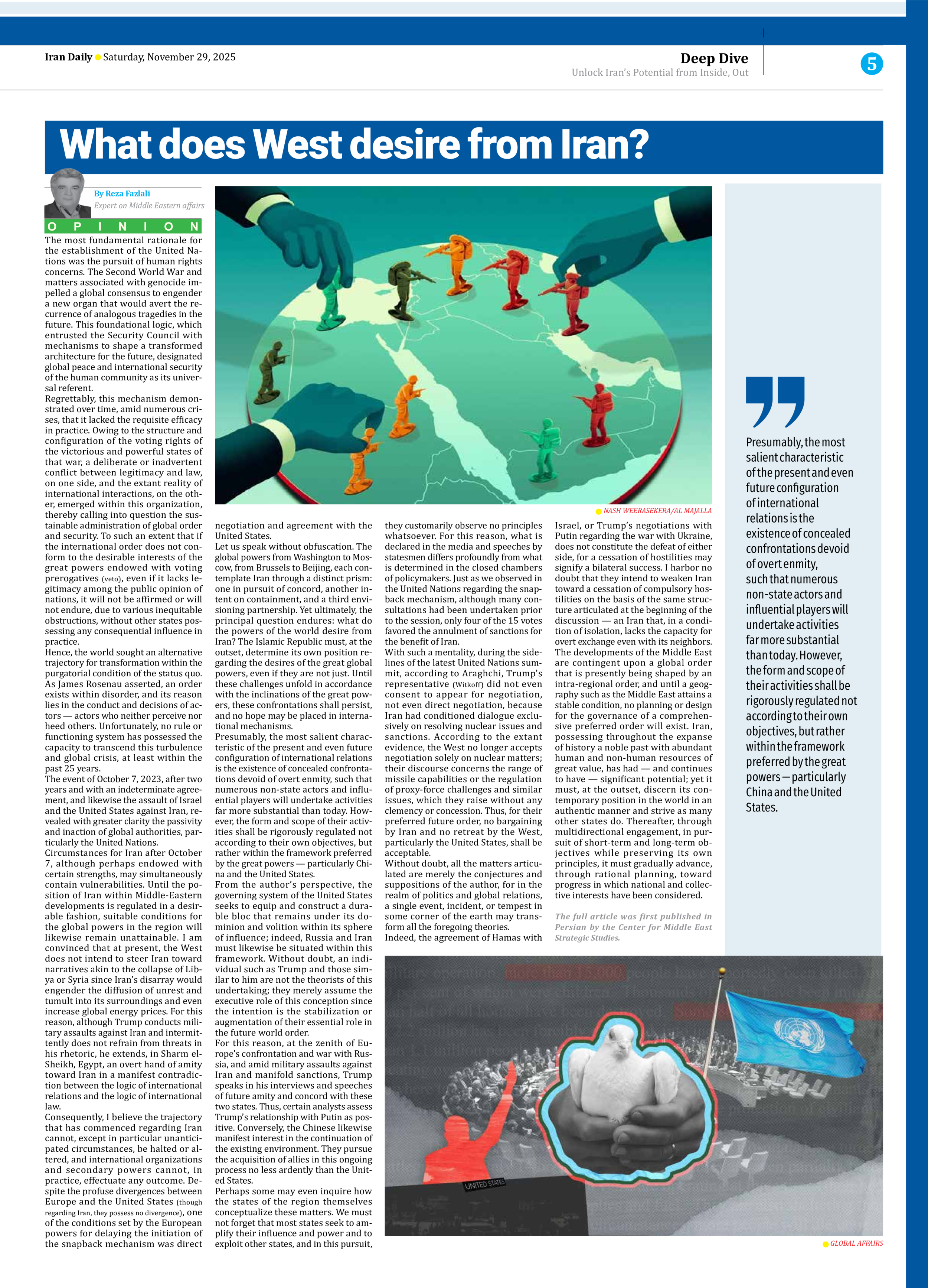
Let us speak without obfuscation. The global powers from Washington to Moscow, from Brussels to Beijing, each contemplate Iran through a distinct prism: one in pursuit of concord, another intent on containment, and a third envisioning partnership. Yet ultimately, the principal question endures: what do the powers of the world desire from Iran? The Islamic Republic must, at the outset, determine its own position regarding the desires of the great global powers, even if they are not just. Until these challenges unfold in accordance with the inclinations of the great powers, these confrontations shall persist, and no hope may be placed in international mechanisms.
Presumably, the most salient characteristic of the present and even future configuration of international relations is the existence of concealed confrontations devoid of overt enmity, such that numerous non-state actors and influential players will undertake activities far more substantial than today. However, the form and scope of their activities shall be rigorously regulated not according to their own objectives, but rather within the framework preferred by the great powers — particularly China and the United States.
From the author’s perspective, the governing system of the United States seeks to equip and construct a durable bloc that remains under its dominion and volition within its sphere of influence; indeed, Russia and Iran must likewise be situated within this framework. Without doubt, an individual such as Trump and those similar to him are not the theorists of this undertaking; they merely assume the executive role of this conception since the intention is the stabilization or augmentation of their essential role in the future world order.
For this reason, at the zenith of Europe’s confrontation and war with Russia, and amid military assaults against Iran and manifold sanctions, Trump speaks in his interviews and speeches of future amity and concord with these two states. Thus, certain analysts assess Trump’s relationship with Putin as positive. Conversely, the Chinese likewise manifest interest in the continuation of the existing environment. They pursue the acquisition of allies in this ongoing process no less ardently than the United States.
Perhaps some may even inquire how the states of the region themselves conceptualize these matters. We must not forget that most states seek to amplify their influence and power and to exploit other states, and in this pursuit, they customarily observe no principles whatsoever. For this reason, what is declared in the media and speeches by statesmen differs profoundly from what is determined in the closed chambers of policymakers. Just as we observed in the United Nations regarding the snapback mechanism, although many consultations had been undertaken prior to the session, only four of the 15 votes favored the annulment of sanctions for the benefit of Iran.
With such a mentality, during the sidelines of the latest United Nations summit, according to Araghchi, Trump’s representative (Witkoff) did not even consent to appear for negotiation, not even direct negotiation, because Iran had conditioned dialogue exclusively on resolving nuclear issues and sanctions. According to the extant evidence, the West no longer accepts negotiation solely on nuclear matters; their discourse concerns the range of missile capabilities or the regulation of proxy-force challenges and similar issues, which they raise without any clemency or concession. Thus, for their preferred future order, no bargaining by Iran and no retreat by the West, particularly the United States, shall be acceptable.
Without doubt, all the matters articulated are merely the conjectures and suppositions of the author, for in the realm of politics and global relations, a single event, incident, or tempest in some corner of the earth may transform all the foregoing theories.
Indeed, the agreement of Hamas with Israel, or Trump’s negotiations with Putin regarding the war with Ukraine, does not constitute the defeat of either side, for a cessation of hostilities may signify a bilateral success. I harbor no doubt that they intend to weaken Iran toward a cessation of compulsory hostilities on the basis of the same structure articulated at the beginning of the discussion — an Iran that, in a condition of isolation, lacks the capacity for overt exchange even with its neighbors.
The developments of the Middle East are contingent upon a global order that is presently being shaped by an intra-regional order, and until a geography such as the Middle East attains a stable condition, no planning or design for the governance of a comprehensive preferred order will exist. Iran, possessing throughout the expanse of history a noble past with abundant human and non-human resources of great value, has had — and continues to have — significant potential; yet it must, at the outset, discern its contemporary position in the world in an authentic manner and strive as many other states do. Thereafter, through multidirectional engagement, in pursuit of short-term and long-term objectives while preserving its own principles, it must gradually advance, through rational planning, toward progress in which national and collective interests have been considered.
The full article was first published in
Persian by the Center for Middle East
Strategic Studies.