





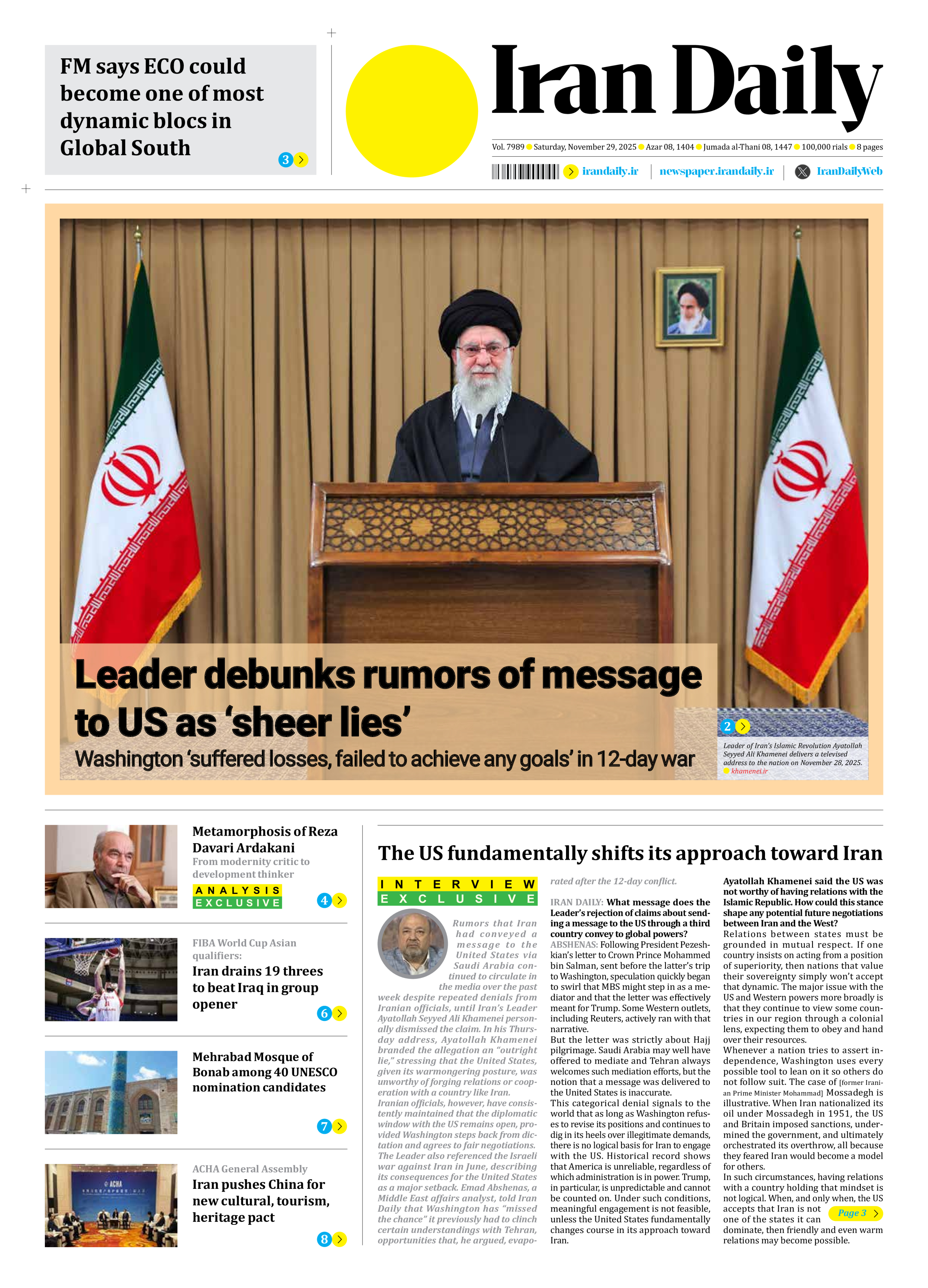


The US fundamentally shifts its approach toward Iran
Rumors that Iran had conveyed a message to the United States via Saudi Arabia continued to circulate in the media over the past week despite repeated denials from Iranian officials, until Iran’s Leader Ayatollah Seyyed Ali Khamenei personally dismissed the claim. In his Thursday address, Ayatollah Khamenei branded the allegation an “outright lie,” stressing that the United States, given its warmongering posture, was unworthy of forging relations or cooperation with a country like Iran.
Iranian officials, however, have consistently maintained that the diplomatic window with the US remains open, provided Washington steps back from dictation and agrees to fair negotiations.
The Leader also referenced the Israeli war against Iran in June, describing its consequences for the United States as a major setback. Emad Abshenas, a Middle East affairs analyst, told Iran Daily that Washington has “missed the chance” it previously had to clinch certain understandings with Tehran, opportunities that, he argued, evaporated after the 12-day conflict.
IRAN DAILY: What message does the Leader’s rejection of claims about sending a message to the US through a third country convey to global powers?
ABSHENAS: Following President Pezeshkian’s letter to Crown Prince Mohammed bin Salman, sent before the latter’s trip to Washington, speculation quickly began to swirl that MBS might step in as a mediator and that the letter was effectively meant for Trump. Some Western outlets, including Reuters, actively ran with that narrative.
But the letter was strictly about Hajj pilgrimage. Saudi Arabia may well have offered to mediate and Tehran always welcomes such mediation efforts, but the notion that a message was delivered to the United States is inaccurate.
This categorical denial signals to the world that as long as Washington refuses to revise its positions and continues to dig in its heels over illegitimate demands, there is no logical basis for Iran to engage with the US. Historical record shows that America is unreliable, regardless of which administration is in power. Trump, in particular, is unpredictable and cannot be counted on. Under such conditions, meaningful engagement is not feasible, unless the United States fundamentally changes course in its approach toward Iran.
Ayatollah Khamenei said the US was not worthy of having relations with the Islamic Republic. How could this stance shape any potential future negotiations between Iran and the West?
Relations between states must be grounded in mutual respect. If one country insists on acting from a position of superiority, then nations that value their sovereignty simply won’t accept that dynamic. The major issue with the US and Western powers more broadly is that they continue to view some countries in our region through a colonial lens, expecting them to obey and hand over their resources.
Whenever a nation tries to assert independence, Washington uses every possible tool to lean on it so others do not follow suit. The case of [former Iranian Prime Minister Mohammad] Mossadegh is illustrative. When Iran nationalized its oil under Mossadegh in 1951, the US and Britain imposed sanctions, undermined the government, and ultimately orchestrated its overthrow, all because they feared Iran would become a model for others.
In such circumstances, having relations with a country holding that mindset is not logical. When, and only when, the US accepts that Iran is not one of the states it can dominate, then friendly and even warm relations may become possible.
Page 3