







Iranian museums gain global recognition through education, innovation, and cultural diplomacy
By Hamideh Hosseini
Staff writer
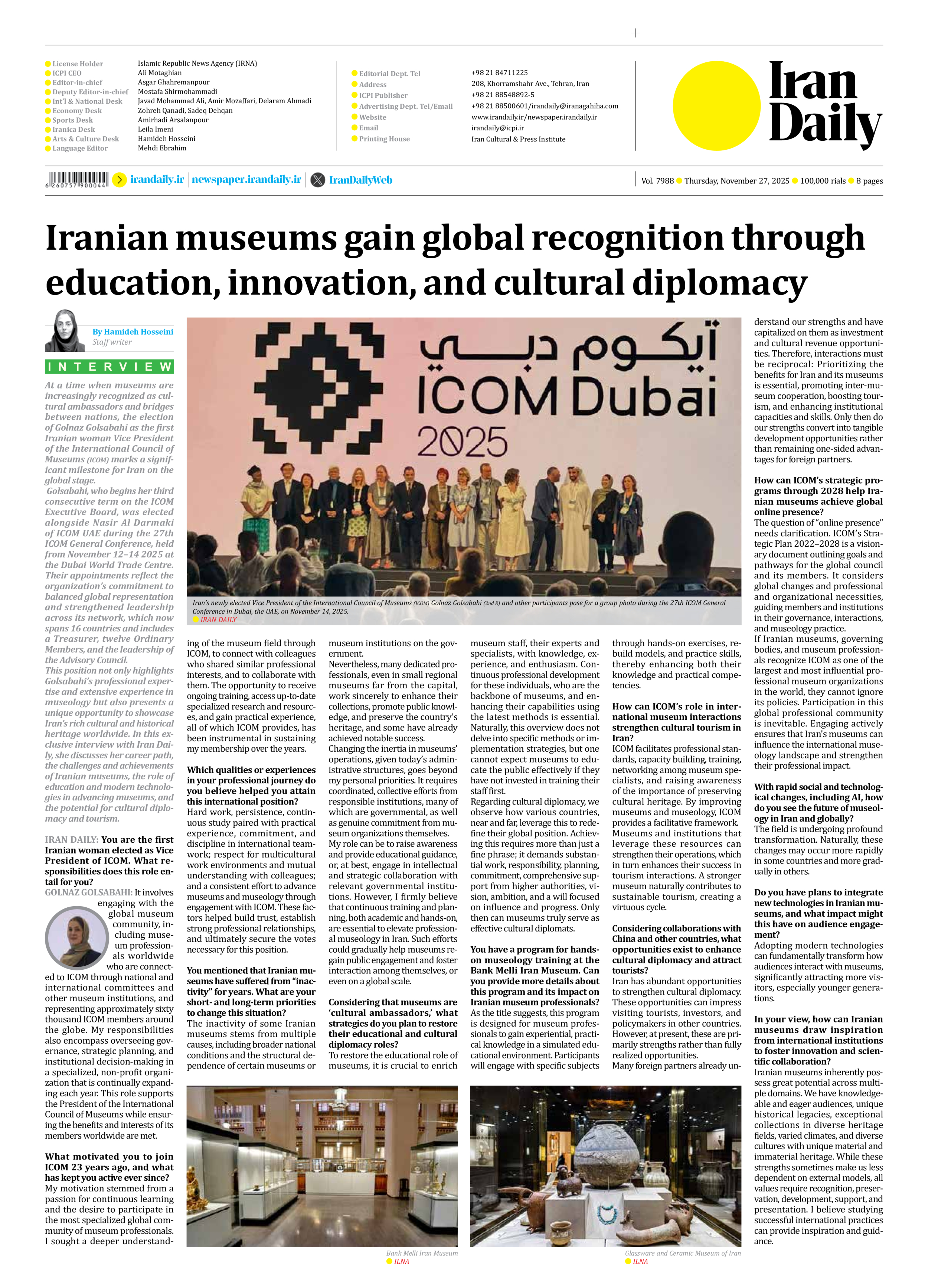
At a time when museums are increasingly recognized as cultural ambassadors and bridges between nations, the election of Golnaz Golsabahi as the first Iranian woman Vice President of the International Council of Museums (ICOM) marks a significant milestone for Iran on the global stage.
Golsabahi, who begins her third consecutive term on the ICOM Executive Board, was elected alongside Nasir Al Darmaki of ICOM UAE during the 27th ICOM General Conference, held from November 12–14 2025 at the Dubai World Trade Centre. Their appointments reflect the organization’s commitment to balanced global representation and strengthened leadership across its network, which now spans 16 countries and includes a Treasurer, twelve Ordinary Members, and the leadership of the Advisory Council.
This position not only highlights Golsabahi’s professional expertise and extensive experience in museology but also presents a unique opportunity to showcase Iran’s rich cultural and historical heritage worldwide. In this exclusive interview with Iran Daily, she discusses her career path, the challenges and achievements of Iranian museums, the role of education and modern technologies in advancing museums, and the potential for cultural diplomacy and tourism.
IRAN DAILY: You are the first Iranian woman elected as Vice President of ICOM. What responsibilities does this role entail for you?
GOLNAZ GOLSABAHI: It involves engaging with the global museum community, including museum professionals worldwide who are connected to ICOM through national and international committees and other museum institutions, and representing approximately sixty thousand ICOM members around the globe. My responsibilities also encompass overseeing governance, strategic planning, and institutional decision-making in a specialized, non-profit organization that is continually expanding each year. This role supports the President of the International Council of Museums while ensuring the benefits and interests of its members worldwide are met.
What motivated you to join ICOM 23 years ago, and what has kept you active ever since?
My motivation stemmed from a passion for continuous learning and the desire to participate in the most specialized global community of museum professionals. I sought a deeper understanding of the museum field through ICOM, to connect with colleagues who shared similar professional interests, and to collaborate with them. The opportunity to receive ongoing training, access up-to-date specialized research and resources, and gain practical experience, all of which ICOM provides, has been instrumental in sustaining my membership over the years.
Which qualities or experiences in your professional journey do you believe helped you attain this international position?
Hard work, persistence, continuous study paired with practical experience, commitment, and discipline in international teamwork; respect for multicultural work environments and mutual understanding with colleagues; and a consistent effort to advance museums and museology through engagement with ICOM. These factors helped build trust, establish strong professional relationships, and ultimately secure the votes necessary for this position.
You mentioned that Iranian museums have suffered from “inactivity” for years. What are your short- and long-term priorities to change this situation?
The inactivity of some Iranian museums stems from multiple causes, including broader national conditions and the structural dependence of certain museums or museum institutions on the government.
Nevertheless, many dedicated professionals, even in small regional museums far from the capital, work sincerely to enhance their collections, promote public knowledge, and preserve the country’s heritage, and some have already achieved notable success.
Changing the inertia in museums’ operations, given today’s administrative structures, goes beyond my personal priorities. It requires coordinated, collective efforts from responsible institutions, many of which are governmental, as well as genuine commitment from museum organizations themselves.
My role can be to raise awareness and provide educational guidance, or, at best, engage in intellectual and strategic collaboration with relevant governmental institutions. However, I firmly believe that continuous training and planning, both academic and hands-on, are essential to elevate professional museology in Iran. Such efforts could gradually help museums regain public engagement and foster interaction among themselves, or even on a global scale.
Considering that museums are ‘cultural ambassadors,’ what strategies do you plan to restore their educational and cultural diplomacy roles?
To restore the educational role of museums, it is crucial to enrich museum staff, their experts and specialists, with knowledge, experience, and enthusiasm. Continuous professional development for these individuals, who are the backbone of museums, and enhancing their capabilities using the latest methods is essential. Naturally, this overview does not delve into specific methods or implementation strategies, but one cannot expect museums to educate the public effectively if they have not invested in training their staff first.
Regarding cultural diplomacy, we observe how various countries, near and far, leverage this to redefine their global position. Achieving this requires more than just a fine phrase; it demands substantial work, responsibility, planning, commitment, comprehensive support from higher authorities, vision, ambition, and a will focused on influence and progress. Only then can museums truly serve as effective cultural diplomats.
You have a program for hands-on museology training at the Bank Melli Iran Museum. Can you provide more details about this program and its impact on Iranian museum professionals?
As the title suggests, this program is designed for museum professionals to gain experiential, practical knowledge in a simulated educational environment. Participants will engage with specific subjects through hands-on exercises, rebuild models, and practice skills, thereby enhancing both their knowledge and practical competencies.
How can ICOM’s role in international museum interactions strengthen cultural tourism in Iran?
ICOM facilitates professional standards, capacity building, training, networking among museum specialists, and raising awareness of the importance of preserving cultural heritage. By improving museums and museology, ICOM provides a facilitative framework.
Museums and institutions that leverage these resources can strengthen their operations, which in turn enhances their success in tourism interactions. A stronger museum naturally contributes to sustainable tourism, creating a virtuous cycle.
Considering collaborations with China and other countries, what opportunities exist to enhance cultural diplomacy and attract tourists?
Iran has abundant opportunities to strengthen cultural diplomacy. These opportunities can impress visiting tourists, investors, and policymakers in other countries. However, at present, these are primarily strengths rather than fully realized opportunities.
Many foreign partners already understand our strengths and have capitalized on them as investment and cultural revenue opportunities. Therefore, interactions must be reciprocal: Prioritizing the benefits for Iran and its museums is essential, promoting inter-museum cooperation, boosting tourism, and enhancing institutional capacities and skills. Only then do our strengths convert into tangible development opportunities rather than remaining one-sided advantages for foreign partners.
How can ICOM’s strategic programs through 2028 help Iranian museums achieve global online presence?
The question of “online presence” needs clarification. ICOM’s Strategic Plan 2022–2028 is a visionary document outlining goals and pathways for the global council and its members. It considers global changes and professional and organizational necessities, guiding members and institutions in their governance, interactions, and museology practice.
If Iranian museums, governing bodies, and museum professionals recognize ICOM as one of the largest and most influential professional museum organizations in the world, they cannot ignore its policies. Participation in this global professional community is inevitable. Engaging actively ensures that Iran’s museums can influence the international museology landscape and strengthen their professional impact.
With rapid social and technological changes, including AI, how do you see the future of museology in Iran and globally?
The field is undergoing profound transformation. Naturally, these changes may occur more rapidly in some countries and more gradually in others.
Do you have plans to integrate new technologies in Iranian museums, and what impact might this have on audience engagement?
Adopting modern technologies can fundamentally transform how audiences interact with museums, significantly attracting more visitors, especially younger generations.
In your view, how can Iranian museums draw inspiration from international institutions to foster innovation and scientific collaboration?
Iranian museums inherently possess great potential across multiple domains. We have knowledgeable and eager audiences, unique historical legacies, exceptional collections in diverse heritage fields, varied climates, and diverse cultures with unique material and immaterial heritage. While these strengths sometimes make us less dependent on external models, all values require recognition, preservation, development, support, and presentation. I believe studying successful international practices can provide inspiration and guidance.