







Kuwait can act as Iran’s gateway to Arab markets, GCC: Joint chamber
By Sadeq Dehqan
Staff writer
The vice president of the Iran-Kuwait Joint Chamber of Commerce lauded on Wednesday the high capacity of trade between the two countries, stressing that Kuwait can serve as Iran's gateway to Arab markets and the Persian Gulf Cooperation Council (GCC)’s member states.
Arash Nikpey told Iran Daily that the volume of exchanges between the two sides can be increased to approximately 1 billion dollars, which is more than three times the current volume.
“The potential for trade between Iran and Kuwait, if the land route is facilitated, a joint committee is formed, and administrative obstacles are removed, can increase from the current 300 million dollars to 1 billion dollars within two to three years,” Nikpey said.
Pointing to the fact that the Kuwaiti market is thirsty for high-quality Iranian products, he stated, “Due to Kuwait's need for various products, Kuwait's imports from other countries amount to over 52 billion dollars annually. However, Iran's share of the Kuwaiti market is very small and has much room for growth. Iran, with its strong industry, agriculture, and services, as well as skilled workforce, can have a higher share of Kuwait's import market, especially in food security, technical services, and construction.”
Nikpey underlined that the lack of a direct land route between Iran and Kuwait, as well as visa issuance challenges, are among the serious and main obstacles to the development of trade exchanges.
“Despite Iran being on the other side of the Persian Gulf, Iran and Kuwait do not share a common land border; therefore, for cargo transportation, there are only three existing routes, each facing challenges,” he said.
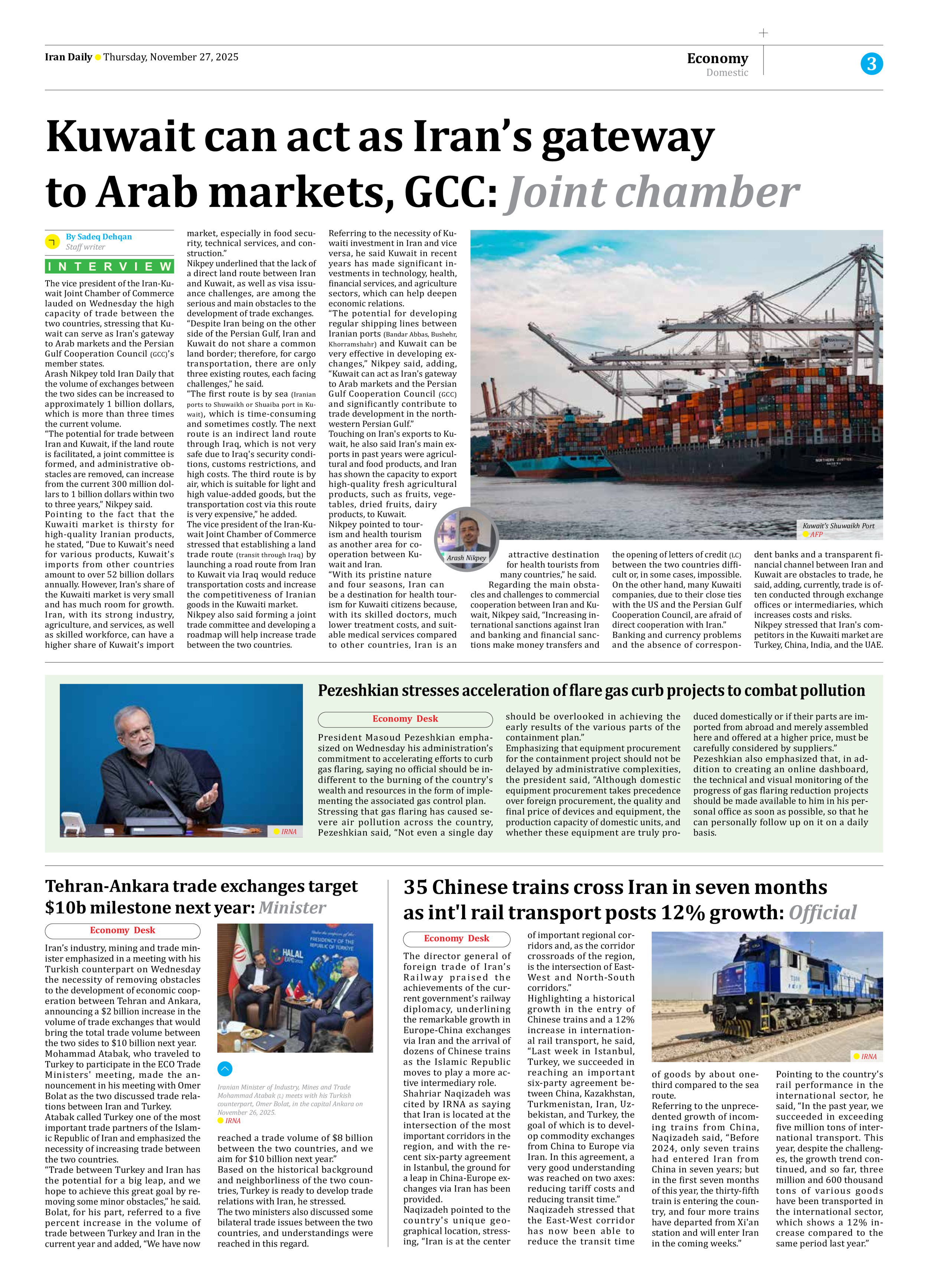
“The first route is by sea (Iranian ports to Shuwaikh or Shuaiba port in Kuwait), which is time-consuming and sometimes costly. The next route is an indirect land route through Iraq, which is not very safe due to Iraq's security conditions, customs restrictions, and high costs. The third route is by air, which is suitable for light and high value-added goods, but the transportation cost via this route is very expensive,” he added.
The vice president of the Iran-Kuwait Joint Chamber of Commerce stressed that establishing a land trade route (transit through Iraq) by launching a road route from Iran to Kuwait via Iraq would reduce transportation costs and increase the competitiveness of Iranian goods in the Kuwaiti market.
Nikpey also said forming a joint trade committee and developing a roadmap will help increase trade between the two countries.
Referring to the necessity of Kuwaiti investment in Iran and vice versa, he said Kuwait in recent years has made significant investments in technology, health, financial services, and agriculture sectors, which can help deepen economic relations.
“The potential for developing regular shipping lines between Iranian ports (Bandar Abbas, Bushehr, Khorramshahr) and Kuwait can be very effective in developing exchanges,” Nikpey said, adding, “Kuwait can act as Iran's gateway to Arab markets and the Persian Gulf Cooperation Council (GCC) and significantly contribute to trade development in the northwestern Persian Gulf.”
Touching on Iran's exports to Kuwait, he also said Iran's main exports in past years were agricultural and food products, and Iran has shown the capacity to export high-quality fresh agricultural products, such as fruits, vegetables, dried fruits, dairy products, to Kuwait.
Nikpey pointed to tourism and health tourism as another area for cooperation between Kuwait and Iran.
“With its pristine nature and four seasons, Iran can be a destination for health tourism for Kuwaiti citizens because, with its skilled doctors, much lower treatment costs, and suitable medical services compared to other countries, Iran is an attractive destination for health tourists from many countries,” he said.
Regarding the main obstacles and challenges to commercial cooperation between Iran and Kuwait, Nikpey said, “Increasing international sanctions against Iran and banking and financial sanctions make money transfers and the opening of letters of credit (LC) between the two countries difficult or, in some cases, impossible. On the other hand, many Kuwaiti companies, due to their close ties with the US and the Persian Gulf Cooperation Council, are afraid of direct cooperation with Iran.”
Banking and currency problems and the absence of correspondent banks and a transparent financial channel between Iran and Kuwait are obstacles to trade, he said, adding, currently, trade is often conducted through exchange offices or intermediaries, which increases costs and risks.
Nikpey stressed that Iran's competitors in the Kuwaiti market are Turkey, China, India, and the UAE.