







Is high-level Iran–Pakistan security cooperation possible?
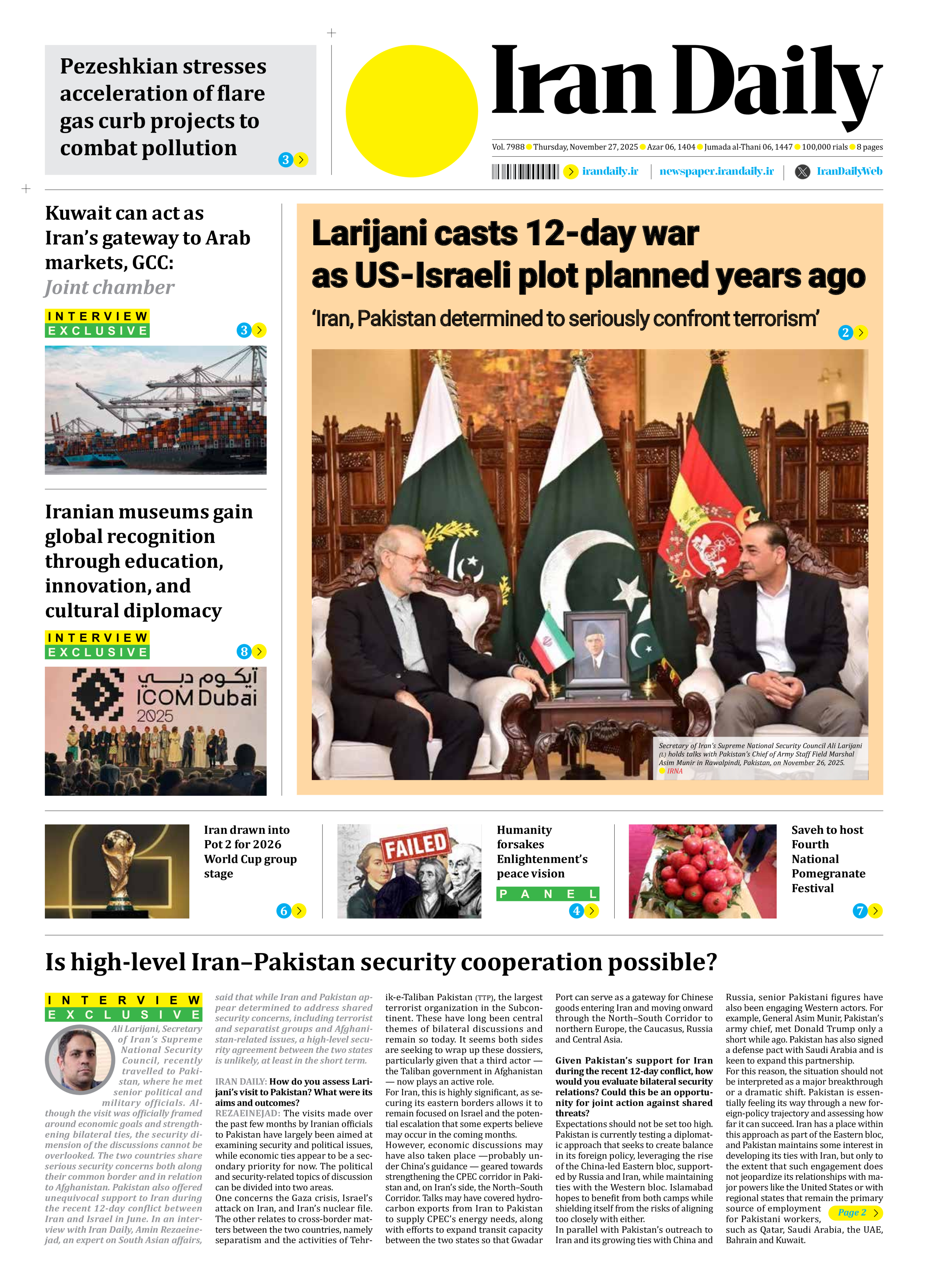
Ali Larijani, Secretary of Iran’s Supreme National Security Council, recently travelled to Pakistan, where he met senior political and military officials. Although the visit was officially framed around economic goals and strengthening bilateral ties, the security dimension of the discussions cannot be overlooked. The two countries share serious security concerns both along their common border and in relation to Afghanistan. Pakistan also offered unequivocal support to Iran during the recent 12-day conflict between Iran and Israel in June. In an interview with Iran Daily, Amin Rezaeinejad, an expert on South Asian affairs, said that while Iran and Pakistan appear determined to address shared security concerns, including terrorist and separatist groups and Afghanistan-related issues, a high-level security agreement between the two states is unlikely, at least in the short term.
IRAN DAILY: How do you assess Larijani’s visit to Pakistan? What were its aims and outcomes?
REZAEINEJAD: The visits made over the past few months by Iranian officials to Pakistan have largely been aimed at examining security and political issues, while economic ties appear to be a secondary priority for now. The political and security-related topics of discussion can be divided into two areas.
One concerns the Gaza crisis, Israel’s attack on Iran, and Iran’s nuclear file. The other relates to cross-border matters between the two countries, namely separatism and the activities of Tehrik-e-Taliban Pakistan (TTP), the largest terrorist organization in the Subcontinent. These have long been central themes of bilateral discussions and remain so today. It seems both sides are seeking to wrap up these dossiers, particularly given that a third actor — the Taliban government in Afghanistan — now plays an active role.
For Iran, this is highly significant, as securing its eastern borders allows it to remain focused on Israel and the potential escalation that some experts believe may occur in the coming months.
However, economic discussions may have also taken place —probably under China’s guidance — geared towards strengthening the CPEC corridor in Pakistan and, on Iran’s side, the North–South Corridor. Talks may have covered hydrocarbon exports from Iran to Pakistan to supply CPEC’s energy needs, along with efforts to expand transit capacity between the two states so that Gwadar Port can serve as a gateway for Chinese goods entering Iran and moving onward through the North–South Corridor to northern Europe, the Caucasus, Russia and Central Asia.
Given Pakistan’s support for Iran during the recent 12-day conflict, how would you evaluate bilateral security relations? Could this be an opportunity for joint action against shared threats?
Expectations should not be set too high. Pakistan is currently testing a diplomatic approach that seeks to create balance in its foreign policy, leveraging the rise of the China-led Eastern bloc, supported by Russia and Iran, while maintaining ties with the Western bloc. Islamabad hopes to benefit from both camps while shielding itself from the risks of aligning too closely with either.
In parallel with Pakistan’s outreach to Iran and its growing ties with China and Russia, senior Pakistani figures have also been engaging Western actors. For example, General Asim Munir, Pakistan’s army chief, met Donald Trump only a short while ago. Pakistan has also signed a defense pact with Saudi Arabia and is keen to expand this partnership.
For this reason, the situation should not be interpreted as a major breakthrough or a dramatic shift. Pakistan is essentially feeling its way through a new foreign-policy trajectory and assessing how far it can succeed. Iran has a place within this approach as part of the Eastern bloc, and Pakistan maintains some interest in developing its ties with Iran, but only to the extent that such engagement does not jeopardize its relationships with major powers like the United States or with regional states that remain the primary source of employment for Pakistani workers, such as Qatar, Saudi Arabia, the UAE, Bahrain and Kuwait.
Page 2