







Iran’s Bahmanyar aiming to build on Riyadh success at World Championships
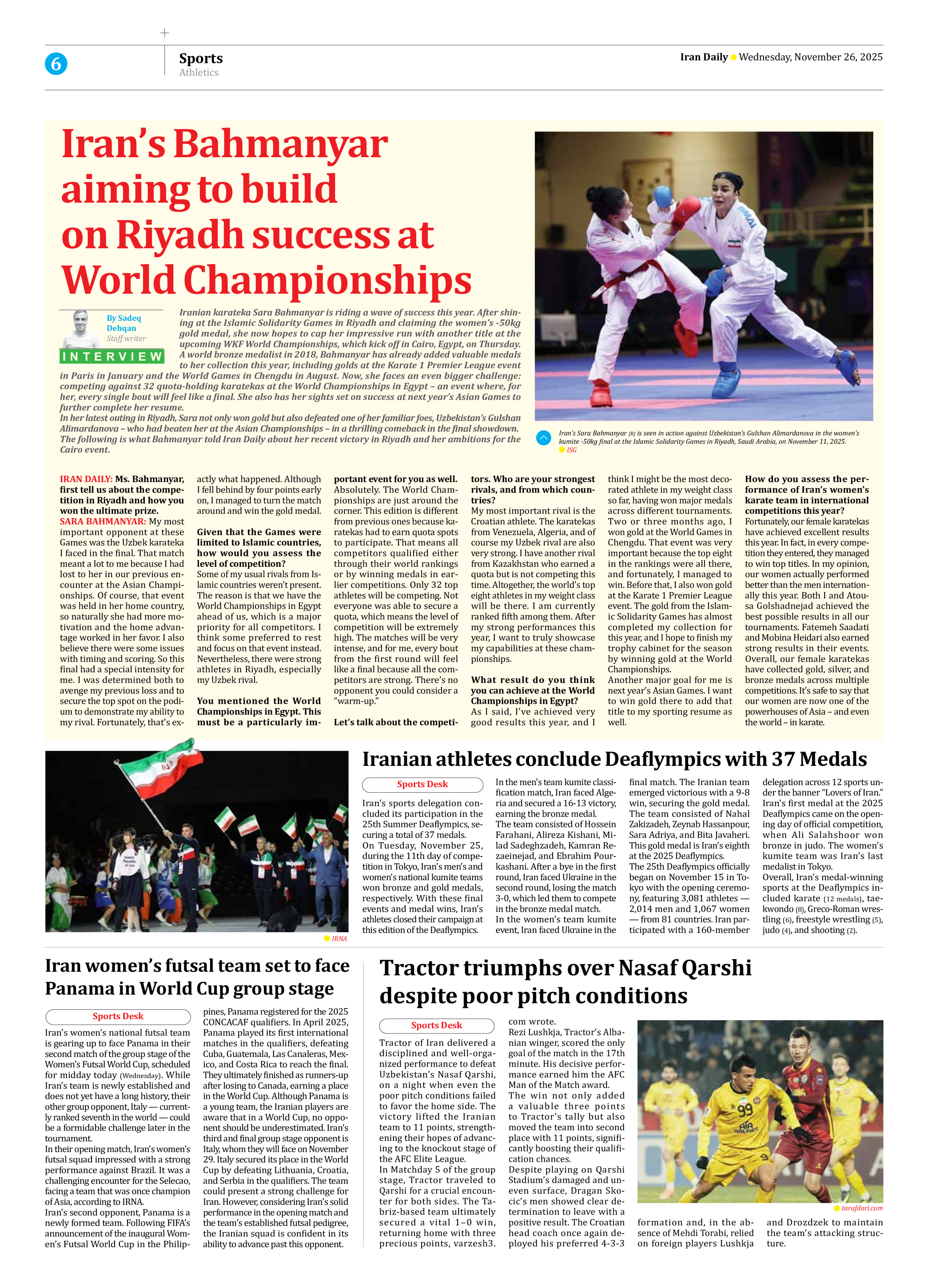
Iranian karateka Sara Bahmanyar is riding a wave of success this year. After shining at the Islamic Solidarity Games in Riyadh and claiming the women’s -50kg gold medal, she now hopes to cap her impressive run with another title at the upcoming WKF World Championships, which kick off in Cairo, Egypt, on Thursday. A world bronze medalist in 2018, Bahmanyar has already added valuable medals to her collection this year, including golds at the Karate 1 Premier League event in Paris in January and the World Games in Chengdu in August. Now, she faces an even bigger challenge: competing against 32 quota-holding karatekas at the World Championships in Egypt – an event where, for her, every single bout will feel like a final. She also has her sights set on success at next year’s Asian Games to further complete her resume. In her latest outing in Riyadh, Sara not only won gold but also defeated one of her familiar foes, Uzbekistan’s Gulshan Alimardanova – who had beaten her at the Asian Championships – in a thrilling comeback in the final showdown. The following is what Bahmanyar told Iran Daily about her recent victory in Riyadh and her ambitions for the Cairo event.
By Sadeq Dehqan
Staff writer
IRAN DAILY: Ms. Bahmanyar, first tell us about the competition in Riyadh and how you won the ultimate prize.
SARA BAHMANYAR: My most important opponent at these Games was the Uzbek karateka I faced in the final. That match meant a lot to me because I had lost to her in our previous encounter at the Asian Championships. Of course, that event was held in her home country, so naturally she had more motivation and the home advantage worked in her favor. I also believe there were some issues with timing and scoring. So this final had a special intensity for me. I was determined both to avenge my previous loss and to secure the top spot on the podium to demonstrate my ability to my rival. Fortunately, that’s exactly what happened. Although I fell behind by four points early on, I managed to turn the match around and win the gold medal.
Given that the Games were limited to Islamic countries, how would you assess the level of competition?
Some of my usual rivals from Islamic countries weren’t present. The reason is that we have the World Championships in Egypt ahead of us, which is a major priority for all competitors. I think some preferred to rest and focus on that event instead. Nevertheless, there were strong athletes in Riyadh, especially my Uzbek rival.
You mentioned the World Championships in Egypt. This must be a particularly important event for you as well.
Absolutely. The World Championships are just around the corner. This edition is different from previous ones because karatekas had to earn quota spots to participate. That means all competitors qualified either through their world rankings or by winning medals in earlier competitions. Only 32 top athletes will be competing. Not everyone was able to secure a quota, which means the level of competition will be extremely high. The matches will be very intense, and for me, every bout from the first round will feel like a final because all the competitors are strong. There’s no opponent you could consider a “warm-up.”
Let’s talk about the competitors. Who are your strongest rivals, and from which countries?
My most important rival is the Croatian athlete. The karatekas from Venezuela, Algeria, and of course my Uzbek rival are also very strong. I have another rival from Kazakhstan who earned a quota but is not competing this time. Altogether, the world’s top eight athletes in my weight class will be there. I am currently ranked fifth among them. After my strong performances this year, I want to truly showcase my capabilities at these championships.
What result do you think you can achieve at the World Championships in Egypt?
As I said, I’ve achieved very good results this year, and I think I might be the most decorated athlete in my weight class so far, having won major medals across different tournaments. Two or three months ago, I won gold at the World Games in Chengdu. That event was very important because the top eight in the rankings were all there, and fortunately, I managed to win. Before that, I also won gold at the Karate 1 Premier League event. The gold from the Islamic Solidarity Games has almost completed my collection for this year, and I hope to finish my trophy cabinet for the season by winning gold at the World Championships.
Another major goal for me is next year’s Asian Games. I want to win gold there to add that title to my sporting resume as well.
How do you assess the performance of Iran’s women’s karate team in international competitions this year?
Fortunately, our female karatekas have achieved excellent results this year. In fact, in every competition they entered, they managed to win top titles. In my opinion, our women actually performed better than the men internationally this year. Both I and Atousa Golshadnejad achieved the best possible results in all our tournaments. Fatemeh Saadati and Mobina Heidari also earned strong results in their events. Overall, our female karatekas have collected gold, silver, and bronze medals across multiple competitions. It’s safe to say that our women are now one of the powerhouses of Asia – and even the world – in karate.