





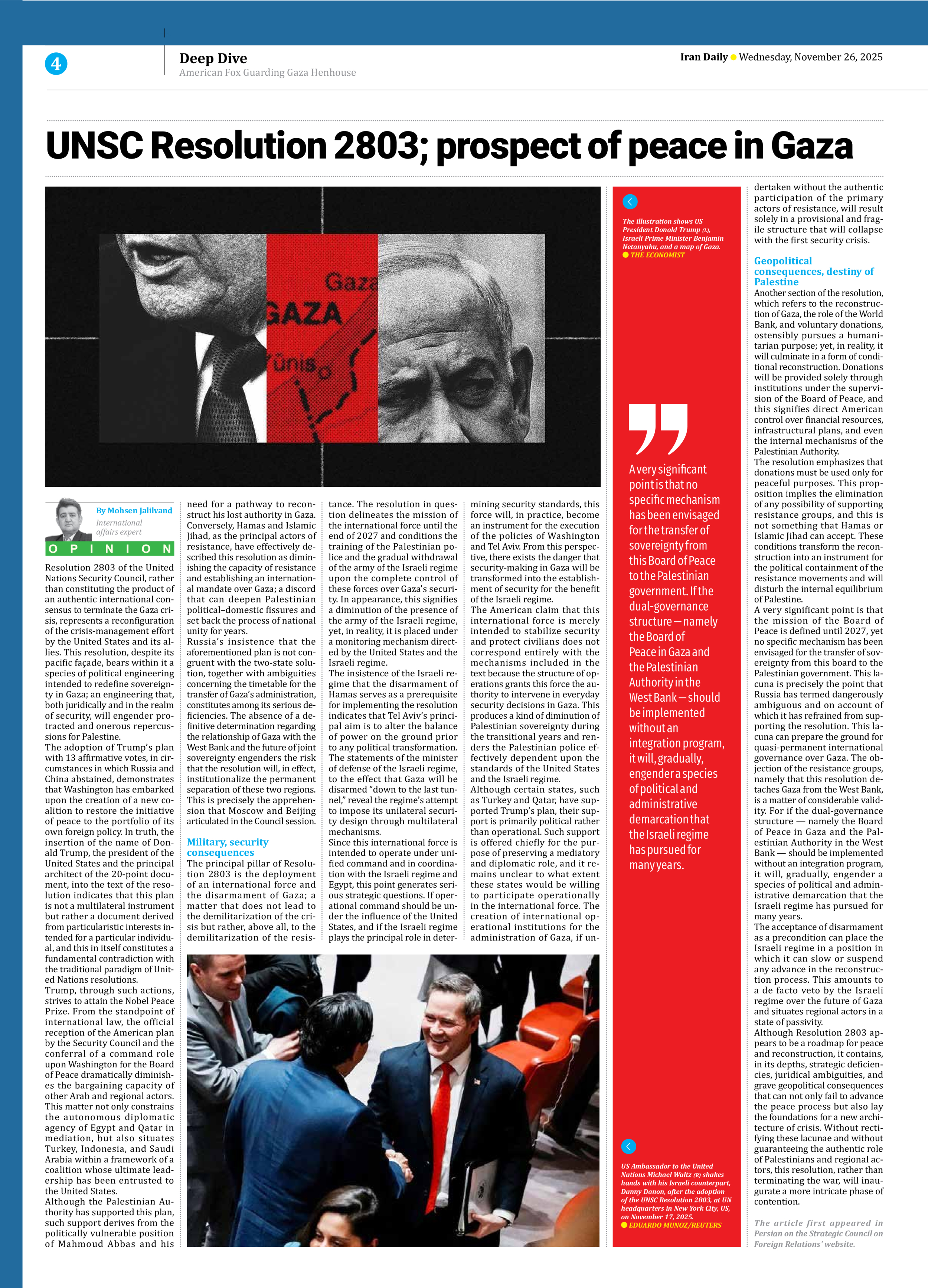


UNSC Resolution 2803; prospect of peace in Gaza
By Mohsen Jalilvand
International
affairs expert
Resolution 2803 of the United Nations Security Council, rather than constituting the product of an authentic international consensus to terminate the Gaza crisis, represents a reconfiguration of the crisis-management effort by the United States and its allies. This resolution, despite its pacific façade, bears within it a species of political engineering intended to redefine sovereignty in Gaza; an engineering that, both juridically and in the realm of security, will engender protracted and onerous repercussions for Palestine.
The adoption of Trump’s plan with 13 affirmative votes, in circumstances in which Russia and China abstained, demonstrates that Washington has embarked upon the creation of a new coalition to restore the initiative of peace to the portfolio of its own foreign policy. In truth, the insertion of the name of Donald Trump, the president of the United States and the principal architect of the 20-point document, into the text of the resolution indicates that this plan is not a multilateral instrument but rather a document derived from particularistic interests intended for a particular individual, and this in itself constitutes a fundamental contradiction with the traditional paradigm of United Nations resolutions.
Trump, through such actions, strives to attain the Nobel Peace Prize. From the standpoint of international law, the official reception of the American plan by the Security Council and the conferral of a command role upon Washington for the Board of Peace dramatically diminishes the bargaining capacity of other Arab and regional actors. This matter not only constrains the autonomous diplomatic agency of Egypt and Qatar in mediation, but also situates Turkey, Indonesia, and Saudi Arabia within a framework of a coalition whose ultimate leadership has been entrusted to the United States.
Although the Palestinian Authority has supported this plan, such support derives from the politically vulnerable position of Mahmoud Abbas and his need for a pathway to reconstruct his lost authority in Gaza. Conversely, Hamas and Islamic Jihad, as the principal actors of resistance, have effectively described this resolution as diminishing the capacity of resistance and establishing an international mandate over Gaza; a discord that can deepen Palestinian political–domestic fissures and set back the process of national unity for years.
Russia’s insistence that the aforementioned plan is not congruent with the two-state solution, together with ambiguities concerning the timetable for the transfer of Gaza’s administration, constitutes among its serious deficiencies. The absence of a definitive determination regarding the relationship of Gaza with the West Bank and the future of joint sovereignty engenders the risk that the resolution will, in effect, institutionalize the permanent separation of these two regions. This is precisely the apprehension that Moscow and Beijing articulated in the Council session.
Military, security consequences
The principal pillar of Resolution 2803 is the deployment of an international force and the disarmament of Gaza; a matter that does not lead to the demilitarization of the crisis but rather, above all, to the demilitarization of the resistance. The resolution in question delineates the mission of the international force until the end of 2027 and conditions the training of the Palestinian police and the gradual withdrawal of the army of the Israeli regime upon the complete control of these forces over Gaza’s security. In appearance, this signifies a diminution of the presence of the army of the Israeli regime, yet, in reality, it is placed under a monitoring mechanism directed by the United States and the Israeli regime.
The insistence of the Israeli regime that the disarmament of Hamas serves as a prerequisite for implementing the resolution indicates that Tel Aviv’s principal aim is to alter the balance of power on the ground prior to any political transformation. The statements of the minister of defense of the Israeli regime, to the effect that Gaza will be disarmed “down to the last tunnel,” reveal the regime’s attempt to impose its unilateral security design through multilateral mechanisms.
Since this international force is intended to operate under unified command and in coordination with the Israeli regime and Egypt, this point generates serious strategic questions. If operational command should be under the influence of the United States, and if the Israeli regime plays the principal role in determining security standards, this force will, in practice, become an instrument for the execution of the policies of Washington and Tel Aviv. From this perspective, there exists the danger that security-making in Gaza will be transformed into the establishment of security for the benefit of the Israeli regime.
The American claim that this international force is merely intended to stabilize security and protect civilians does not correspond entirely with the mechanisms included in the text because the structure of operations grants this force the authority to intervene in everyday security decisions in Gaza. This produces a kind of diminution of Palestinian sovereignty during the transitional years and renders the Palestinian police effectively dependent upon the standards of the United States and the Israeli regime.
Although certain states, such as Turkey and Qatar, have supported Trump’s plan, their support is primarily political rather than operational. Such support is offered chiefly for the purpose of preserving a mediatory and diplomatic role, and it remains unclear to what extent these states would be willing to participate operationally in the international force. The creation of international operational institutions for the administration of Gaza, if undertaken without the authentic participation of the primary actors of resistance, will result solely in a provisional and fragile structure that will collapse with the first security crisis.
Geopolitical consequences, destiny of Palestine
Another section of the resolution, which refers to the reconstruction of Gaza, the role of the World Bank, and voluntary donations, ostensibly pursues a humanitarian purpose; yet, in reality, it will culminate in a form of conditional reconstruction. Donations will be provided solely through institutions under the supervision of the Board of Peace, and this signifies direct American control over financial resources, infrastructural plans, and even the internal mechanisms of the Palestinian Authority.
The resolution emphasizes that donations must be used only for peaceful purposes. This proposition implies the elimination of any possibility of supporting resistance groups, and this is not something that Hamas or Islamic Jihad can accept. These conditions transform the reconstruction into an instrument for the political containment of the resistance movements and will disturb the internal equilibrium of Palestine.
A very significant point is that the mission of the Board of Peace is defined until 2027, yet no specific mechanism has been envisaged for the transfer of sovereignty from this board to the Palestinian government. This lacuna is precisely the point that Russia has termed dangerously ambiguous and on account of which it has refrained from supporting the resolution. This lacuna can prepare the ground for quasi-permanent international governance over Gaza. The objection of the resistance groups, namely that this resolution detaches Gaza from the West Bank, is a matter of considerable validity. For if the dual-governance structure — namely the Board of Peace in Gaza and the Palestinian Authority in the West Bank — should be implemented without an integration program, it will, gradually, engender a species of political and administrative demarcation that the Israeli regime has pursued for many years.
The acceptance of disarmament as a precondition can place the Israeli regime in a position in which it can slow or suspend any advance in the reconstruction process. This amounts to a de facto veto by the Israeli regime over the future of Gaza and situates regional actors in a state of passivity.
Although Resolution 2803 appears to be a roadmap for peace and reconstruction, it contains, in its depths, strategic deficiencies, juridical ambiguities, and grave geopolitical consequences that can not only fail to advance the peace process but also lay the foundations for a new architecture of crisis. Without rectifying these lacunae and without guaranteeing the authentic role of Palestinians and regional actors, this resolution, rather than terminating the war, will inaugurate a more intricate phase of contention.
The article first appeared in
Persian on the Strategic Council on Foreign Relations' website.