





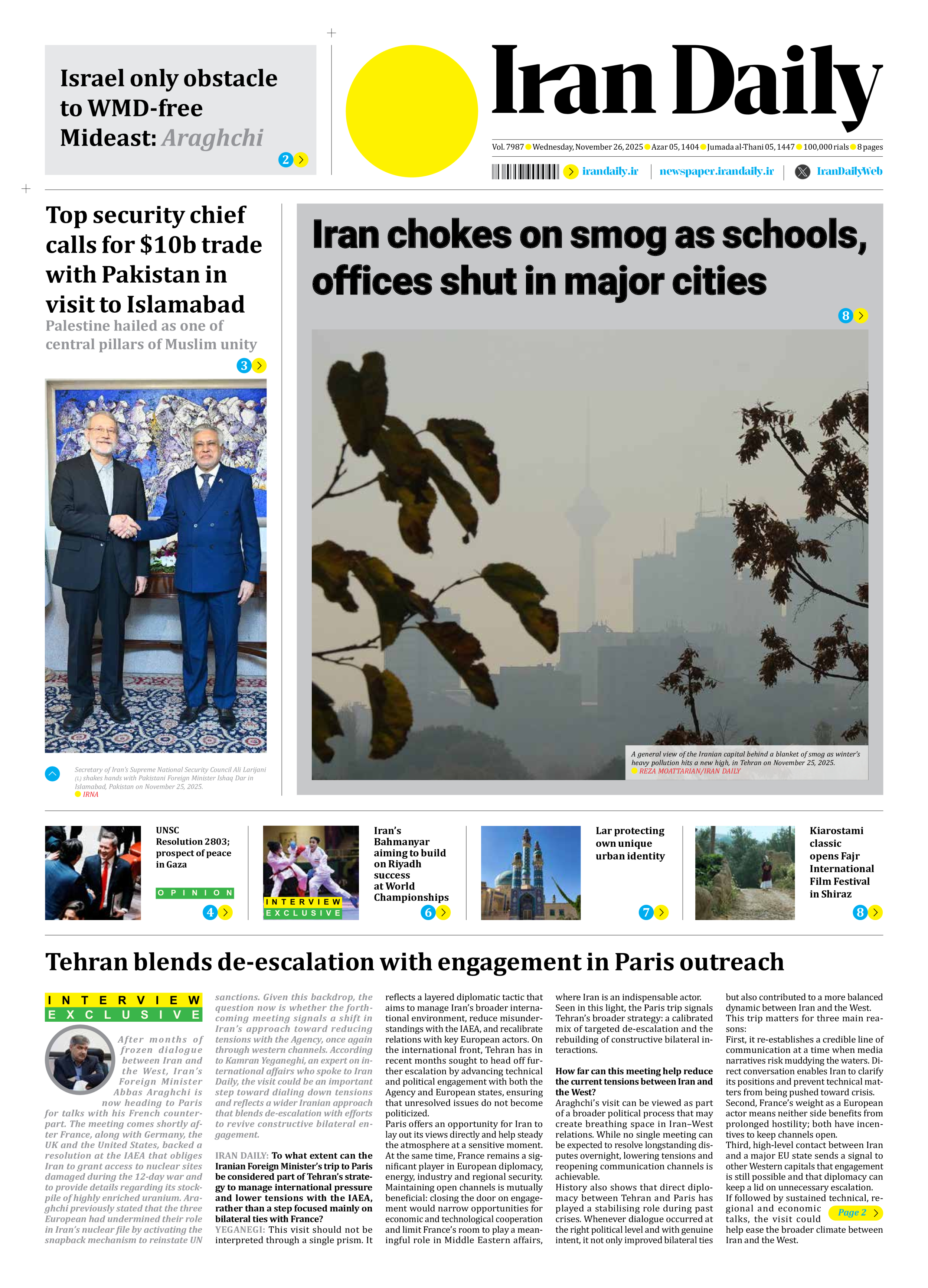


Tehran blends de-escalation with engagement in Paris outreach
After months of frozen dialogue between Iran and the West, Iran’s Foreign Minister Abbas Araghchi is now heading to Paris for talks with his French counterpart. The meeting comes shortly after France, along with Germany, the UK and the United States, backed a resolution at the IAEA that obliges Iran to grant access to nuclear sites damaged during the 12-day war and to provide details regarding its stockpile of highly enriched uranium. Araghchi previously stated that the three European had undermined their role in Iran’s nuclear file by activating the snapback mechanism to reinstate UN sanctions. Given this backdrop, the question now is whether the forthcoming meeting signals a shift in Iran’s approach toward reducing tensions with the Agency, once again through western channels. According to Kamran Yeganeghi, an expert on international affairs who spoke to Iran Daily, the visit could be an important step toward dialing down tensions and reflects a wider Iranian approach that blends de-escalation with efforts to revive constructive bilateral engagement.
IRAN DAILY: To what extent can the Iranian Foreign Minister’s trip to Paris be considered part of Tehran’s strategy to manage international pressure and lower tensions with the IAEA, rather than a step focused mainly on bilateral ties with France?
YEGANEGI: This visit should not be interpreted through a single prism. It reflects a layered diplomatic tactic that aims to manage Iran’s broader international environment, reduce misunderstandings with the IAEA, and recalibrate relations with key European actors. On the international front, Tehran has in recent months sought to head off further escalation by advancing technical and political engagement with both the Agency and European states, ensuring that unresolved issues do not become politicized.
Paris offers an opportunity for Iran to lay out its views directly and help steady the atmosphere at a sensitive moment. At the same time, France remains a significant player in European diplomacy, energy, industry and regional security. Maintaining open channels is mutually beneficial: closing the door on engagement would narrow opportunities for economic and technological cooperation and limit France’s room to play a meaningful role in Middle Eastern affairs, where Iran is an indispensable actor.
Seen in this light, the Paris trip signals Tehran’s broader strategy: a calibrated mix of targeted de-escalation and the rebuilding of constructive bilateral interactions.
How far can this meeting help reduce the current tensions between Iran and the West?
Araghchi’s visit can be viewed as part of a broader political process that may create breathing space in Iran–West relations. While no single meeting can be expected to resolve longstanding disputes overnight, lowering tensions and reopening communication channels is achievable.
History also shows that direct diplomacy between Tehran and Paris has played a stabilising role during past crises. Whenever dialogue occurred at the right political level and with genuine intent, it not only improved bilateral ties but also contributed to a more balanced dynamic between Iran and the West.
This trip matters for three main reasons:
First, it re-establishes a credible line of communication at a time when media narratives risk muddying the waters. Direct conversation enables Iran to clarify its positions and prevent technical matters from being pushed toward crisis.
Second, France’s weight as a European actor means neither side benefits from prolonged hostility; both have incentives to keep channels open.
Third, high-level contact between Iran and a major EU state sends a signal to other Western capitals that engagement is still possible and that diplomacy can keep a lid on unnecessary escalation.
If followed by sustained technical, regional and economic talks, the visit could help ease the broader climate between Iran and the West.
Page 2