







Inside musical ‘Oliver Twist’ with its director
No shortcuts in theater, grand productions demand big commitment
By Hamideh Hosseini
Staff writer
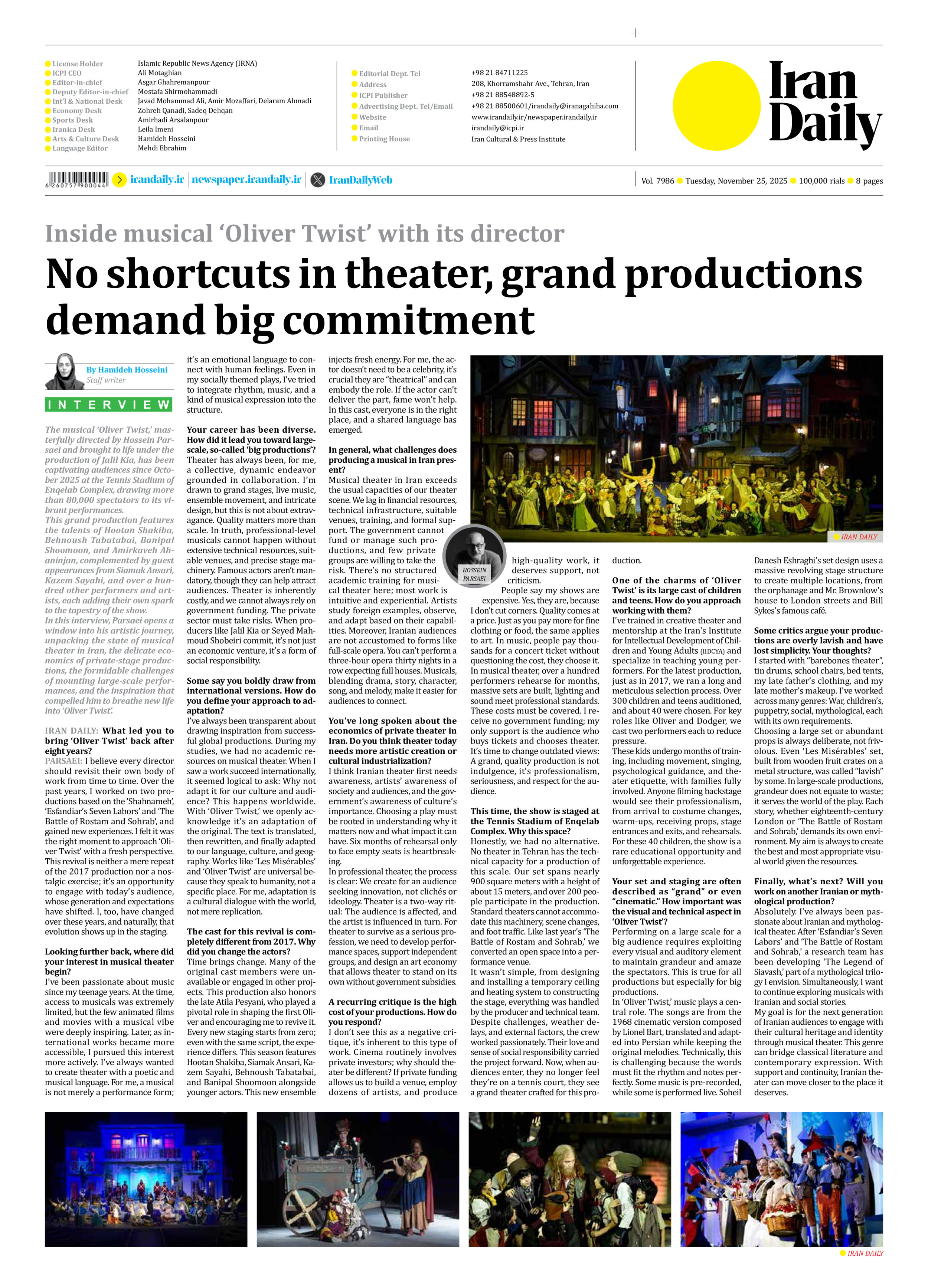
The musical ‘Oliver Twist,’ masterfully directed by Hossein Parsaei and brought to life under the production of Jalil Kia, has been captivating audiences since October 2025 at the Tennis Stadium of Enqelab Complex, drawing more than 80,000 spectators to its vibrant performances.
This grand production features the talents of Hootan Shakiba, Behnoush Tabatabai, Banipal Shoomoon, and Amirkaveh Ahaninjan, complemented by guest appearances from Siamak Ansari, Kazem Sayahi, and over a hundred other performers and artists, each adding their own spark to the tapestry of the show.
In this interview, Parsaei opens a window into his artistic journey, unpacking the state of musical theater in Iran, the delicate economics of private-stage productions, the formidable challenges of mounting large-scale performances, and the inspiration that compelled him to breathe new life into ‘Oliver Twist’.
IRAN DAILY: What led you to bring ‘Oliver Twist’ back after eight years?
PARSAEI: I believe every director should revisit their own body of work from time to time. Over the past years, I worked on two productions based on the ‘Shahnameh’, ‘Esfandiar’s Seven Labors’ and ‘The Battle of Rostam and Sohrab’, and gained new experiences. I felt it was the right moment to approach ‘Oliver Twist’ with a fresh perspective. This revival is neither a mere repeat of the 2017 production nor a nostalgic exercise; it’s an opportunity to engage with today’s audience, whose generation and expectations have shifted. I, too, have changed over these years, and naturally, that evolution shows up in the staging.
Looking further back, where did your interest in musical theater begin?
I’ve been passionate about music since my teenage years. At the time, access to musicals was extremely limited, but the few animated films and movies with a musical vibe were deeply inspiring. Later, as international works became more accessible, I pursued this interest more actively. I’ve always wanted to create theater with a poetic and musical language. For me, a musical is not merely a performance form; it’s an emotional language to connect with human feelings. Even in my socially themed plays, I’ve tried to integrate rhythm, music, and a kind of musical expression into the structure.
Your career has been diverse. How did it lead you toward large-scale, so-called ‘big productions’?
Theater has always been, for me, a collective, dynamic endeavor grounded in collaboration. I’m drawn to grand stages, live music, ensemble movement, and intricate design, but this is not about extravagance. Quality matters more than scale. In truth, professional-level musicals cannot happen without extensive technical resources, suitable venues, and precise stage machinery. Famous actors aren’t mandatory, though they can help attract audiences. Theater is inherently costly, and we cannot always rely on government funding. The private sector must take risks. When producers like Jalil Kia or Seyed Mahmoud Shobeiri commit, it’s not just an economic venture, it’s a form of social responsibility.
Some say you boldly draw from international versions. How do you define your approach to adaptation?
I’ve always been transparent about drawing inspiration from successful global productions. During my studies, we had no academic resources on musical theater. When I saw a work succeed internationally, it seemed logical to ask: Why not adapt it for our culture and audience? This happens worldwide. With ‘Oliver Twist,’ we openly acknowledge it’s an adaptation of the original. The text is translated, then rewritten, and finally adapted to our language, culture, and geography. Works like ‘Les Misérables’ and ‘Oliver Twist’ are universal because they speak to humanity, not a specific place. For me, adaptation is a cultural dialogue with the world, not mere replication.
The cast for this revival is completely different from 2017. Why did you change the actors?
Time brings change. Many of the original cast members were unavailable or engaged in other projects. This production also honors the late Atila Pesyani, who played a pivotal role in shaping the first Oliver and encouraging me to revive it. Every new staging starts from zero; even with the same script, the experience differs. This season features Hootan Shakiba, Siamak Ansari, Kazem Sayahi, Behnoush Tabatabai, and Banipal Shoomoon alongside younger actors. This new ensemble injects fresh energy. For me, the actor doesn’t need to be a celebrity, it’s crucial they are “theatrical” and can embody the role. If the actor can’t deliver the part, fame won’t help. In this cast, everyone is in the right place, and a shared language has emerged.
In general, what challenges does producing a musical in Iran present?
Musical theater in Iran exceeds the usual capacities of our theater scene. We lag in financial resources, technical infrastructure, suitable venues, training, and formal support. The government cannot fund or manage such productions, and few private groups are willing to take the risk. There’s no structured academic training for musical theater here; most work is intuitive and experiential. Artists study foreign examples, observe, and adapt based on their capabilities. Moreover, Iranian audiences are not accustomed to forms like full-scale opera. You can’t perform a three-hour opera thirty nights in a row expecting full houses. Musicals, blending drama, story, character, song, and melody, make it easier for audiences to connect.
You’ve long spoken about the economics of private theater in Iran. Do you think theater today needs more artistic creation or cultural industrialization?
I think Iranian theater first needs awareness, artists’ awareness of society and audiences, and the government’s awareness of culture’s importance. Choosing a play must be rooted in understanding why it matters now and what impact it can have. Six months of rehearsal only to face empty seats is heartbreaking.
In professional theater, the process is clear: We create for an audience seeking innovation, not clichés or ideology. Theater is a two-way ritual: The audience is affected, and the artist is influenced in turn. For theater to survive as a serious profession, we need to develop performance spaces, support independent groups, and design an art economy that allows theater to stand on its own without government subsidies.
A recurring critique is the high cost of your productions. How do you respond?
I don’t see this as a negative critique, it’s inherent to this type of work. Cinema routinely involves private investors; why should theater be different? If private funding allows us to build a venue, employ dozens of artists, and produce high-quality work, it deserves support, not criticism.
People say my shows are expensive. Yes, they are, because I don’t cut corners. Quality comes at a price. Just as you pay more for fine clothing or food, the same applies to art. In music, people pay thousands for a concert ticket without questioning the cost, they choose it. In musical theater, over a hundred performers rehearse for months, massive sets are built, lighting and sound meet professional standards. These costs must be covered. I receive no government funding; my only support is the audience who buys tickets and chooses theater. It’s time to change outdated views: A grand, quality production is not indulgence, it’s professionalism, seriousness, and respect for the audience.
This time, the show is staged at the Tennis Stadium of Enqelab Complex. Why this space?
Honestly, we had no alternative. No theater in Tehran has the technical capacity for a production of this scale. Our set spans nearly 900 square meters with a height of about 15 meters, and over 200 people participate in the production. Standard theaters cannot accommodate this machinery, scene changes, and foot traffic. Like last year’s ‘The Battle of Rostam and Sohrab,’ we converted an open space into a performance venue.
It wasn’t simple, from designing and installing a temporary ceiling and heating system to constructing the stage, everything was handled by the producer and technical team. Despite challenges, weather delays, and external factors, the crew worked passionately. Their love and sense of social responsibility carried the project forward. Now, when audiences enter, they no longer feel they’re on a tennis court, they see a grand theater crafted for this production.
One of the charms of ‘Oliver Twist’ is its large cast of children and teens. How do you approach working with them?
I’ve trained in creative theater and mentorship at the Iran's Institute for Intellectual Development of Children and Young Adults (IIDCYA) and specialize in teaching young performers. For the latest production, just as in 2017, we ran a long and meticulous selection process. Over 300 children and teens auditioned, and about 40 were chosen. For key roles like Oliver and Dodger, we cast two performers each to reduce pressure.
These kids undergo months of training, including movement, singing, psychological guidance, and theater etiquette, with families fully involved. Anyone filming backstage would see their professionalism, from arrival to costume changes, warm-ups, receiving props, stage entrances and exits, and rehearsals. For these 40 children, the show is a rare educational opportunity and unforgettable experience.
Your set and staging are often described as “grand” or even “cinematic.” How important was the visual and technical aspect in ‘Oliver Twist’?
Performing on a large scale for a big audience requires exploiting every visual and auditory element to maintain grandeur and amaze the spectators. This is true for all productions but especially for big productions.
In ‘Oliver Twist,’ music plays a central role. The songs are from the 1968 cinematic version composed by Lionel Bart, translated and adapted into Persian while keeping the original melodies. Technically, this is challenging because the words must fit the rhythm and notes perfectly. Some music is pre-recorded, while some is performed live. Soheil Danesh Eshraghi’s set design uses a massive revolving stage structure to create multiple locations, from the orphanage and Mr. Brownlow’s house to London streets and Bill Sykes’s famous café.
Some critics argue your productions are overly lavish and have lost simplicity. Your thoughts?
I started with “barebones theater”, tin drums, school chairs, bed tents, my late father’s clothing, and my late mother’s makeup. I’ve worked across many genres: War, children’s, puppetry, social, mythological, each with its own requirements.
Choosing a large set or abundant props is always deliberate, not frivolous. Even ‘Les Misérables’ set, built from wooden fruit crates on a metal structure, was called “lavish” by some. In large-scale productions, grandeur does not equate to waste; it serves the world of the play. Each story, whether eighteenth-century London or ‘The Battle of Rostam and Sohrab,’ demands its own environment. My aim is always to create the best and most appropriate visual world given the resources.
Finally, what’s next? Will you work on another Iranian or mythological production?
Absolutely. I’ve always been passionate about Iranian and mythological theater. After ‘Esfandiar’s Seven Labors’ and ‘The Battle of Rostam and Sohrab,’ a research team has been developing ‘The Legend of Siavash,’ part of a mythological trilogy I envision. Simultaneously, I want to continue exploring musicals with Iranian and social stories.
My goal is for the next generation of Iranian audiences to engage with their cultural heritage and identity through musical theater. This genre can bridge classical literature and contemporary expression. With support and continuity, Iranian theater can move closer to the place it deserves.