







Women rewrote Iranian music
The daily existence of women in Iran is a reflection of the intricate interplay between opportunities and constraints; a milieu that both furnishes the possibility of cultivation and participation and simultaneously confronts structural, social, and cultural challenges. Contemporary women, endowed with diverse roles within the family, the workplace, and society, encounter realities that at times put the constraints in the spotlight and at times exhibit their capabilities and inventiveness. The analysis of these realities not only offers a more exact depiction of the condition of women but also reveals how laws, traditions, and public culture configure their daily lives.
In the early decades following the Islamic Revolution, many women interested in music discovered their future trajectories in the instruction and performance of non-vocal instruments. The piano, violin, santur, and guitar became sanctuaries for young women, enabling them both to articulate their emotions and to obtain an intellectual share of this art within the pedagogical environment.
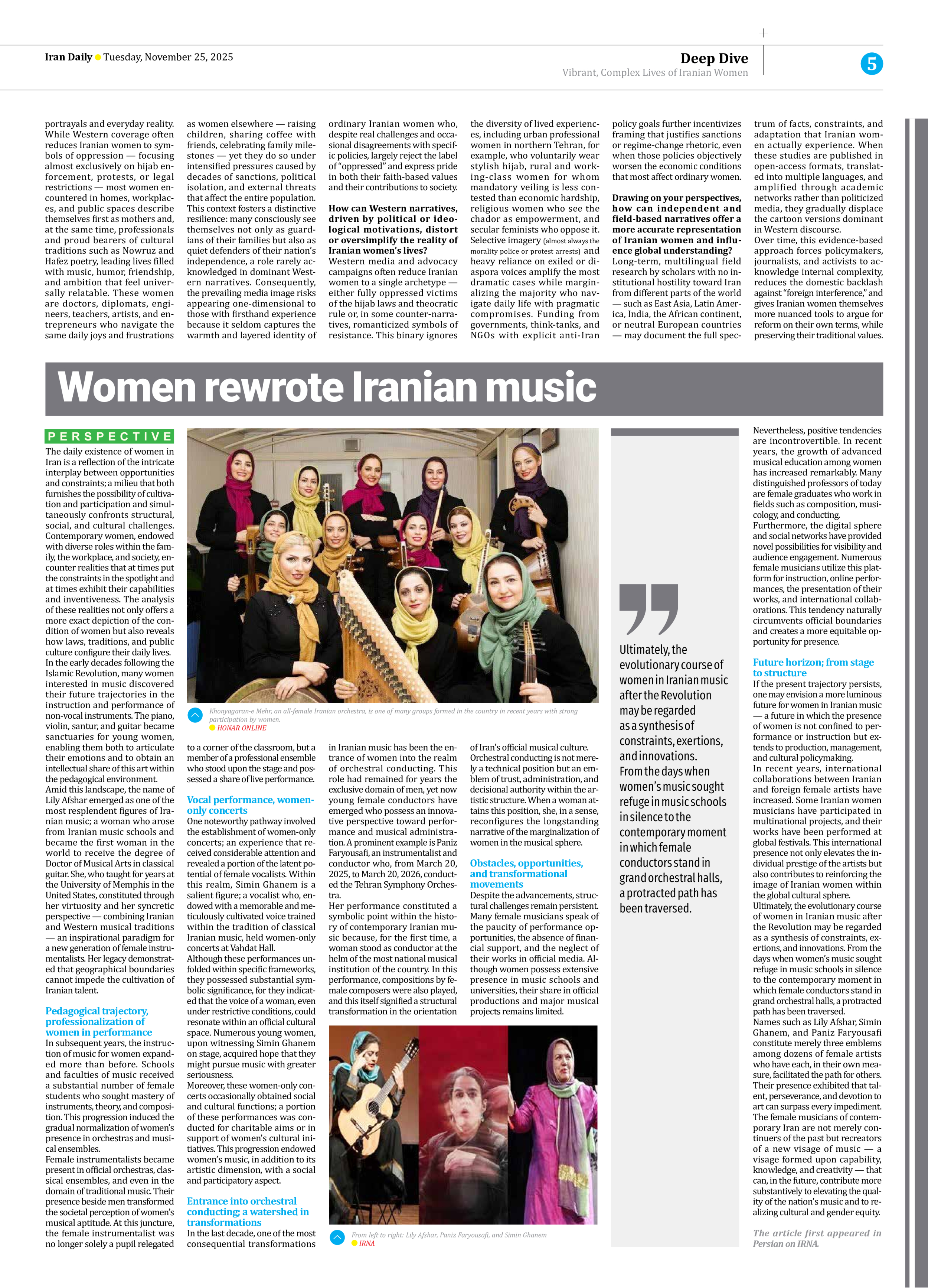
Amid this landscape, the name of Lily Afshar emerged as one of the most resplendent figures of Iranian music; a woman who arose from Iranian music schools and became the first woman in the world to receive the degree of Doctor of Musical Arts in classical guitar. She, who taught for years at the University of Memphis in the United States, constituted through her virtuosity and her syncretic perspective — combining Iranian and Western musical traditions — an inspirational paradigm for a new generation of female instrumentalists. Her legacy demonstrated that geographical boundaries cannot impede the cultivation of Iranian talent.
Pedagogical trajectory, professionalization of women in performance
In subsequent years, the instruction of music for women expanded more than before. Schools and faculties of music received a substantial number of female students who sought mastery of instruments, theory, and composition. This progression induced the gradual normalization of women’s presence in orchestras and musical ensembles.
Female instrumentalists became present in official orchestras, classical ensembles, and even in the domain of traditional music. Their presence beside men transformed the societal perception of women’s musical aptitude. At this juncture, the female instrumentalist was no longer solely a pupil relegated to a corner of the classroom, but a member of a professional ensemble who stood upon the stage and possessed a share of live performance.
Vocal performance, women-only concerts
One noteworthy pathway involved the establishment of women-only concerts; an experience that received considerable attention and revealed a portion of the latent potential of female vocalists. Within this realm, Simin Ghanem is a salient figure; a vocalist who, endowed with a memorable and meticulously cultivated voice trained within the tradition of classical Iranian music, held women-only concerts at Vahdat Hall.
Although these performances unfolded within specific frameworks, they possessed substantial symbolic significance, for they indicated that the voice of a woman, even under restrictive conditions, could resonate within an official cultural space. Numerous young women, upon witnessing Simin Ghanem on stage, acquired hope that they might pursue music with greater seriousness.
Moreover, these women-only concerts occasionally obtained social and cultural functions; a portion of these performances was conducted for charitable aims or in support of women’s cultural initiatives. This progression endowed women’s music, in addition to its artistic dimension, with a social and participatory aspect.
Entrance into orchestral conducting; a watershed in transformations
In the last decade, one of the most consequential transformations in Iranian music has been the entrance of women into the realm of orchestral conducting. This role had remained for years the exclusive domain of men, yet now young female conductors have emerged who possess an innovative perspective toward performance and musical administration. A prominent example is Paniz Faryousafi, an instrumentalist and conductor who, from March 20, 2025, to March 20, 2026, conducted the Tehran Symphony Orchestra.
Her performance constituted a symbolic point within the history of contemporary Iranian music because, for the first time, a woman stood as conductor at the helm of the most national musical institution of the country. In this performance, compositions by female composers were also played, and this itself signified a structural transformation in the orientation of Iran’s official musical culture.
Orchestral conducting is not merely a technical position but an emblem of trust, administration, and decisional authority within the artistic structure. When a woman attains this position, she, in a sense, reconfigures the longstanding narrative of the marginalization of women in the musical sphere.
Obstacles, opportunities, and transformational movements
Despite the advancements, structural challenges remain persistent. Many female musicians speak of the paucity of performance opportunities, the absence of financial support, and the neglect of their works in official media. Although women possess extensive presence in music schools and universities, their share in official productions and major musical projects remains limited.
Nevertheless, positive tendencies are incontrovertible. In recent years, the growth of advanced musical education among women has increased remarkably. Many distinguished professors of today are female graduates who work in fields such as composition, musicology, and conducting.
Furthermore, the digital sphere and social networks have provided novel possibilities for visibility and audience engagement. Numerous female musicians utilize this platform for instruction, online performances, the presentation of their works, and international collaborations. This tendency naturally circumvents official boundaries and creates a more equitable opportunity for presence.
Future horizon; from stage to structure
If the present trajectory persists, one may envision a more luminous future for women in Iranian music — a future in which the presence of women is not confined to performance or instruction but extends to production, management, and cultural policymaking.
In recent years, international collaborations between Iranian and foreign female artists have increased. Some Iranian women musicians have participated in multinational projects, and their works have been performed at global festivals. This international presence not only elevates the individual prestige of the artists but also contributes to reinforcing the image of Iranian women within the global cultural sphere.
Ultimately, the evolutionary course of women in Iranian music after the Revolution may be regarded as a synthesis of constraints, exertions, and innovations. From the days when women’s music sought refuge in music schools in silence to the contemporary moment in which female conductors stand in grand orchestral halls, a protracted path has been traversed.
Names such as Lily Afshar, Simin Ghanem, and Paniz Faryousafi constitute merely three emblems among dozens of female artists who have each, in their own measure, facilitated the path for others. Their presence exhibited that talent, perseverance, and devotion to art can surpass every impediment.
The female musicians of contemporary Iran are not merely continuers of the past but recreators of a new visage of music — a visage formed upon capability, knowledge, and creativity — that can, in the future, contribute more substantively to elevating the quality of the nation’s music and to realizing cultural and gender equity.
The article first appeared in
Persian on IRNA.