







Beyond stereotypes
Dismantling Western fictions about Iranian women
Ecaterina-Elena Matoi is a political and security consultant and a scholar of Middle Eastern politics. Her work bridges academic research, teaching, and policy. She holds two doctorates: one in Near and Middle Eastern Studies from the University of Basel, Switzerland, and another in Intelligence and National Security from the National Defence University in Bucharest, Romania. In this exclusive interview with Iran Daily, Matoi, an independent political and security consultant from Romania, offers a profound and analytical perspective on the portrayal of Iranian women in Western media and institutions. Drawing on field research and the lived experiences of Iranian women, she demonstrates that dominant Western narratives are often selective, incomplete, and one-dimensional. Matoi carefully examines the differences between social, cultural, and political pressures in Iran and external perceptions, emphasizing that Iranian women, grounded in their cultural and religious values, play influential and constructive roles in both family and society. This conversation provides a fresh perspective on the resilience, agency, and multifaceted identities of Iranian women, highlighting how field-based analyses can deliver a far more accurate understanding of their real lives.
By Asgar Ghahremanpour
Editor-in-chief
IRAN DAILY: How do Western media and institutions portray Iranian women, and to what extent does this portrayal align with the social and cultural realities in Iran?
MATOI: Western media and institutions predominantly portray Iranian women through the lens of victimhood — focusing heavily on veiling, restrictions on personal freedoms, and instances of protest or punishment — presenting them as largely oppressed and lacking full agency within a strict patriarchal and theocratic system. This framing, while issues and events, often becomes the dominant and sometimes exclusive narrative, overshadowing all dimensions of Iranian women’s lives and contributions.
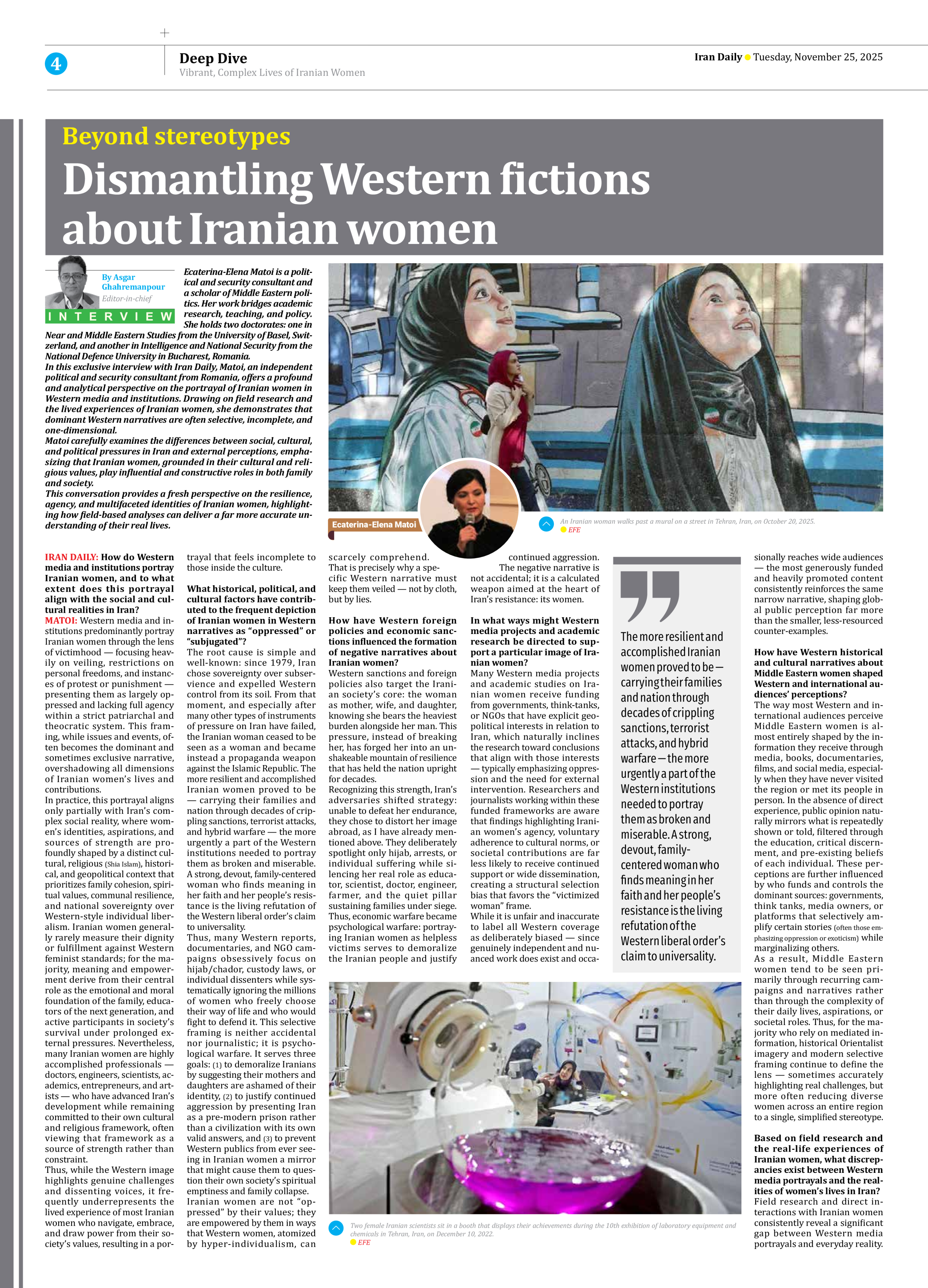
In practice, this portrayal aligns only partially with Iran’s complex social reality, where women’s identities, aspirations, and sources of strength are profoundly shaped by a distinct cultural, religious (Shia Islam), historical, and geopolitical context that prioritizes family cohesion, spiritual values, communal resilience, and national sovereignty over Western-style individual liberalism. Iranian women generally rarely measure their dignity or fulfillment against Western feminist standards; for the majority, meaning and empowerment derive from their central role as the emotional and moral foundation of the family, educators of the next generation, and active participants in society’s survival under prolonged external pressures. Nevertheless, many Iranian women are highly accomplished professionals — doctors, engineers, scientists, academics, entrepreneurs, and artists — who have advanced Iran’s development while remaining committed to their own cultural and religious framework, often viewing that framework as a source of strength rather than constraint.
Thus, while the Western image highlights genuine challenges and dissenting voices, it frequently underrepresents the lived experience of most Iranian women who navigate, embrace, and draw power from their society’s values, resulting in a portrayal that feels incomplete to those inside the culture.
What historical, political, and cultural factors have contributed to the frequent depiction of Iranian women in Western narratives as “oppressed” or “subjugated”?
The root cause is simple and well-known: since 1979, Iran chose sovereignty over subservience and expelled Western control from its soil. From that moment, and especially after many other types of instruments of pressure on Iran have failed, the Iranian woman ceased to be seen as a woman and became instead a propaganda weapon against the Islamic Republic. The more resilient and accomplished Iranian women proved to be — carrying their families and nation through decades of crippling sanctions, terrorist attacks, and hybrid warfare — the more urgently a part of the Western institutions needed to portray them as broken and miserable. A strong, devout, family-centered woman who finds meaning in her faith and her people’s resistance is the living refutation of the Western liberal order’s claim to universality.
Thus, many Western reports, documentaries, and NGO campaigns obsessively focus on hijab/chador, custody laws, or individual dissenters while systematically ignoring the millions of women who freely choose their way of life and who would fight to defend it. This selective framing is neither accidental nor journalistic; it is psychological warfare. It serves three goals: (1) to demoralize Iranians by suggesting their mothers and daughters are ashamed of their identity, (2) to justify continued aggression by presenting Iran as a pre-modern prison rather than a civilization with its own valid answers, and (3) to prevent Western publics from ever seeing in Iranian women a mirror that might cause them to question their own society’s spiritual emptiness and family collapse.
Iranian women are not “oppressed” by their values; they are empowered by them in ways that Western women, atomized by hyper-individualism, can scarcely comprehend. That is precisely why a specific Western narrative must keep them veiled — not by cloth, but by lies.
How have Western foreign policies and economic sanctions influenced the formation of negative narratives about Iranian women?
Western sanctions and foreign policies also target the Iranian society’s core: the woman as mother, wife, and daughter, knowing she bears the heaviest burden alongside her man. This pressure, instead of breaking her, has forged her into an unshakeable mountain of resilience that has held the nation upright for decades.
Recognizing this strength, Iran’s adversaries shifted strategy: unable to defeat her endurance, they chose to distort her image abroad, as I have already mentioned above. They deliberately spotlight only hijab, arrests, or individual suffering while silencing her real role as educator, scientist, doctor, engineer, farmer, and the quiet pillar sustaining families under siege. Thus, economic warfare became psychological warfare: portraying Iranian women as helpless victims serves to demoralize the Iranian people and justify continued aggression. The negative narrative is not accidental; it is a calculated weapon aimed at the heart of Iran’s resistance: its women.
In what ways might Western media projects and academic research be directed to support a particular image of Iranian women?
Many Western media projects and academic studies on Iranian women receive funding from governments, think-tanks, or NGOs that have explicit geopolitical interests in relation to Iran, which naturally inclines the research toward conclusions that align with those interests — typically emphasizing oppression and the need for external intervention. Researchers and journalists working within these funded frameworks are aware that findings highlighting Iranian women’s agency, voluntary adherence to cultural norms, or societal contributions are far less likely to receive continued support or wide dissemination, creating a structural selection bias that favors the “victimized woman” frame.
While it is unfair and inaccurate to label all Western coverage as deliberately biased — since genuinely independent and nuanced work does exist and occasionally reaches wide audiences — the most generously funded and heavily promoted content consistently reinforces the same narrow narrative, shaping global public perception far more than the smaller, less-resourced counter-examples.
How have Western historical and cultural narratives about Middle Eastern women shaped Western and international audiences’ perceptions?
The way most Western and international audiences perceive Middle Eastern women is almost entirely shaped by the information they receive through media, books, documentaries, films, and social media, especially when they have never visited the region or met its people in person. In the absence of direct experience, public opinion naturally mirrors what is repeatedly shown or told, filtered through the education, critical discernment, and pre-existing beliefs of each individual. These perceptions are further influenced by who funds and controls the dominant sources: governments, think tanks, media owners, or platforms that selectively amplify certain stories (often those emphasizing oppression or exoticism) while marginalizing others.
As a result, Middle Eastern women tend to be seen primarily through recurring campaigns and narratives rather than through the complexity of their daily lives, aspirations, or societal roles. Thus, for the majority who rely on mediated information, historical Orientalist imagery and modern selective framing continue to define the lens — sometimes accurately highlighting real challenges, but more often reducing diverse women across an entire region to a single, simplified stereotype.
Based on field research and the real-life experiences of Iranian women, what discrepancies exist between Western media portrayals and the realities of women’s lives in Iran?
Field research and direct interactions with Iranian women consistently reveal a significant gap between Western media portrayals and everyday reality. While Western coverage often reduces Iranian women to symbols of oppression — focusing almost exclusively on hijab enforcement, protests, or legal restrictions — most women encountered in homes, workplaces, and public spaces describe themselves first as mothers and, at the same time, professionals and proud bearers of cultural traditions such as Nowruz and Hafez poetry, leading lives filled with music, humor, friendship, and ambition that feel universally relatable. These women are doctors, diplomats, engineers, teachers, artists, and entrepreneurs who navigate the same daily joys and frustrations as women elsewhere — raising children, sharing coffee with friends, celebrating family milestones — yet they do so under intensified pressures caused by decades of sanctions, political isolation, and external threats that affect the entire population.
This context fosters a distinctive resilience: many consciously see themselves not only as guardians of their families but also as quiet defenders of their nation’s independence, a role rarely acknowledged in dominant Western narratives. Consequently, the prevailing media image risks appearing one-dimensional to those with firsthand experience because it seldom captures the warmth and layered identity of ordinary Iranian women who, despite real challenges and occasional disagreements with specific policies, largely reject the label of “oppressed” and express pride in both their faith-based values and their contributions to society.
How can Western narratives, driven by political or ideological motivations, distort or oversimplify the reality of Iranian women’s lives?
Western media and advocacy campaigns often reduce Iranian women to a single archetype — either fully oppressed victims of the hijab laws and theocratic rule or, in some counter-narratives, romanticized symbols of resistance. This binary ignores the diversity of lived experiences, including urban professional women in northern Tehran, for example, who voluntarily wear stylish hijab, rural and working-class women for whom veiling is less contested than economic hardship, religious women who see the chador as empowerment, and secular feminists who oppose it.
Selective imagery and heavy reliance on exiled or diaspora voices amplify the most dramatic cases while marginalizing the majority who navigate daily life with pragmatic compromises. Funding from governments, think-tanks, and NGOs with explicit anti-Iran policy goals further incentivizes framing that justifies sanctions or regime-change rhetoric, even when those policies objectively worsen the economic conditions that most affect ordinary women.
Drawing on your perspectives, how can independent and field-based narratives offer a more accurate representation of Iranian women and influence global understanding?
Long-term, multilingual field research by scholars with no institutional hostility toward Iran from different parts of the world — such as East Asia, Latin America, India, the African continent, or neutral European countries — may document the full spectrum of facts, constraints, and adaptation that Iranian women actually experience. When these studies are published in open-access formats, translated into multiple languages, and amplified through academic networks rather than politicized media, they gradually displace the cartoon versions dominant in Western discourse.
Over time, this evidence-based approach forces policymakers, journalists, and activists to acknowledge internal complexity, reduces the domestic backlash against “foreign interference,” and gives Iranian women themselves more nuanced tools to argue for reform on their own terms, while preserving their traditional values.