





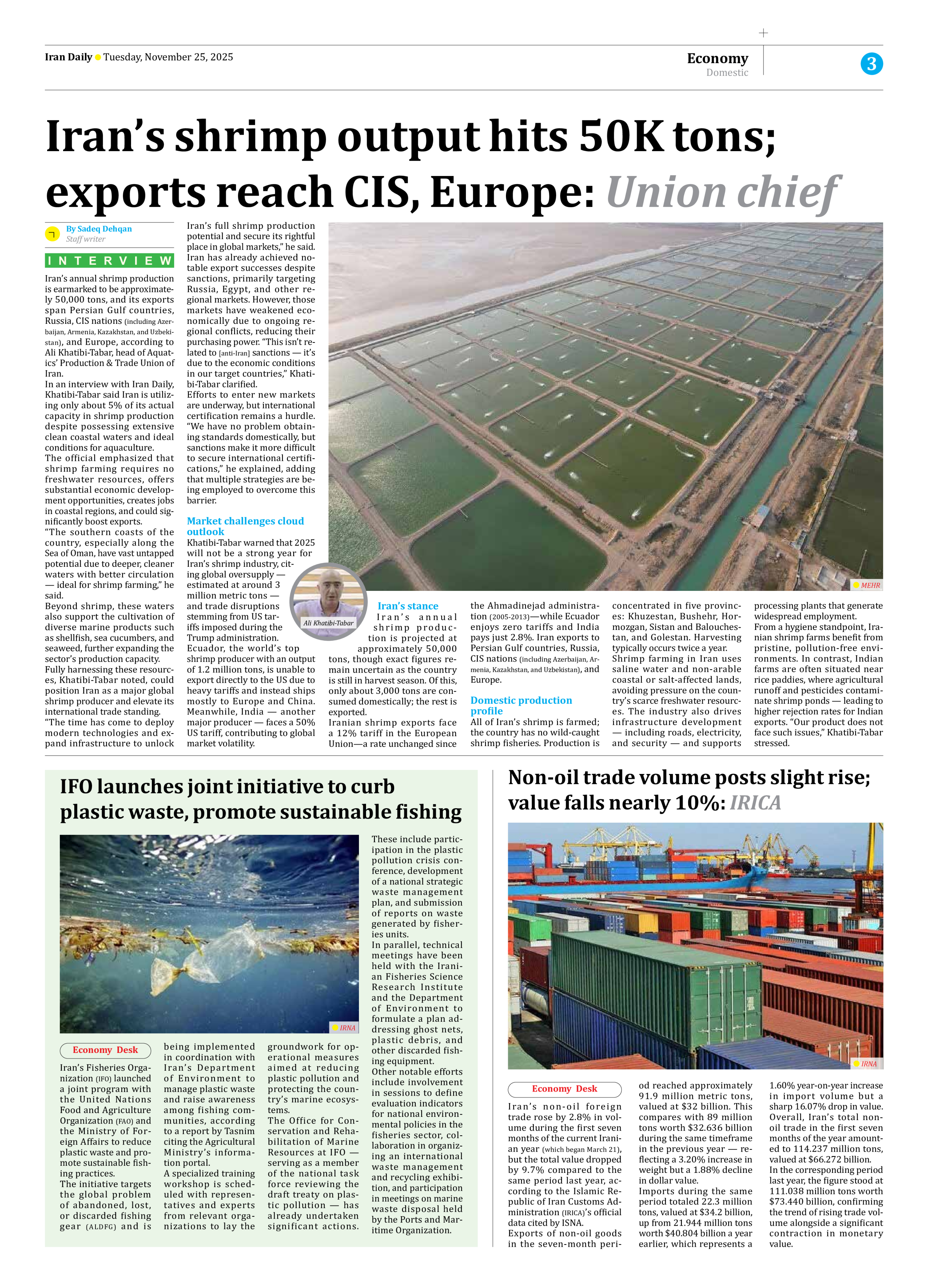


Iran’s shrimp output hits 50K tons; exports reach CIS, Europe: Union chief
By Sadeq Dehqan
Staff writer
Iran’s annual shrimp production is earmarked to be approximately 50,000 tons, and its exports span Persian Gulf countries, Russia, CIS nations (including Azerbaijan, Armenia, Kazakhstan, and Uzbekistan), and Europe, according to Ali Khatibi-Tabar, head of Aquatics’ Production & Trade Union of Iran.
In an interview with Iran Daily, Khatibi-Tabar said Iran is utilizing only about 5% of its actual capacity in shrimp production despite possessing extensive clean coastal waters and ideal conditions for aquaculture.
The official emphasized that shrimp farming requires no freshwater resources, offers substantial economic development opportunities, creates jobs in coastal regions, and could significantly boost exports.
“The southern coasts of the country, especially along the Sea of Oman, have vast untapped potential due to deeper, cleaner waters with better circulation — ideal for shrimp farming,” he said.
Beyond shrimp, these waters also support the cultivation of diverse marine products such as shellfish, sea cucumbers, and seaweed, further expanding the sector’s production capacity.
Fully harnessing these resources, Khatibi-Tabar noted, could position Iran as a major global shrimp producer and elevate its international trade standing.
“The time has come to deploy modern technologies and expand infrastructure to unlock Iran’s full shrimp production potential and secure its rightful place in global markets,” he said.
Iran has already achieved notable export successes despite sanctions, primarily targeting Russia, Egypt, and other regional markets. However, those markets have weakened economically due to ongoing regional conflicts, reducing their purchasing power. “This isn’t related to [anti-Iran] sanctions — it’s due to the economic conditions in our target countries,” Khatibi-Tabar clarified.
Efforts to enter new markets are underway, but international certification remains a hurdle. “We have no problem obtaining standards domestically, but sanctions make it more difficult to secure international certifications,” he explained, adding that multiple strategies are being employed to overcome this barrier.
Market challenges cloud outlook
Khatibi-Tabar warned that 2025 will not be a strong year for Iran’s shrimp industry, citing global oversupply — estimated at around 3 million metric tons — and trade disruptions stemming from US tariffs imposed during the Trump administration.
Ecuador, the world’s top shrimp producer with an output of 1.2 million tons, is unable to export directly to the US due to heavy tariffs and instead ships mostly to Europe and China. Meanwhile, India — another major producer — faces a 50% US tariff, contributing to global market volatility.
Iran’s stance
Iran’s annual shrimp production is projected at approximately 50,000 tons, though exact figures remain uncertain as the country is still in harvest season. Of this, only about 3,000 tons are consumed domestically; the rest is exported.
Iranian shrimp exports face a 12% tariff in the European Union—a rate unchanged since the Ahmadinejad administration (2005-2013)—while Ecuador enjoys zero tariffs and India pays just 2.8%. Iran exports to Persian Gulf countries, Russia, CIS nations (including Azerbaijan, Armenia, Kazakhstan, and Uzbekistan), and Europe.
Domestic production profile
All of Iran’s shrimp is farmed; the country has no wild-caught shrimp fisheries. Production is concentrated in five provinces: Khuzestan, Bushehr, Hormozgan, Sistan and Balouchestan, and Golestan. Harvesting typically occurs twice a year.
Shrimp farming in Iran uses saline water and non-arable coastal or salt-affected lands, avoiding pressure on the country’s scarce freshwater resources. The industry also drives infrastructure development — including roads, electricity, and security — and supports processing plants that generate widespread employment.
From a hygiene standpoint, Iranian shrimp farms benefit from pristine, pollution-free environments. In contrast, Indian farms are often situated near rice paddies, where agricultural runoff and pesticides contaminate shrimp ponds — leading to higher rejection rates for Indian exports. “Our product does not face such issues,” Khatibi-Tabar stressed.