







Fajr Int’l Film Festival to welcome 200 foreign guests to Shiraz
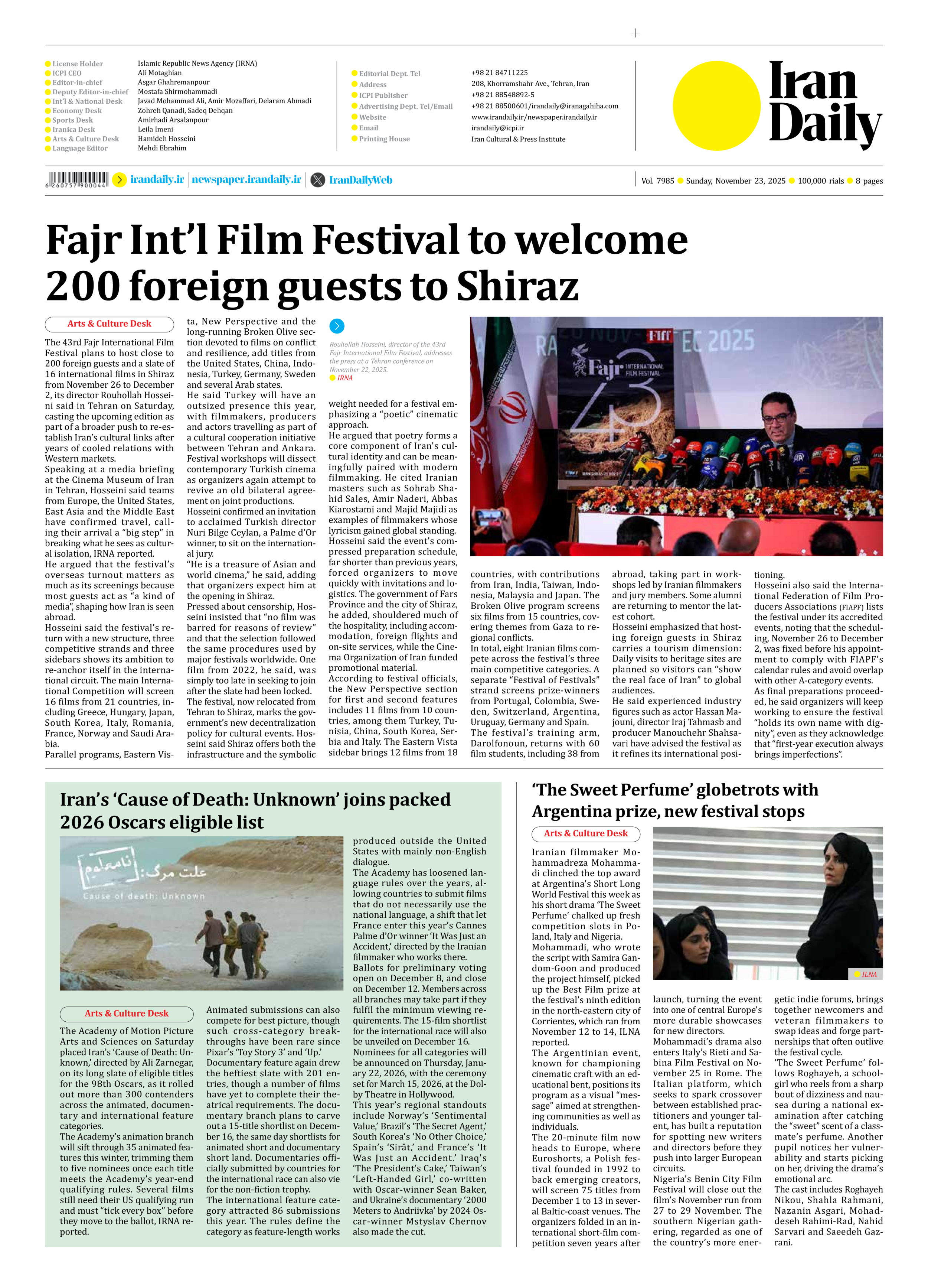
The 43rd Fajr International Film Festival plans to host close to 200 foreign guests and a slate of 16 international films in Shiraz from November 26 to December 2, its director Rouhollah Hosseini said in Tehran on Saturday, casting the upcoming edition as part of a broader push to re-establish Iran’s cultural links after years of cooled relations with Western markets.
Speaking at a media briefing at the Cinema Museum of Iran in Tehran, Hosseini said teams from Europe, the United States, East Asia and the Middle East have confirmed travel, calling their arrival a “big step” in breaking what he sees as cultural isolation, IRNA reported.
He argued that the festival’s overseas turnout matters as much as its screenings because most guests act as “a kind of media”, shaping how Iran is seen abroad.
Hosseini said the festival’s return with a new structure, three competitive strands and three sidebars shows its ambition to re-anchor itself in the international circuit. The main International Competition will screen 16 films from 21 countries, including Greece, Hungary, Japan, South Korea, Italy, Romania, France, Norway and Saudi Arabia.
Parallel programs, Eastern Vista, New Perspective and the long-running Broken Olive section devoted to films on conflict and resilience, add titles from the United States, China, Indonesia, Turkey, Germany, Sweden and several Arab states.
He said Turkey will have an outsized presence this year, with filmmakers, producers and actors travelling as part of a cultural cooperation initiative between Tehran and Ankara. Festival workshops will dissect contemporary Turkish cinema as organizers again attempt to revive an old bilateral agreement on joint productions.
Hosseini confirmed an invitation to acclaimed Turkish director Nuri Bilge Ceylan, a Palme d’Or winner, to sit on the international jury.
“He is a treasure of Asian and world cinema,” he said, adding that organizers expect him at the opening in Shiraz.
Pressed about censorship, Hosseini insisted that “no film was barred for reasons of review” and that the selection followed the same procedures used by major festivals worldwide. One film from 2022, he said, was simply too late in seeking to join after the slate had been locked.
The festival, now relocated from Tehran to Shiraz, marks the government’s new decentralization policy for cultural events. Hosseini said Shiraz offers both the infrastructure and the symbolic weight needed for a festival emphasizing a “poetic” cinematic approach.
He argued that poetry forms a core component of Iran’s cultural identity and can be meaningfully paired with modern filmmaking. He cited Iranian masters such as Sohrab Shahid Sales, Amir Naderi, Abbas Kiarostami and Majid Majidi as examples of filmmakers whose lyricism gained global standing.
Hosseini said the event’s compressed preparation schedule, far shorter than previous years, forced organizers to move quickly with invitations and logistics. The government of Fars Province and the city of Shiraz, he added, shouldered much of the hospitality, including accommodation, foreign flights and on-site services, while the Cinema Organization of Iran funded promotional material.
According to festival officials, the New Perspective section for first and second features includes 11 films from 10 countries, among them Turkey, Tunisia, China, South Korea, Serbia and Italy. The Eastern Vista sidebar brings 12 films from 18 countries, with contributions from Iran, India, Taiwan, Indonesia, Malaysia and Japan. The Broken Olive program screens six films from 15 countries, covering themes from Gaza to regional conflicts.
In total, eight Iranian films compete across the festival’s three main competitive categories. A separate “Festival of Festivals” strand screens prize-winners from Portugal, Colombia, Sweden, Switzerland, Argentina, Uruguay, Germany and Spain.
The festival’s training arm, Darolfonoun, returns with 60 film students, including 38 from abroad, taking part in workshops led by Iranian filmmakers and jury members. Some alumni are returning to mentor the latest cohort.
Hosseini emphasized that hosting foreign guests in Shiraz carries a tourism dimension: Daily visits to heritage sites are planned so visitors can “show the real face of Iran” to global audiences.
He said experienced industry figures such as actor Hassan Majouni, director Iraj Tahmasb and producer Manouchehr Shahsavari have advised the festival as it refines its international positioning.
Hosseini also said the International Federation of Film Producers Associations (FIAPF) lists the festival under its accredited events, noting that the scheduling, November 26 to December 2, was fixed before his appointment to comply with FIAPF’s calendar rules and avoid overlap with other A-category events.
As final preparations proceeded, he said organizers will keep working to ensure the festival “holds its own name with dignity”, even as they acknowledge that “first-year execution always brings imperfections”.