





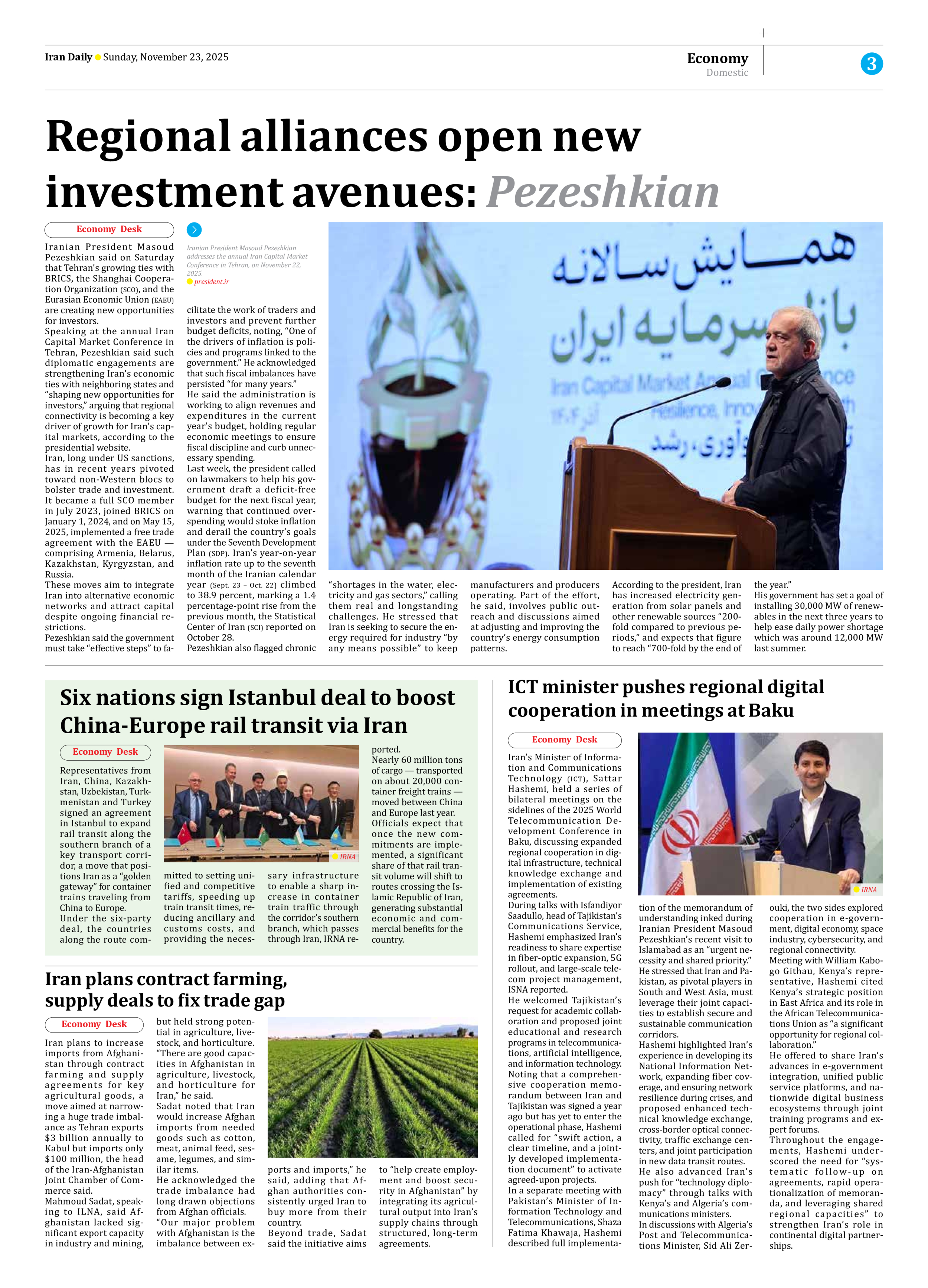


Regional alliances open new investment avenues: Pezeshkian
Iranian President Masoud Pezeshkian said on Saturday that Tehran’s growing ties with BRICS, the Shanghai Cooperation Organization (SCO), and the Eurasian Economic Union (EAEU) are creating new opportunities for investors.
Speaking at the annual Iran Capital Market Conference in Tehran, Pezeshkian said such diplomatic engagements are strengthening Iran’s economic ties with neighboring states and “shaping new opportunities for investors,” arguing that regional connectivity is becoming a key driver of growth for Iran’s capital markets, according to the presidential website.
Iran, long under US sanctions, has in recent years pivoted toward non-Western blocs to bolster trade and investment. It became a full SCO member in July 2023, joined BRICS on January 1, 2024, and on May 15, 2025, implemented a free trade agreement with the EAEU — comprising Armenia, Belarus, Kazakhstan, Kyrgyzstan, and Russia.
These moves aim to integrate Iran into alternative economic networks and attract capital despite ongoing financial restrictions.
Pezeshkian said the government must take “effective steps” to facilitate the work of traders and investors and prevent further budget deficits, noting, “One of the drivers of inflation is policies and programs linked to the government.” He acknowledged that such fiscal imbalances have persisted “for many years.”
He said the administration is working to align revenues and expenditures in the current year’s budget, holding regular economic meetings to ensure fiscal discipline and curb unnecessary spending.
Last week, the president called on lawmakers to help his government draft a deficit-free budget for the next fiscal year, warning that continued overspending would stoke inflation and derail the country’s goals under the Seventh Development Plan (SDP). Iran’s year-on-year inflation rate up to the seventh month of the Iranian calendar year (Sept. 23 – Oct. 22) climbed to 38.9 percent, marking a 1.4 percentage-point rise from the previous month, the Statistical Center of Iran (SCI) reported on October 28.
Pezeshkian also flagged chronic “shortages in the water, electricity and gas sectors,” calling them real and longstanding challenges. He stressed that Iran is seeking to secure the energy required for industry “by any means possible” to keep manufacturers and producers operating. Part of the effort, he said, involves public outreach and discussions aimed at adjusting and improving the country’s energy consumption patterns.
According to the president, Iran has increased electricity generation from solar panels and other renewable sources “200-fold compared to previous periods,” and expects that figure to reach “700-fold by the end of the year.”
His government has set a goal of installing 30,000 MW of renewables in the next three years to help ease daily power shortage which was around 12,000 MW last summer.