







With Cyrus, world entered new epoch
One grounded in peace, reverence for cultural, faith diversity
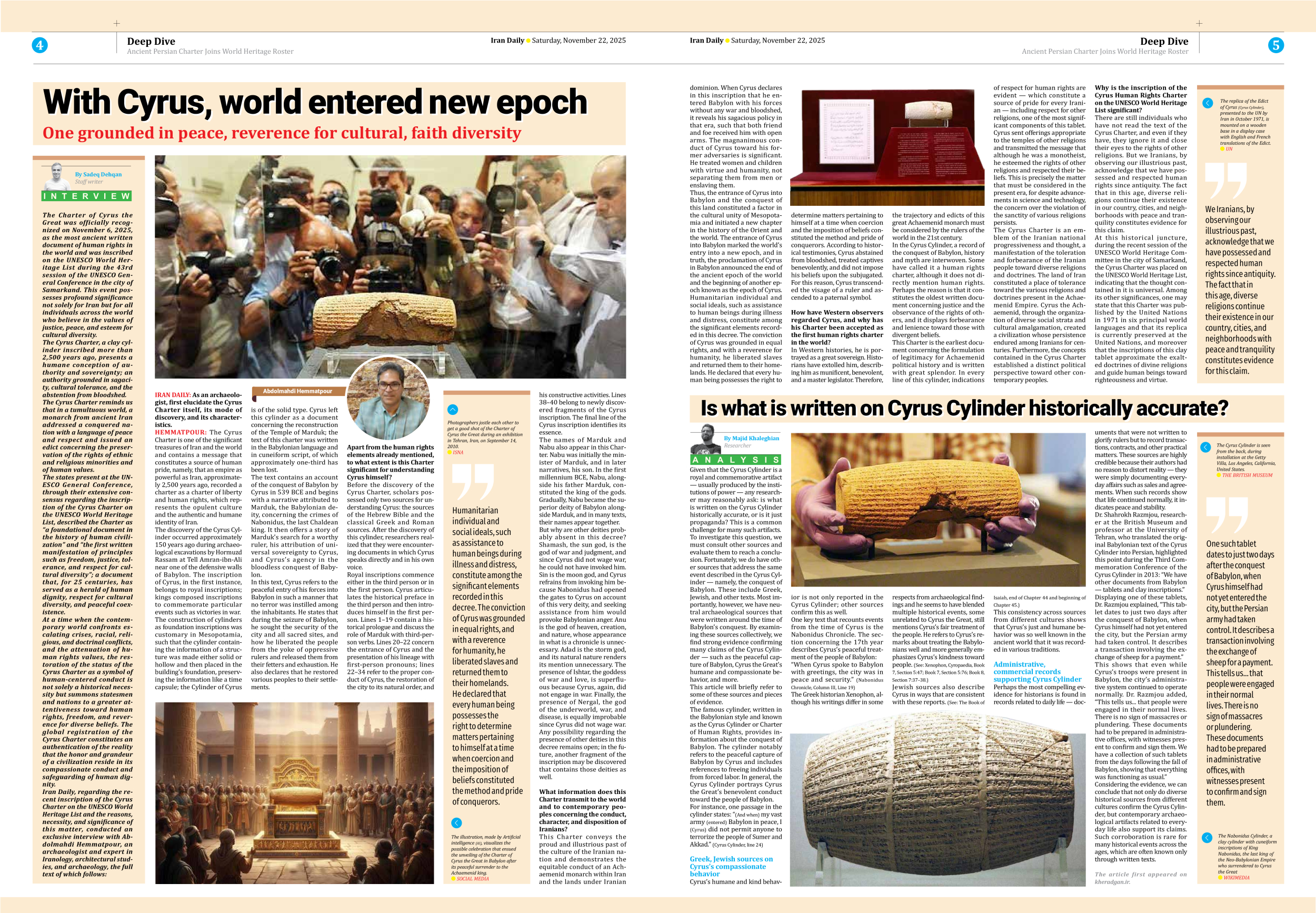
The Charter of Cyrus the Great was officially recognized on November 6, 2025, as the most ancient written document of human rights in the world and was inscribed on the UNESCO World Heritage List during the 43rd session of the UNESCO General Conference in the city of Samarkand. This event possesses profound significance not solely for Iran but for all individuals across the world who believe in the values of justice, peace, and esteem for cultural diversity. The Cyrus Charter, a clay cylinder inscribed more than 2,500 years ago, presents a humane conception of authority and sovereignty; an authority grounded in sagacity, cultural tolerance, and the abstention from bloodshed. The Cyrus Charter reminds us that in a tumultuous world, a monarch from ancient Iran addressed a conquered nation with a language of peace and respect and issued an edict concerning the preservation of the rights of ethnic and religious minorities and of human values. The states present at the UNESCO General Conference, through their extensive consensus regarding the inscription of the Cyrus Charter on the UNESCO World Heritage List, described the Charter as “a foundational document in the history of human civilization” and “the first written manifestation of principles such as freedom, justice, tolerance, and respect for cultural diversity”; a document that, for 25 centuries, has served as a herald of human dignity, respect for cultural diversity, and peaceful coexistence. At a time when the contemporary world confronts escalating crises, racial, religious, and doctrinal conflicts, and the attenuation of human rights values, the restoration of the status of the Cyrus Charter as a symbol of human-centered conduct is not solely a historical necessity but summons statesmen and nations to a greater attentiveness toward human rights, freedom, and reverence for diverse beliefs. The global registration of the Cyrus Charter constitutes an authentication of the reality that the honor and grandeur of a civilization reside in its compassionate conduct and safeguarding of human dignity. Iran Daily, regarding the recent inscription of the Cyrus Charter on the UNESCO World Heritage List and the reasons, necessity, and significance of this matter, conducted an exclusive interview with Abdolmahdi Hemmatpour, an archaeologist and expert in Iranology, architectural studies, and archaeology, the full text of which follows:
By Sadeq Dehqan
Staff writer
IRAN DAILY: As an archaeologist, first elucidate the Cyrus Charter itself, its mode of discovery, and its characteristics.
HEMMATPOUR: The Cyrus Charter is one of the significant treasures of Iran and the world and contains a message that constitutes a source of human pride, namely, that an empire as powerful as Iran, approximately 2,500 years ago, recorded a charter as a charter of liberty and human rights, which represents the opulent culture and the authentic and humane identity of Iran.
The discovery of the Cyrus Cylinder occurred approximately 150 years ago during archaeological excavations by Hormuzd Rassam at Tell Amran-ibn-Ali near one of the defensive walls of Babylon. The inscription of Cyrus, in the first instance, belongs to royal inscriptions; kings composed inscriptions to commemorate particular events such as victories in war.
The construction of cylinders as foundation inscriptions was customary in Mesopotamia, such that the cylinder containing the information of a structure was made either solid or hollow and then placed in the building’s foundation, preserving the information like a time capsule; the Cylinder of Cyrus is of the solid type. Cyrus left this cylinder as a document concerning the reconstruction of the Temple of Marduk; the text of this charter was written in the Babylonian language and in cuneiform script, of which approximately one-third has been lost.
The text contains an account of the conquest of Babylon by Cyrus in 539 BCE and begins with a narrative attributed to Marduk, the Babylonian deity, concerning the crimes of Nabonidus, the last Chaldean king. It then offers a story of Marduk’s search for a worthy ruler, his attribution of universal sovereignty to Cyrus, and Cyrus’s agency in the bloodless conquest of Babylon.
In this text, Cyrus refers to the peaceful entry of his forces into Babylon in such a manner that no terror was instilled among the inhabitants. He states that during the seizure of Babylon, he sought the security of the city and all sacred sites, and how he liberated the people from the yoke of oppressive rulers and released them from their fetters and exhaustion. He also declares that he restored various peoples to their settlements.
Apart from the human rights elements already mentioned, to what extent is this Charter significant for understanding Cyrus himself?
Before the discovery of the Cyrus Charter, scholars possessed only two sources for understanding Cyrus: the sources of the Hebrew Bible and the classical Greek and Roman sources. After the discovery of this cylinder, researchers realized that they were encountering documents in which Cyrus speaks directly and in his own voice.
Royal inscriptions commence either in the third person or in the first person. Cyrus articulates the historical preface in the third person and then introduces himself in the first person. Lines 1–19 contain a historical prologue and discuss the role of Marduk with third-person verbs. Lines 20–22 concern the entrance of Cyrus and the presentation of his lineage with first-person pronouns; lines 22–34 refer to the proper conduct of Cyrus, the restoration of the city to its natural order, and his constructive activities. Lines 38–40 belong to newly discovered fragments of the Cyrus inscription. The final line of the Cyrus inscription identifies its essence.
The names of Marduk and Nabu also appear in this Charter. Nabu was initially the minister of Marduk, and in later narratives, his son. In the first millennium BCE, Nabu, alongside his father Marduk, constituted the king of the gods. Gradually, Nabu became the superior deity of Babylon alongside Marduk, and in many texts, their names appear together.
But why are other deities probably absent in this decree? Shamash, the sun god, is the god of war and judgment, and since Cyrus did not wage war, he could not have invoked him. Sin is the moon god, and Cyrus refrains from invoking him because Nabonidus had opened the gates to Cyrus on account of this very deity, and seeking assistance from him would provoke Babylonian anger. Anu is the god of heaven, creation, and nature, whose appearance in what is a chronicle is unnecessary. Adad is the storm god, and its natural nature renders its mention unnecessary. The presence of Ishtar, the goddess of war and love, is superfluous because Cyrus, again, did not engage in war. Finally, the presence of Nergal, the god of the underworld, war, and disease, is equally improbable since Cyrus did not wage war. Any possibility regarding the presence of other deities in this decree remains open; in the future, another fragment of the inscription may be discovered that contains those deities as well.
What information does this Charter transmit to the world and to contemporary peoples concerning the conduct, character, and disposition of Iranians?
This Charter conveys the proud and illustrious past of the culture of the Iranian nation and demonstrates the equitable conduct of an Achaemenid monarch within Iran and the lands under Iranian dominion. When Cyrus declares in this inscription that he entered Babylon with his forces without any war and bloodshed, it reveals his sagacious policy in that era, such that both friend and foe received him with open arms. The magnanimous conduct of Cyrus toward his former adversaries is significant. He treated women and children with virtue and humanity, not separating them from men or enslaving them.
Thus, the entrance of Cyrus into Babylon and the conquest of this land constituted a factor in the cultural unity of Mesopotamia and initiated a new chapter in the history of the Orient and the world. The entrance of Cyrus into Babylon marked the world’s entry into a new epoch, and in truth, the proclamation of Cyrus in Babylon announced the end of the ancient epoch of the world and the beginning of another epoch known as the epoch of Cyrus.
Humanitarian individual and social ideals, such as assistance to human beings during illness and distress, constitute among the significant elements recorded in this decree. The conviction of Cyrus was grounded in equal rights, and with a reverence for humanity, he liberated slaves and returned them to their homelands. He declared that every human being possesses the right to determine matters pertaining to himself at a time when coercion and the imposition of beliefs constituted the method and pride of conquerors. According to historical testimonies, Cyrus abstained from bloodshed, treated captives benevolently, and did not impose his beliefs upon the subjugated. For this reason, Cyrus transcended the visage of a ruler and ascended to a paternal symbol.
How have Western observers regarded Cyrus, and why has his Charter been accepted as the first human rights charter in the world?
In Western histories, he is portrayed as a great sovereign. Historians have extolled him, describing him as munificent, benevolent, and a master legislator. Therefore, the trajectory and edicts of this great Achaemenid monarch must be considered by the rulers of the world in the 21st century.
In the Cyrus Cylinder, a record of the conquest of Babylon, history and myth are interwoven. Some have called it a human rights charter, although it does not directly mention human rights. Perhaps the reason is that it constitutes the oldest written document concerning justice and the observance of the rights of others, and it displays forbearance and lenience toward those with divergent beliefs.
This Charter is the earliest document concerning the formulation of legitimacy for Achaemenid political history and is written with great splendor. In every line of this cylinder, indications of respect for human rights are evident — which constitute a source of pride for every Iranian — including respect for other religions, one of the most significant components of this tablet. Cyrus sent offerings appropriate to the temples of other religions and transmitted the message that although he was a monotheist, he esteemed the rights of other religions and respected their beliefs. This is precisely the matter that must be considered in the present era, for despite advancements in science and technology, the concern over the violation of the sanctity of various religions persists.
The Cyrus Charter is an emblem of the Iranian national progressiveness and thought, a manifestation of the toleration and forbearance of the Iranian people toward diverse religions and doctrines. The land of Iran constituted a place of tolerance toward the various religions and doctrines present in the Achaemenid Empire. Cyrus the Achaemenid, through the organization of diverse social strata and cultural amalgamation, created a civilization whose persistence endured among Iranians for centuries. Furthermore, the concepts contained in the Cyrus Charter established a distinct political perspective toward other contemporary peoples.
Why is the inscription of the Cyrus Human Rights Charter on the UNESCO World Heritage List significant?
There are still individuals who have not read the text of the Cyrus Charter, and even if they have, they ignore it and close their eyes to the rights of other religions. But we Iranians, by observing our illustrious past, acknowledge that we have possessed and respected human rights since antiquity. The fact that in this age, diverse religions continue their existence in our country, cities, and neighborhoods with peace and tranquility constitutes evidence for this claim.
At this historical juncture, during the recent session of the UNESCO World Heritage Committee in the city of Samarkand, the Cyrus Charter was placed on the UNESCO World Heritage List, indicating that the thought contained in it is universal. Among its other significances, one may state that this Charter was published by the United Nations in 1971 in six principal world languages and that its replica is currently preserved at the United Nations, and moreover that the inscriptions of this clay tablet approximate the exalted doctrines of divine religions and guide human beings toward righteousness and virtue.