







Deputy FM: What is West’s apprehension now that Iran doesn’t enrich uranium?
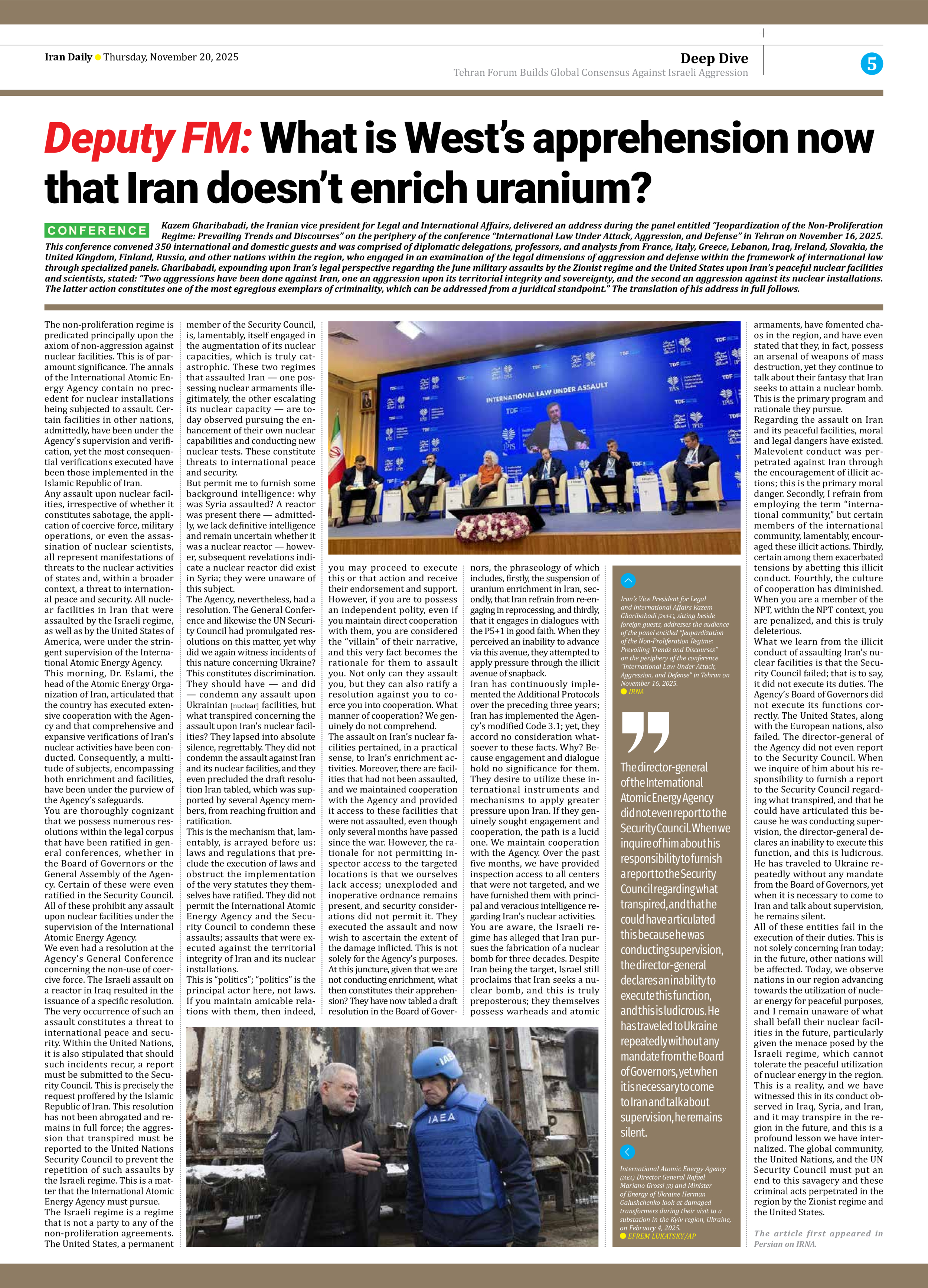
Kazem Gharibabadi, the Iranian vice president for Legal and International Affairs, delivered an address during the panel entitled “Jeopardization of the Non-Proliferation Regime: Prevailing Trends and Discourses” on the periphery of the conference “International Law Under Attack, Aggression, and Defense” in Tehran on November 16, 2025. This conference convened 350 international and domestic guests and was comprised of diplomatic delegations, professors, and analysts from France, Italy, Greece, Lebanon, Iraq, Ireland, Slovakia, the United Kingdom, Finland, Russia, and other nations within the region, who engaged in an examination of the legal dimensions of aggression and defense within the framework of international law through specialized panels. Gharibabadi, expounding upon Iran’s legal perspective regarding the June military assaults by the Zionist regime and the United States upon Iran’s peaceful nuclear facilities and scientists, stated: “Two aggressions have been done against Iran, one an aggression upon its territorial integrity and sovereignty, and the second an aggression against its nuclear installations. The latter action constitutes one of the most egregious exemplars of criminality, which can be addressed from a juridical standpoint.” The translation of his address in full follows.
The non-proliferation regime is predicated principally upon the axiom of non-aggression against nuclear facilities. This is of paramount significance. The annals of the International Atomic Energy Agency contain no precedent for nuclear installations being subjected to assault. Certain facilities in other nations, admittedly, have been under the Agency’s supervision and verification, yet the most consequential verifications executed have been those implemented in the Islamic Republic of Iran.
Any assault upon nuclear facilities, irrespective of whether it constitutes sabotage, the application of coercive force, military operations, or even the assassination of nuclear scientists, all represent manifestations of threats to the nuclear activities of states and, within a broader context, a threat to international peace and security. All nuclear facilities in Iran that were assaulted by the Israeli regime, as well as by the United States of America, were under the stringent supervision of the International Atomic Energy Agency.
This morning, Dr. Eslami, the head of the Atomic Energy Organization of Iran, articulated that the country has executed extensive cooperation with the Agency and that comprehensive and expansive verifications of Iran’s nuclear activities have been conducted. Consequently, a multitude of subjects, encompassing both enrichment and facilities, have been under the purview of the Agency’s safeguards.
You are thoroughly cognizant that we possess numerous resolutions within the legal corpus that have been ratified in general conferences, whether in the Board of Governors or the General Assembly of the Agency. Certain of these were even ratified in the Security Council. All of these prohibit any assault upon nuclear facilities under the supervision of the International Atomic Energy Agency.
We even had a resolution at the Agency’s General Conference concerning the non-use of coercive force. The Israeli assault on a reactor in Iraq resulted in the issuance of a specific resolution. The very occurrence of such an assault constitutes a threat to international peace and security. Within the United Nations, it is also stipulated that should such incidents recur, a report must be submitted to the Security Council. This is precisely the request proffered by the Islamic Republic of Iran. This resolution has not been abrogated and remains in full force; the aggression that transpired must be reported to the United Nations Security Council to prevent the repetition of such assaults by the Israeli regime. This is a matter that the International Atomic Energy Agency must pursue.
The Israeli regime is a regime that is not a party to any of the non-proliferation agreements. The United States, a permanent member of the Security Council, is, lamentably, itself engaged in the augmentation of its nuclear capacities, which is truly catastrophic. These two regimes that assaulted Iran — one possessing nuclear armaments illegitimately, the other escalating its nuclear capacity — are today observed pursuing the enhancement of their own nuclear capabilities and conducting new nuclear tests. These constitute threats to international peace and security.
But permit me to furnish some background intelligence: why was Syria assaulted? A reactor was present there — admittedly, we lack definitive intelligence and remain uncertain whether it was a nuclear reactor — however, subsequent revelations indicate a nuclear reactor did exist in Syria; they were unaware of this subject.
The Agency, nevertheless, had a resolution. The General Conference and likewise the UN Security Council had promulgated resolutions on this matter, yet why did we again witness incidents of this nature concerning Ukraine? This constitutes discrimination. They should have — and did — condemn any assault upon Ukrainian [nuclear] facilities, but what transpired concerning the assault upon Iran’s nuclear facilities? They lapsed into absolute silence, regrettably. They did not condemn the assault against Iran and its nuclear facilities, and they even precluded the draft resolution Iran tabled, which was supported by several Agency members, from reaching fruition and ratification.
This is the mechanism that, lamentably, is arrayed before us: laws and regulations that preclude the execution of laws and obstruct the implementation of the very statutes they themselves have ratified. They did not permit the International Atomic Energy Agency and the Security Council to condemn these assaults; assaults that were executed against the territorial integrity of Iran and its nuclear installations.
This is “politics”; “politics” is the principal actor here, not laws. If you maintain amicable relations with them, then indeed, you may proceed to execute this or that action and receive their endorsement and support. However, if you are to possess an independent polity, even if you maintain direct cooperation with them, you are considered the “villain” of their narrative, and this very fact becomes the rationale for them to assault you. Not only can they assault you, but they can also ratify a resolution against you to coerce you into cooperation. What manner of cooperation? We genuinely do not comprehend.
The assault on Iran’s nuclear facilities pertained, in a practical sense, to Iran’s enrichment activities. Moreover, there are facilities that had not been assaulted, and we maintained cooperation with the Agency and provided it access to these facilities that were not assaulted, even though only several months have passed since the war. However, the rationale for not permitting inspector access to the targeted locations is that we ourselves lack access; unexploded and inoperative ordnance remains present, and security considerations did not permit it. They executed the assault and now wish to ascertain the extent of the damage inflicted. This is not solely for the Agency’s purposes.
At this juncture, given that we are not conducting enrichment, what then constitutes their apprehension? They have now tabled a draft resolution in the Board of Governors, the phraseology of which includes, firstly, the suspension of uranium enrichment in Iran, secondly, that Iran refrain from re-engaging in reprocessing, and thirdly, that it engages in dialogues with the P5+1 in good faith. When they perceived an inability to advance via this avenue, they attempted to apply pressure through the illicit avenue of snapback.
Iran has continuously implemented the Additional Protocols over the preceding three years; Iran has implemented the Agency’s modified Code 3.1; yet, they accord no consideration whatsoever to these facts. Why? Because engagement and dialogue hold no significance for them. They desire to utilize these international instruments and mechanisms to apply greater pressure upon Iran. If they genuinely sought engagement and cooperation, the path is a lucid one. We maintain cooperation with the Agency. Over the past five months, we have provided inspection access to all centers that were not targeted, and we have furnished them with principal and veracious intelligence regarding Iran’s nuclear activities.
You are aware, the Israeli regime has alleged that Iran pursues the fabrication of a nuclear bomb for three decades. Despite Iran being the target, Israel still proclaims that Iran seeks a nuclear bomb, and this is truly preposterous; they themselves possess warheads and atomic armaments, have fomented chaos in the region, and have even stated that they, in fact, possess an arsenal of weapons of mass destruction, yet they continue to talk about their fantasy that Iran seeks to attain a nuclear bomb. This is the primary program and rationale they pursue.
Regarding the assault on Iran and its peaceful facilities, moral and legal dangers have existed. Malevolent conduct was perpetrated against Iran through the encouragement of illicit actions; this is the primary moral danger. Secondly, I refrain from employing the term “international community,” but certain members of the international community, lamentably, encouraged these illicit actions. Thirdly, certain among them exacerbated tensions by abetting this illicit conduct. Fourthly, the culture of cooperation has diminished. When you are a member of the NPT, within the NPT context, you are penalized, and this is truly deleterious.
What we learn from the illicit conduct of assaulting Iran’s nuclear facilities is that the Security Council failed; that is to say, it did not execute its duties. The Agency’s Board of Governors did not execute its functions correctly. The United States, along with the European nations, also failed. The director-general of the Agency did not even report to the Security Council. When we inquire of him about his responsibility to furnish a report to the Security Council regarding what transpired, and that he could have articulated this because he was conducting supervision, the director-general declares an inability to execute this function, and this is ludicrous. He has traveled to Ukraine repeatedly without any mandate from the Board of Governors, yet when it is necessary to come to Iran and talk about supervision, he remains silent.
All of these entities fail in the execution of their duties. This is not solely concerning Iran today; in the future, other nations will be affected. Today, we observe nations in our region advancing towards the utilization of nuclear energy for peaceful purposes, and I remain unaware of what shall befall their nuclear facilities in the future, particularly given the menace posed by the Israeli regime, which cannot tolerate the peaceful utilization of nuclear energy in the region. This is a reality, and we have witnessed this in its conduct observed in Iraq, Syria, and Iran, and it may transpire in the region in the future, and this is a profound lesson we have internalized. The global community, the United Nations, and the UN Security Council must put an end to this savagery and these criminal acts perpetrated in the region by the Zionist regime and the United States.
The article first appeared in
Persian on IRNA.