







Iran seeks Caspian basin’s top health tourism hub with largest regional capacity
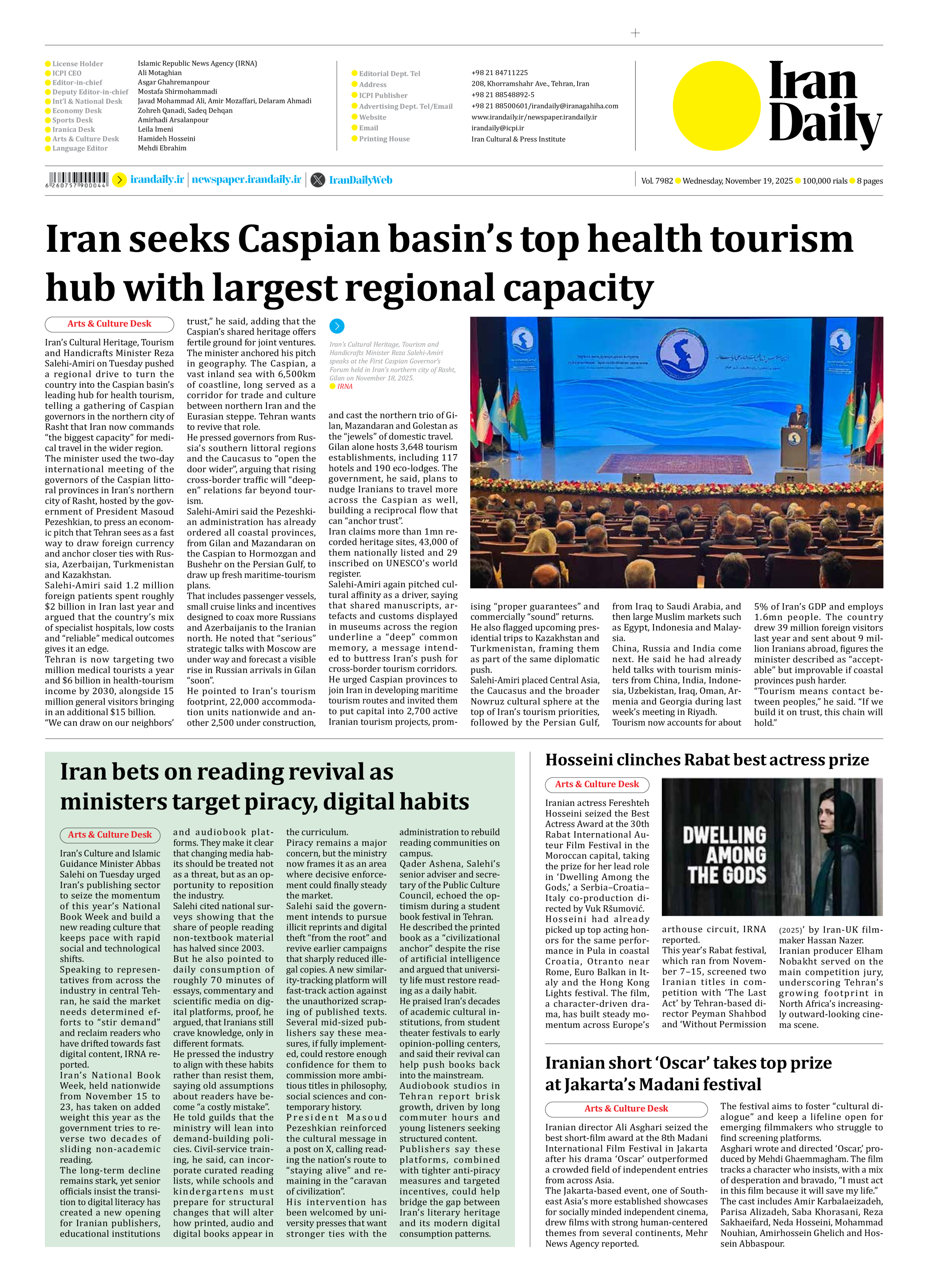
Iran’s Cultural Heritage, Tourism and Handicrafts Minister Reza Salehi-Amiri on Tuesday pushed a regional drive to turn the country into the Caspian basin’s leading hub for health tourism, telling a gathering of Caspian governors in the northern city of Rasht that Iran now commands “the biggest capacity” for medical travel in the wider region.
The minister used the two-day international meeting of the governors of the Caspian littoral provinces in Iran’s northern city of Rasht, hosted by the government of President Masoud Pezeshkian, to press an economic pitch that Tehran sees as a fast way to draw foreign currency and anchor closer ties with Russia, Azerbaijan, Turkmenistan and Kazakhstan.
Salehi-Amiri said 1.2 million foreign patients spent roughly $2 billion in Iran last year and argued that the country’s mix of specialist hospitals, low costs and “reliable” medical outcomes gives it an edge.
Tehran is now targeting two million medical tourists a year and $6 billion in health-tourism income by 2030, alongside 15 million general visitors bringing in an additional $15 billion.
“We can draw on our neighbors’ trust,” he said, adding that the Caspian’s shared heritage offers fertile ground for joint ventures.
The minister anchored his pitch in geography. The Caspian, a vast inland sea with 6,500km of coastline, long served as a corridor for trade and culture between northern Iran and the Eurasian steppe. Tehran wants to revive that role.
He pressed governors from Russia’s southern littoral regions and the Caucasus to “open the door wider”, arguing that rising cross-border traffic will “deepen” relations far beyond tourism.
Salehi-Amiri said the Pezeshkian administration has already ordered all coastal provinces, from Gilan and Mazandaran on the Caspian to Hormozgan and Bushehr on the Persian Gulf, to draw up fresh maritime-tourism plans.
That includes passenger vessels, small cruise links and incentives designed to coax more Russians and Azerbaijanis to the Iranian north. He noted that “serious” strategic talks with Moscow are under way and forecast a visible rise in Russian arrivals in Gilan “soon”.
He pointed to Iran’s tourism footprint, 22,000 accommodation units nationwide and another 2,500 under construction, and cast the northern trio of Gilan, Mazandaran and Golestan as the “jewels” of domestic travel.
Gilan alone hosts 3,648 tourism establishments, including 117 hotels and 190 eco-lodges. The government, he said, plans to nudge Iranians to travel more across the Caspian as well, building a reciprocal flow that can “anchor trust”.
Iran claims more than 1mn recorded heritage sites, 43,000 of them nationally listed and 29 inscribed on UNESCO’s world register.
Salehi-Amiri again pitched cultural affinity as a driver, saying that shared manuscripts, artefacts and customs displayed in museums across the region underline a “deep” common memory, a message intended to buttress Iran’s push for cross-border tourism corridors.
He urged Caspian provinces to join Iran in developing maritime tourism routes and invited them to put capital into 2,700 active Iranian tourism projects, promising “proper guarantees” and commercially “sound” returns.
He also flagged upcoming presidential trips to Kazakhstan and Turkmenistan, framing them as part of the same diplomatic push.
Salehi-Amiri placed Central Asia, the Caucasus and the broader Nowruz cultural sphere at the top of Iran’s tourism priorities, followed by the Persian Gulf, from Iraq to Saudi Arabia, and then large Muslim markets such as Egypt, Indonesia and Malaysia.
China, Russia and India come next. He said he had already held talks with tourism ministers from China, India, Indonesia, Uzbekistan, Iraq, Oman, Armenia and Georgia during last week’s meeting in Riyadh.
Tourism now accounts for about 5% of Iran’s GDP and employs 1.6mn people. The country drew 39 million foreign visitors last year and sent about 9 million Iranians abroad, figures the minister described as “acceptable” but improvable if coastal provinces push harder.
“Tourism means contact between peoples,” he said. “If we build it on trust, this chain will hold.”