







Craftsmen restore ancient Lenj-building tradition in Persian Gulf
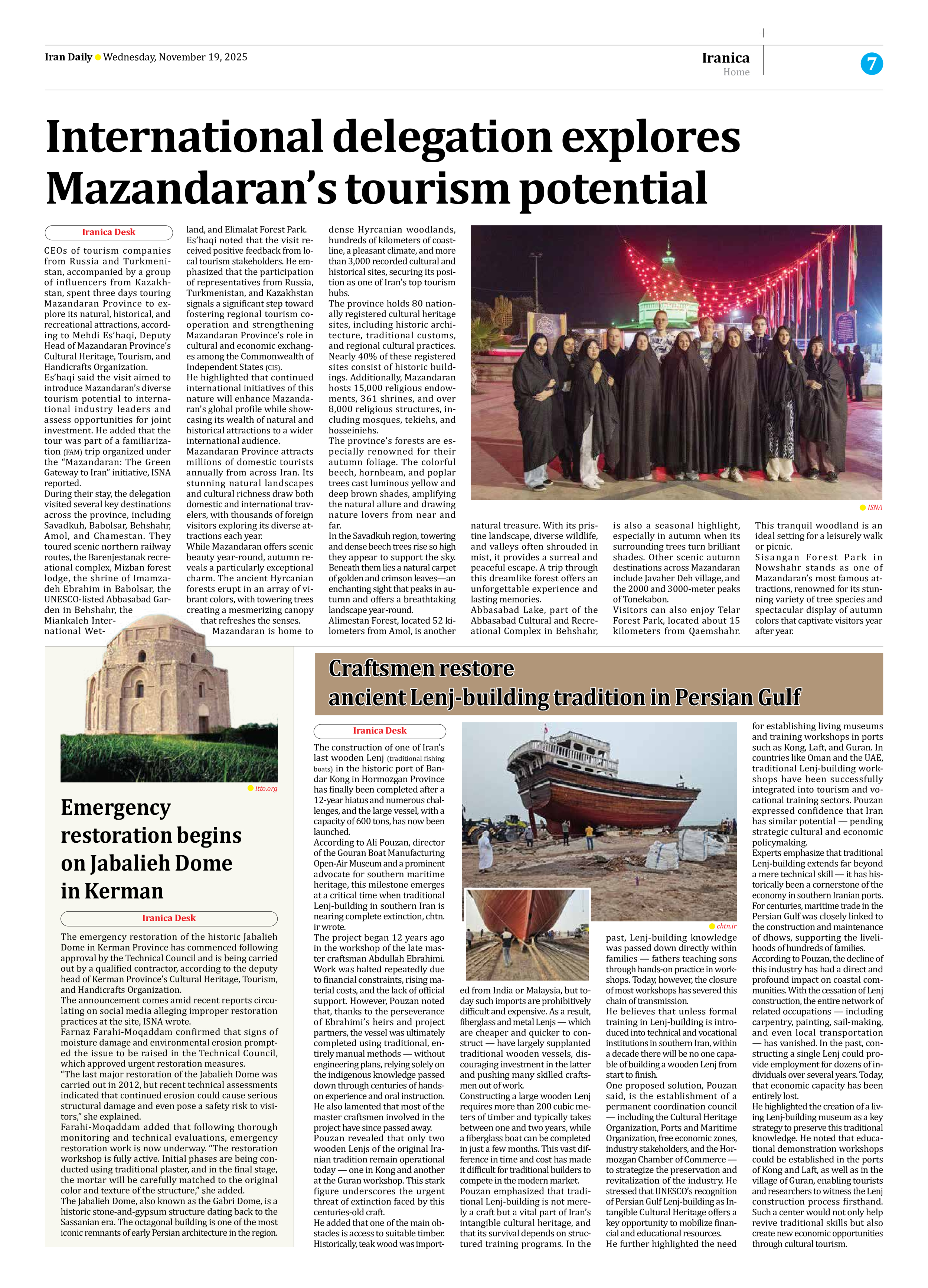
The construction of one of Iran’s last wooden Lenj (traditional fishing boats) in the historic port of Bandar Kong in Hormozgan Province has finally been completed after a 12-year hiatus and numerous challenges, and the large vessel, with a capacity of 600 tons, has now been launched.
According to Ali Pouzan, director of the Gouran Boat Manufacturing Open-Air Museum and a prominent advocate for southern maritime heritage, this milestone emerges at a critical time when traditional Lenj-building in southern Iran is nearing complete extinction, chtn.ir wrote.
The project began 12 years ago in the workshop of the late master craftsman Abdullah Ebrahimi. Work was halted repeatedly due to financial constraints, rising material costs, and the lack of official support. However, Pouzan noted that, thanks to the perseverance of Ebrahimi’s heirs and project partners, the vessel was ultimately completed using traditional, entirely manual methods — without engineering plans, relying solely on the indigenous knowledge passed down through centuries of hands-on experience and oral instruction. He also lamented that most of the master craftsmen involved in the project have since passed away.
Pouzan revealed that only two wooden Lenjs of the original Iranian tradition remain operational today — one in Kong and another at the Guran workshop. This stark figure underscores the urgent threat of extinction faced by this centuries-old craft.
He added that one of the main obstacles is access to suitable timber. Historically, teak wood was imported from India or Malaysia, but today such imports are prohibitively difficult and expensive. As a result, fiberglass and metal Lenjs — which are cheaper and quicker to construct — have largely supplanted traditional wooden vessels, discouraging investment in the latter and pushing many skilled craftsmen out of work.
Constructing a large wooden Lenj requires more than 200 cubic meters of timber and typically takes between one and two years, while a fiberglass boat can be completed in just a few months. This vast difference in time and cost has made it difficult for traditional builders to compete in the modern market.
Pouzan emphasized that traditional Lenj-building is not merely a craft but a vital part of Iran’s intangible cultural heritage, and that its survival depends on structured training programs. In the past, Lenj-building knowledge was passed down directly within families — fathers teaching sons through hands-on practice in workshops. Today, however, the closure of most workshops has severed this chain of transmission.
He believes that unless formal training in Lenj-building is introduced into technical and vocational institutions in southern Iran, within a decade there will be no one capable of building a wooden Lenj from start to finish.
One proposed solution, Pouzan said, is the establishment of a permanent coordination council — including the Cultural Heritage Organization, Ports and Maritime Organization, free economic zones, industry stakeholders, and the Hormozgan Chamber of Commerce — to strategize the preservation and revitalization of the industry. He stressed that UNESCO’s recognition of Persian Gulf Lenj-building as Intangible Cultural Heritage offers a key opportunity to mobilize financial and educational resources.
He further highlighted the need for establishing living museums and training workshops in ports such as Kong, Laft, and Guran. In countries like Oman and the UAE, traditional Lenj-building workshops have been successfully integrated into tourism and vocational training sectors. Pouzan expressed confidence that Iran has similar potential — pending strategic cultural and economic policymaking.
Experts emphasize that traditional Lenj-building extends far beyond a mere technical skill — it has historically been a cornerstone of the economy in southern Iranian ports. For centuries, maritime trade in the Persian Gulf was closely linked to the construction and maintenance of dhows, supporting the livelihoods of hundreds of families.
According to Pouzan, the decline of this industry has had a direct and profound impact on coastal communities. With the cessation of Lenj construction, the entire network of related occupations — including carpentry, painting, sail-making, and even local transportation — has vanished. In the past, constructing a single Lenj could provide employment for dozens of individuals over several years. Today, that economic capacity has been entirely lost.
He highlighted the creation of a living Lenj-building museum as a key strategy to preserve this traditional knowledge. He noted that educational demonstration workshops could be established in the ports of Kong and Laft, as well as in the village of Guran, enabling tourists and researchers to witness the Lenj construction process firsthand. Such a center would not only help revive traditional skills but also create new economic opportunities through cultural tourism.