





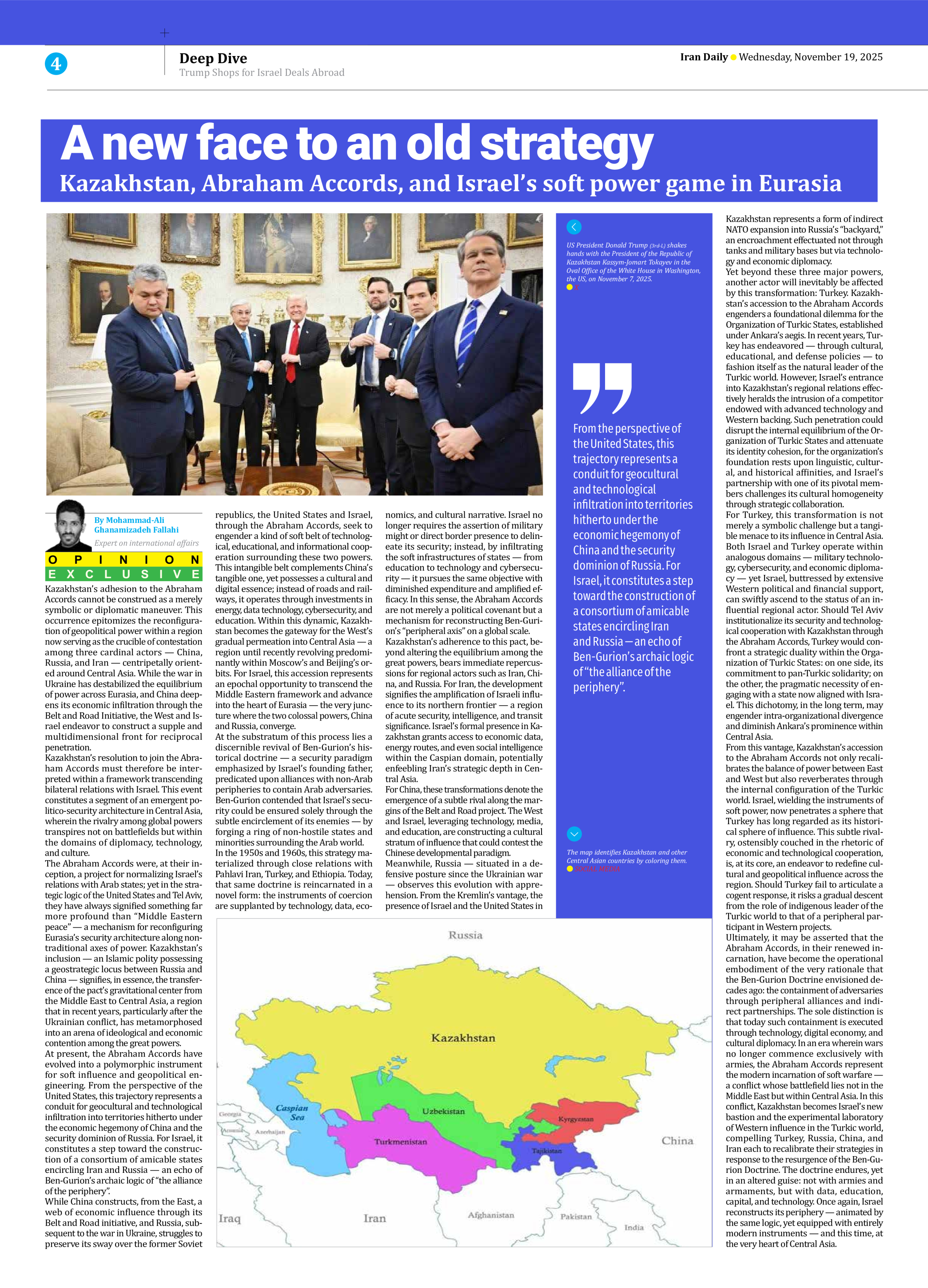


A new face to an old strategy
Kazakhstan, Abraham Accords, and Israel’s soft power game in Eurasia
By Mohammad-Ali Ghanamizadeh Fallahi
Expert on international affairs
Kazakhstan’s adhesion to the Abraham Accords cannot be construed as a merely symbolic or diplomatic maneuver. This occurrence epitomizes the reconfiguration of geopolitical power within a region now serving as the crucible of contestation among three cardinal actors — China, Russia, and Iran — centripetally oriented around Central Asia. While the war in Ukraine has destabilized the equilibrium of power across Eurasia, and China deepens its economic infiltration through the Belt and Road Initiative, the West and Israel endeavor to construct a supple and multidimensional front for reciprocal penetration.
Kazakhstan’s resolution to join the Abraham Accords must therefore be interpreted within a framework transcending bilateral relations with Israel. This event constitutes a segment of an emergent politico-security architecture in Central Asia, wherein the rivalry among global powers transpires not on battlefields but within the domains of diplomacy, technology, and culture.
The Abraham Accords were, at their inception, a project for normalizing Israel’s relations with Arab states; yet in the strategic logic of the United States and Tel Aviv, they have always signified something far more profound than “Middle Eastern peace” — a mechanism for reconfiguring Eurasia’s security architecture along nontraditional axes of power. Kazakhstan’s inclusion — an Islamic polity possessing a geostrategic locus between Russia and China — signifies, in essence, the transference of the pact’s gravitational center from the Middle East to Central Asia, a region that in recent years, particularly after the Ukrainian conflict, has metamorphosed into an arena of ideological and economic contention among the great powers.
At present, the Abraham Accords have evolved into a polymorphic instrument for soft influence and geopolitical engineering. From the perspective of the United States, this trajectory represents a conduit for geocultural and technological infiltration into territories hitherto under the economic hegemony of China and the security dominion of Russia. For Israel, it constitutes a step toward the construction of a consortium of amicable states encircling Iran and Russia — an echo of Ben-Gurion’s archaic logic of “the alliance of the periphery”.
While China constructs, from the East, a web of economic influence through its Belt and Road initiative, and Russia, subsequent to the war in Ukraine, struggles to preserve its sway over the former Soviet republics, the United States and Israel, through the Abraham Accords, seek to engender a kind of soft belt of technological, educational, and informational cooperation surrounding these two powers. This intangible belt complements China’s tangible one, yet possesses a cultural and digital essence; instead of roads and railways, it operates through investments in energy, data technology, cybersecurity, and education. Within this dynamic, Kazakhstan becomes the gateway for the West’s gradual permeation into Central Asia — a region until recently revolving predominantly within Moscow’s and Beijing’s orbits. For Israel, this accession represents an epochal opportunity to transcend the Middle Eastern framework and advance into the heart of Eurasia — the very juncture where the two colossal powers, China and Russia, converge.
At the substratum of this process lies a discernible revival of Ben-Gurion’s historical doctrine — a security paradigm emphasized by Israel’s founding father, predicated upon alliances with non-Arab peripheries to contain Arab adversaries. Ben-Gurion contended that Israel’s security could be ensured solely through the subtle encirclement of its enemies — by forging a ring of non-hostile states and minorities surrounding the Arab world.
In the 1950s and 1960s, this strategy materialized through close relations with Pahlavi Iran, Turkey, and Ethiopia. Today, that same doctrine is reincarnated in a novel form: the instruments of coercion are supplanted by technology, data, economics, and cultural narrative. Israel no longer requires the assertion of military might or direct border presence to delineate its security; instead, by infiltrating the soft infrastructures of states — from education to technology and cybersecurity — it pursues the same objective with diminished expenditure and amplified efficacy. In this sense, the Abraham Accords are not merely a political covenant but a mechanism for reconstructing Ben-Gurion’s “peripheral axis” on a global scale.
Kazakhstan’s adherence to this pact, beyond altering the equilibrium among the great powers, bears immediate repercussions for regional actors such as Iran, China, and Russia. For Iran, the development signifies the amplification of Israeli influence to its northern frontier — a region of acute security, intelligence, and transit significance. Israel’s formal presence in Kazakhstan grants access to economic data, energy routes, and even social intelligence within the Caspian domain, potentially enfeebling Iran’s strategic depth in Central Asia.
For China, these transformations denote the emergence of a subtle rival along the margins of the Belt and Road project. The West and Israel, leveraging technology, media, and education, are constructing a cultural stratum of influence that could contest the Chinese developmental paradigm.
Meanwhile, Russia — situated in a defensive posture since the Ukrainian war — observes this evolution with apprehension. From the Kremlin’s vantage, the presence of Israel and the United States in Kazakhstan represents a form of indirect NATO expansion into Russia’s “backyard,” an encroachment effectuated not through tanks and military bases but via technology and economic diplomacy.
Yet beyond these three major powers, another actor will inevitably be affected by this transformation: Turkey. Kazakhstan’s accession to the Abraham Accords engenders a foundational dilemma for the Organization of Turkic States, established under Ankara’s aegis. In recent years, Turkey has endeavored — through cultural, educational, and defense policies — to fashion itself as the natural leader of the Turkic world. However, Israel’s entrance into Kazakhstan’s regional relations effectively heralds the intrusion of a competitor endowed with advanced technology and Western backing. Such penetration could disrupt the internal equilibrium of the Organization of Turkic States and attenuate its identity cohesion, for the organization’s foundation rests upon linguistic, cultural, and historical affinities, and Israel’s partnership with one of its pivotal members challenges its cultural homogeneity through strategic collaboration.
For Turkey, this transformation is not merely a symbolic challenge but a tangible menace to its influence in Central Asia. Both Israel and Turkey operate within analogous domains — military technology, cybersecurity, and economic diplomacy — yet Israel, buttressed by extensive Western political and financial support, can swiftly ascend to the status of an influential regional actor. Should Tel Aviv institutionalize its security and technological cooperation with Kazakhstan through the Abraham Accords, Turkey would confront a strategic duality within the Organization of Turkic States: on one side, its commitment to pan-Turkic solidarity; on the other, the pragmatic necessity of engaging with a state now aligned with Israel. This dichotomy, in the long term, may engender intra-organizational divergence and diminish Ankara’s prominence within Central Asia.
From this vantage, Kazakhstan’s accession to the Abraham Accords not only recalibrates the balance of power between East and West but also reverberates through the internal configuration of the Turkic world. Israel, wielding the instruments of soft power, now penetrates a sphere that Turkey has long regarded as its historical sphere of influence. This subtle rivalry, ostensibly couched in the rhetoric of economic and technological cooperation, is, at its core, an endeavor to redefine cultural and geopolitical influence across the region. Should Turkey fail to articulate a cogent response, it risks a gradual descent from the role of indigenous leader of the Turkic world to that of a peripheral participant in Western projects.
Ultimately, it may be asserted that the Abraham Accords, in their renewed incarnation, have become the operational embodiment of the very rationale that the Ben-Gurion Doctrine envisioned decades ago: the containment of adversaries through peripheral alliances and indirect partnerships. The sole distinction is that today such containment is executed through technology, digital economy, and cultural diplomacy. In an era wherein wars no longer commence exclusively with armies, the Abraham Accords represent the modern incarnation of soft warfare — a conflict whose battlefield lies not in the Middle East but within Central Asia. In this conflict, Kazakhstan becomes Israel’s new bastion and the experimental laboratory of Western influence in the Turkic world, compelling Turkey, Russia, China, and Iran each to recalibrate their strategies in response to the resurgence of the Ben-Gurion Doctrine. The doctrine endures, yet in an altered guise: not with armies and armaments, but with data, education, capital, and technology. Once again, Israel reconstructs its periphery — animated by the same logic, yet equipped with entirely modern instruments — and this time, at the very heart of Central Asia.