





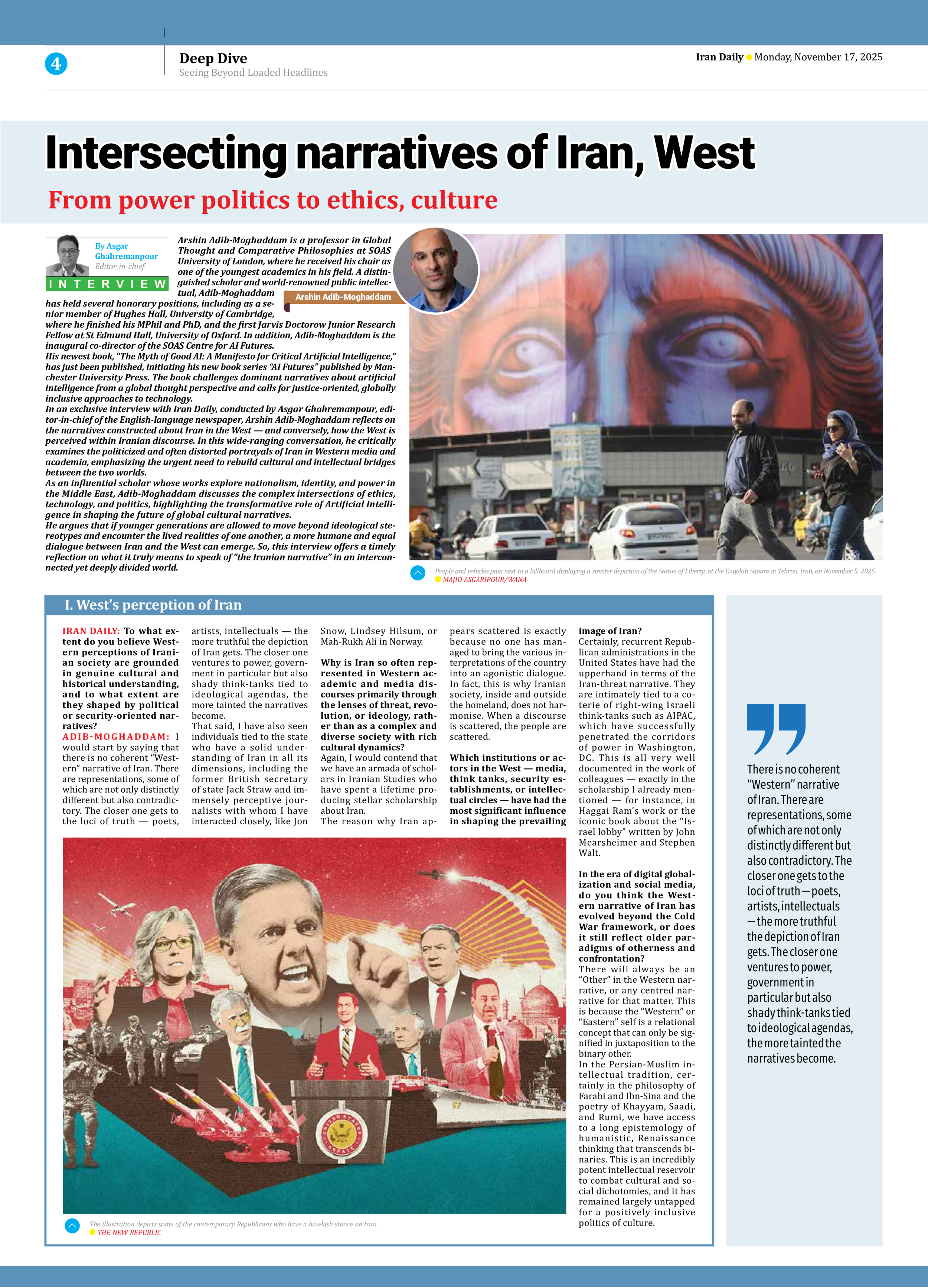


Intersecting narratives of Iran, West
From power politics to ethics, culture
Arshin Adib-Moghaddam Arshin Adib-Moghaddam is a professor in Global Thought and Comparative Philosophies at SOAS University of London, where he received his chair as one of the youngest academics in his field. A distinguished scholar and world-renowned public intellectual, Adib-Moghaddam has held several honorary positions, including as a senior member of Hughes Hall, University of Cambridge, where he finished his MPhil and PhD, and the first Jarvis Doctorow Junior Research Fellow at St Edmund Hall, University of Oxford. In addition, Adib-Moghaddam is the inaugural co-director of the SOAS Centre for AI Futures. His newest book, “The Myth of Good AI: A Manifesto for Critical Artificial Intelligence,“ has just been published, initiating his new book series “AI Futures” published by Manchester University Press. The book challenges dominant narratives about artificial intelligence from a global thought perspective and calls for justice-oriented, globally inclusive approaches to technology. In an exclusive interview with Iran Daily, conducted by Asgar Ghahremanpour, editor-in-chief of the English-language newspaper, Arshin Adib-Moghaddam reflects on the narratives constructed about Iran in the West — and conversely, how the West is perceived within Iranian discourse. In this wide-ranging conversation, he critically examines the politicized and often distorted portrayals of Iran in Western media and academia, emphasizing the urgent need to rebuild cultural and intellectual bridges between the two worlds. As an influential scholar whose works explore nationalism, identity, and power in the Middle East, Adib-Moghaddam discusses the complex intersections of ethics, technology, and politics, highlighting the transformative role of Artificial Intelligence in shaping the future of global cultural narratives. He argues that if younger generations are allowed to move beyond ideological stereotypes and encounter the lived realities of one another, a more humane and equal dialogue between Iran and the West can emerge. So, this interview offers a timely reflection on what it truly means to speak of “the Iranian narrative” in an interconnected yet deeply divided world.
By Asgar
Ghahremanpour
Editor-in-chief
I. West’s perception of Iran
IRAN DAILY: To what extent do you believe Western perceptions of Iranian society are grounded in genuine cultural and historical understanding, and to what extent are they shaped by political or security-oriented narratives?
Adib-Moghaddam: I would start by saying that there is no coherent “Western” narrative of Iran. There are representations, some of which are not only distinctly different but also contradictory. The closer one gets to the loci of truth — poets, artists, intellectuals — the more truthful the depiction of Iran gets. The closer one ventures to power, government in particular but also shady think-tanks tied to ideological agendas, the more tainted the narratives become.
That said, I have also seen individuals tied to the state who have a solid understanding of Iran in all its dimensions, including the former British secretary of state Jack Straw and immensely perceptive journalists with whom I have interacted closely, like Jon Snow, Lindsey Hilsum, or Mah-Rukh Ali in Norway.
Why is Iran so often represented in Western academic and media discourses primarily through the lenses of threat, revolution, or ideology, rather than as a complex and diverse society with rich cultural dynamics?
Again, I would contend that we have an armada of scholars in Iranian Studies who have spent a lifetime producing stellar scholarship about Iran.
The reason why Iran appears scattered is exactly because no one has managed to bring the various interpretations of the country into an agonistic dialogue. In fact, this is why Iranian society, inside and outside the homeland, does not harmonise. When a discourse is scattered, the people are scattered.
Which institutions or actors in the West — media, think tanks, security establishments, or intellectual circles — have had the most significant influence in shaping the prevailing image of Iran?
Certainly, recurrent Republican administrations in the United States have had the upperhand in terms of the Iran-threat narrative. They are intimately tied to a coterie of right-wing Israeli think-tanks such as AIPAC, which have successfully penetrated the corridors of power in Washington, DC. This is all very well documented in the work of colleagues — exactly in the scholarship I already mentioned — for instance, in Haggai Ram’s work or the iconic book about the “Israel lobby” written by John Mearsheimer and Stephen Walt.
In the era of digital globalization and social media, do you think the Western narrative of Iran has evolved beyond the Cold War framework, or does it still reflect older paradigms of otherness and confrontation?
There will always be an “Other” in the Western narrative, or any centred narrative for that matter. This is because the “Western” or “Eastern” self is a relational concept that can only be signified in juxtaposition to the binary other.
In the Persian-Muslim intellectual tradition, certainly in the philosophy of Farabi and Ibn-Sina and the poetry of Khayyam, Saadi, and Rumi, we have access to a long epistemology of humanistic, Renaissance thinking that transcends binaries. This is an incredibly potent intellectual reservoir to combat cultural and social dichotomies, and it has remained largely untapped for a positively inclusive politics of culture.
II. Iranian perception of West
Within Iranian discourse, there are multiple and often competing narratives about “the West”. Which of these narratives, in your view, comes closest to a balanced and realistic understanding?
The way you frame this important question already gives us the answer: The representation of Iran in the homeland has had political value.
So, again, our embattled subject matter — mighty Persia — escapes the narrow frame enforced upon it to contain the ability of the people to see the world beyond the artificial fog.
By the way, this is why in Iran, many members of the newer generation believe that the “West” is a Disneyland theme park where everyone is content and happy, an image transmitted by social media channels and satellite TV stations, which has nothing to do with the reality of so-called Western societies. A better understanding of the world and the so-called “West” as a part of it can only emerge out of free Social Sciences and Humanities, a free media, indeed, out of the freedom to see without restrictions. At that stage, the master-narrative of Iran would be presented by Iranians within the country itself.
Does contemporary Iranian society still perceive the West primarily as a model of progress, or more as a cultural and moral challenge?
The reality is that Iran itself is a part of the “Occident” and that Iran has been a central factor in the imagination of the “West” at least since Herodotus. The former theme has been touched upon by Soroush, Zibakalam, and others.
However, identity constructions must be analysed dialectically as it is not enough to point to Iran’s profound Western heritage, but the Persian imprint on the “West” as well. Persia has been a constitutive factor in the making of the Western “self”. The new movements in disciplines such as Global History and Global Thought hint at these universal linkages between the peoples of the world, and they have managed to write better History that emphasises connections rather than dichotomies. This is a movement that can be easily tied into the Persian poets and philosophers’ worldview, as indicated — and we are doing this. This approach is central to my book “What is Iran?”, too.
In the age of social media and global interconnectivity, how do younger generations of Iranians engage with Western societies? Could they become a bridge toward greater mutual understanding?
Undoubtedly, if the new generation is allowed to encounter the realities of the so-called “West” beyond the propaganda, then the bridges can be rebuilt. Now, largely due to the thrown over the “West” within Iran itself, this “othered” and, therefore, untrue version has incited Iranians to find out what lies beneath that tabooed version. Ironically, the “West” appears as even more appealing than it would be if the realities were known without propaganda. Therefore, when people are bridging that gap between representation and the reality of living in the “West,” they rarely look back to the homeland with constructive engagement. In these cases, this gigantic inheritance that we have — Persia — is reduced to a tourist destination to visit family and friends with no real cultural and social benefits for the country, which could be so incredibly immense given the prowess of Iranians all over the world. Cultural bridges need an intricate architecture to hold the heavy presence of the Iranian narrative.
III. Politics, society, and power
In your theoretical perspective, how distinct are politics and society in international relations? Ultimately, who holds the power to reshape perceptions — political institutions or the people themselves? In an increasingly interconnected global public sphere, is humanity moving toward emancipation from state-controlled narratives, or do governments still dominate the discourse?
This speaks to the age-old structure-agency dilemma. Are we mere subjects of political and economic systems, or do we have agency? Can we enact our freedom as individuals? The truth lies somewhere in between as structure and agency are always in a dialectical relationship. We are shaped and shape systems. It lies within the responsibility of everyone to maximise his/her freedom to act beyond the systemic status quo.
Training the mind and the body as the Persian knights would do in the zoorkhaneh would be one prophylaxis against being absorbed and subordinated by unjust systems. It is an everyday enterprise to train yourself to think and act freely within society, and it is the precursor for everything that we associate with being human — from spirituality to political justice.
IV. Ethics, technology, and future
You have emphasized in your writings the importance of ethics and normative responsibility in international politics. Can ethical reasoning realistically counterbalance the logic of power politics? In light of your recent reflections on artificial intelligence and racialized knowledge systems, do you believe AI technologies risk reproducing and amplifying cultural or racial stereotypes — including those about societies like Iran? How can cultural diplomacy and academic exchange contribute to rebuilding a more accurate and humane image of Iran in Western public opinion?
The age of Artificial Intelligence is already reshaping everything. Very soon, we will be faced by an AI god that can be drawn into our everyday life via an app. Large Language Models (LLMs) are already functioning as everyday guidance for many individuals, much in the same way as priests, psychologists, and mentors have done. In my recent research, I have looked into this deus ex machina that transhumanist enthusiasts already worship.
These AI Gods are reshaping the meaning of ethics, morality, and the very definition of what it means to be human in the first place. Given the fact that the boundaries of our cognitive faculties are being breached by companies such as Elon Musk’s Neuralink, (trans)humans will soon be able to communicate with this AI God via a microchip implanted in their heads. There won’t be any hocus pocus anymore. Deus ex machina is not remote. This AI God is literally present in the frontal lobe. Since the beginning of time, humans have wanted a God that is immediately available. Deus ex machina is not only available; via the human-machine microchip, it would be implanted in us.
To my mind, questions of cultural diplomacy and academic exchanges must be analysed within this fundamentally altering landscape for humanity, alerting decision-makers to the urgency of the task. Every Iranian university, cultural institution, NGO, etc., would be well advised to establish an AI outreach unit to liaise and connect with like-minded community AI projects all over the world. In concrete terms, this could translate into virtual research labs, training AI systems that are based on cultural inclusivity, dialogue, and peace — a Hafiz or Rumi AI of some sort. Where there is power, there is always resistance. What we need in this age of artificial intelligence is a civilian, community-based resistance strategy that leverages the vast opportunities that AI offers, whilst containing the harm that it may cause, at the same time.
As ever, it is all about nuance. I am in no doubt that this battle for an Iranian presence in this AI age will determine the future of the country — and, indeed, the viability of the Iranian narrative in human history.