







Int’l Iranology forum opens in Tehran
Minister hails unceasing cultural heritage
Iran opened its largest Iranology forum in years on Saturday, using the gathering in Tehran to underline the government’s view that the country’s cultural development has unfolded without any historical rupture from ancient eras through to the Islamic period.
“Iran has never experienced a historical break,” Iran’s Culture and Islamic Guidance Minister Abbas Salehi declared on Saturday, telling delegates that the country’s cultural and civilizational continuity has endured natural disasters, foreign invasions and modern political shocks.
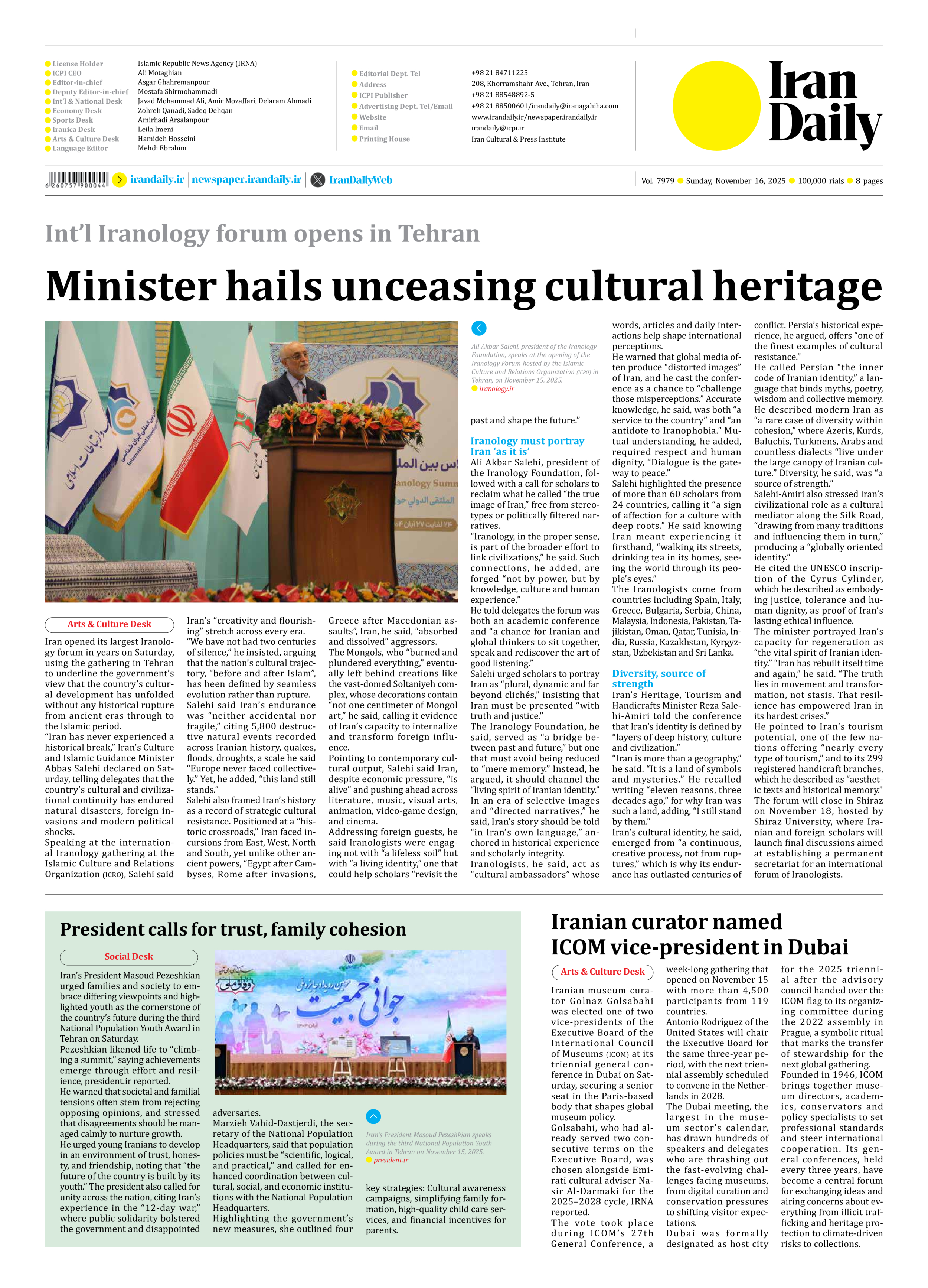
Speaking at the international Iranology gathering at the Islamic Culture and Relations Organization (ICRO), Salehi said Iran’s “creativity and flourishing” stretch across every era.
“We have not had two centuries of silence,” he insisted, arguing that the nation’s cultural trajectory, “before and after Islam”, has been defined by seamless evolution rather than rupture.
Salehi said Iran’s endurance was “neither accidental nor fragile,” citing 5,800 destructive natural events recorded across Iranian history, quakes, floods, droughts, a scale he said “Europe never faced collectively.” Yet, he added, “this land still stands.”
Salehi also framed Iran’s history as a record of strategic cultural resistance. Positioned at a “historic crossroads,” Iran faced incursions from East, West, North and South, yet unlike other ancient powers, “Egypt after Cambyses, Rome after invasions, Greece after Macedonian assaults”, Iran, he said, “absorbed and dissolved” aggressors.
The Mongols, who “burned and plundered everything,” eventually left behind creations like the vast-domed Soltaniyeh complex, whose decorations contain “not one centimeter of Mongol art,” he said, calling it evidence of Iran’s capacity to internalize and transform foreign influence.
Pointing to contemporary cultural output, Salehi said Iran, despite economic pressure, “is alive” and pushing ahead across literature, music, visual arts, animation, video-game design, and cinema.
Addressing foreign guests, he said Iranologists were engaging not with “a lifeless soil” but with “a living identity,” one that could help scholars “revisit the past and shape the future.”
Iranology must portray Iran ‘as it is’
Ali Akbar Salehi, president of the Iranology Foundation, followed with a call for scholars to reclaim what he called “the true image of Iran,” free from stereotypes or politically filtered narratives.
“Iranology, in the proper sense, is part of the broader effort to link civilizations,” he said. Such connections, he added, are forged “not by power, but by knowledge, culture and human experience.”
He told delegates the forum was both an academic conference and “a chance for Iranian and global thinkers to sit together, speak and rediscover the art of good listening.”
Salehi urged scholars to portray Iran as “plural, dynamic and far beyond clichés,” insisting that Iran must be presented “with truth and justice.”
The Iranology Foundation, he said, served as “a bridge between past and future,” but one that must avoid being reduced to “mere memory.” Instead, he argued, it should channel the “living spirit of Iranian identity.”
In an era of selective images and “directed narratives,” he said, Iran’s story should be told “in Iran’s own language,” anchored in historical experience and scholarly integrity.
Iranologists, he said, act as “cultural ambassadors” whose words, articles and daily interactions help shape international perceptions.
He warned that global media often produce “distorted images” of Iran, and he cast the conference as a chance to “challenge those misperceptions.” Accurate knowledge, he said, was both “a service to the country” and “an antidote to Iranophobia.” Mutual understanding, he added, required respect and human dignity, “Dialogue is the gateway to peace.”
Salehi highlighted the presence of more than 60 scholars from 24 countries, calling it “a sign of affection for a culture with deep roots.” He said knowing Iran meant experiencing it firsthand, “walking its streets, drinking tea in its homes, seeing the world through its people’s eyes.”
The Iranologists come from countries including Spain, Italy, Greece, Bulgaria, Serbia, China, Malaysia, Indonesia, Pakistan, Tajikistan, Oman, Qatar, Tunisia, India, Russia, Kazakhstan, Kyrgyzstan, Uzbekistan and Sri Lanka.
Diversity, source of strength
Iran’s Heritage, Tourism and Handicrafts Minister Reza Salehi-Amiri told the conference that Iran’s identity is defined by “layers of deep history, culture and civilization.”
“Iran is more than a geography,” he said. “It is a land of symbols and mysteries.” He recalled writing “eleven reasons, three decades ago,” for why Iran was such a land, adding, “I still stand by them.”
Iran’s cultural identity, he said, emerged from “a continuous, creative process, not from ruptures,” which is why its endurance has outlasted centuries of conflict. Persia’s historical experience, he argued, offers “one of the finest examples of cultural resistance.”
He called Persian “the inner code of Iranian identity,” a language that binds myths, poetry, wisdom and collective memory.
He described modern Iran as “a rare case of diversity within cohesion,” where Azeris, Kurds, Baluchis, Turkmens, Arabs and countless dialects “live under the large canopy of Iranian culture.” Diversity, he said, was “a source of strength.”
Salehi-Amiri also stressed Iran’s civilizational role as a cultural mediator along the Silk Road, “drawing from many traditions and influencing them in turn,” producing a “globally oriented identity.”
He cited the UNESCO inscription of the Cyrus Cylinder, which he described as embodying justice, tolerance and human dignity, as proof of Iran’s lasting ethical influence.
The minister portrayed Iran’s capacity for regeneration as “the vital spirit of Iranian identity.” “Iran has rebuilt itself time and again,” he said. “The truth lies in movement and transformation, not stasis. That resilience has empowered Iran in its hardest crises.”
He pointed to Iran’s tourism potential, one of the few nations offering “nearly every type of tourism,” and to its 299 registered handicraft branches, which he described as “aesthetic texts and historical memory.”
The forum will close in Shiraz on November 18, hosted by Shiraz University, where Iranian and foreign scholars will launch final discussions aimed at establishing a permanent secretariat for an international forum of Iranologists.