







Pragmatism the new norm: Solid defense defines Iran’s World Cup approach
By Amirhadi
Arsalanpour
Staff writer
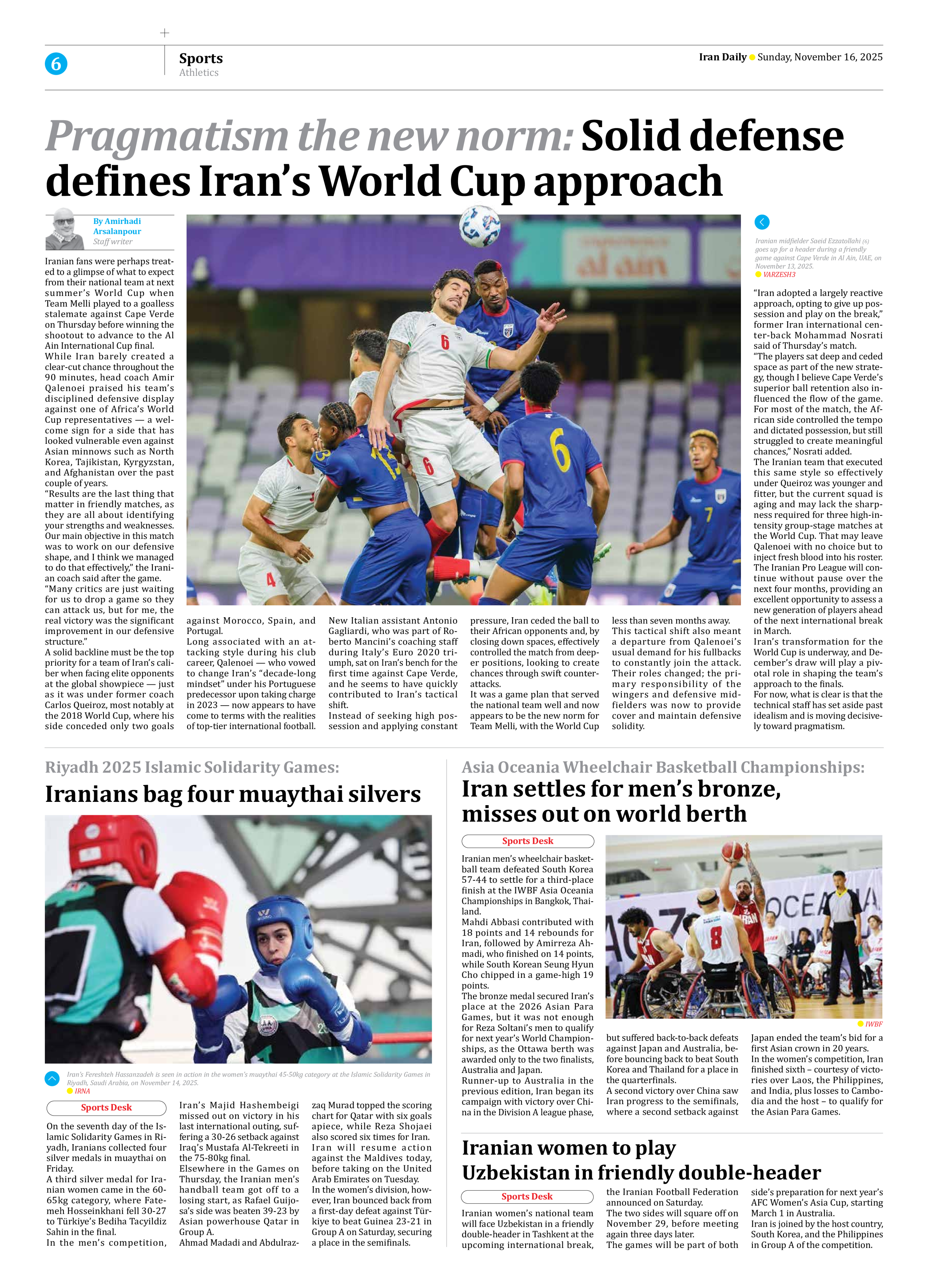
Iranian fans were perhaps treated to a glimpse of what to expect from their national team at next summer’s World Cup when Team Melli played to a goalless stalemate against Cape Verde on Thursday before winning the shootout to advance to the Al Ain International Cup final.
While Iran barely created a clear-cut chance throughout the 90 minutes, head coach Amir Qalenoei praised his team’s disciplined defensive display against one of Africa’s World Cup representatives — a welcome sign for a side that has looked vulnerable even against Asian minnows such as North Korea, Tajikistan, Kyrgyzstan, and Afghanistan over the past couple of years.
“Results are the last thing that matter in friendly matches, as they are all about identifying your strengths and weaknesses. Our main objective in this match was to work on our defensive shape, and I think we managed to do that effectively,” the Iranian coach said after the game.
“Many critics are just waiting for us to drop a game so they can attack us, but for me, the real victory was the significant improvement in our defensive structure.”
A solid backline must be the top priority for a team of Iran’s caliber when facing elite opponents at the global showpiece — just as it was under former coach Carlos Queiroz, most notably at the 2018 World Cup, where his side conceded only two goals against Morocco, Spain, and Portugal.
Long associated with an attacking style during his club career, Qalenoei — who vowed to change Iran’s “decade-long mindset” under his Portuguese predecessor upon taking charge in 2023 — now appears to have come to terms with the realities of top-tier international football.
New Italian assistant Antonio Gagliardi, who was part of Roberto Mancini’s coaching staff during Italy’s Euro 2020 triumph, sat on Iran’s bench for the first time against Cape Verde, and he seems to have quickly contributed to Iran’s tactical shift.
Instead of seeking high possession and applying constant pressure, Iran ceded the ball to their African opponents and, by closing down spaces, effectively controlled the match from deeper positions, looking to create chances through swift counterattacks.
It was a game plan that served the national team well and now appears to be the new norm for Team Melli, with the World Cup less than seven months away.
This tactical shift also meant a departure from Qalenoei’s usual demand for his fullbacks to constantly join the attack. Their roles changed; the primary responsibility of the wingers and defensive midfielders was now to provide cover and maintain defensive solidity.
“Iran adopted a largely reactive approach, opting to give up possession and play on the break,” former Iran international center-back Mohammad Nosrati said of Thursday’s match.
“The players sat deep and ceded space as part of the new strategy, though I believe Cape Verde’s superior ball retention also influenced the flow of the game. For most of the match, the African side controlled the tempo and dictated possession, but still struggled to create meaningful chances,” Nosrati added.
The Iranian team that executed this same style so effectively under Queiroz was younger and fitter, but the current squad is aging and may lack the sharpness required for three high-intensity group-stage matches at the World Cup. That may leave Qalenoei with no choice but to inject fresh blood into his roster.
The Iranian Pro League will continue without pause over the next four months, providing an excellent opportunity to assess a new generation of players ahead of the next international break in March.
Iran’s transformation for the World Cup is underway, and December’s draw will play a pivotal role in shaping the team’s approach to the finals.
For now, what is clear is that the technical staff has set aside past idealism and is moving decisively toward pragmatism.