





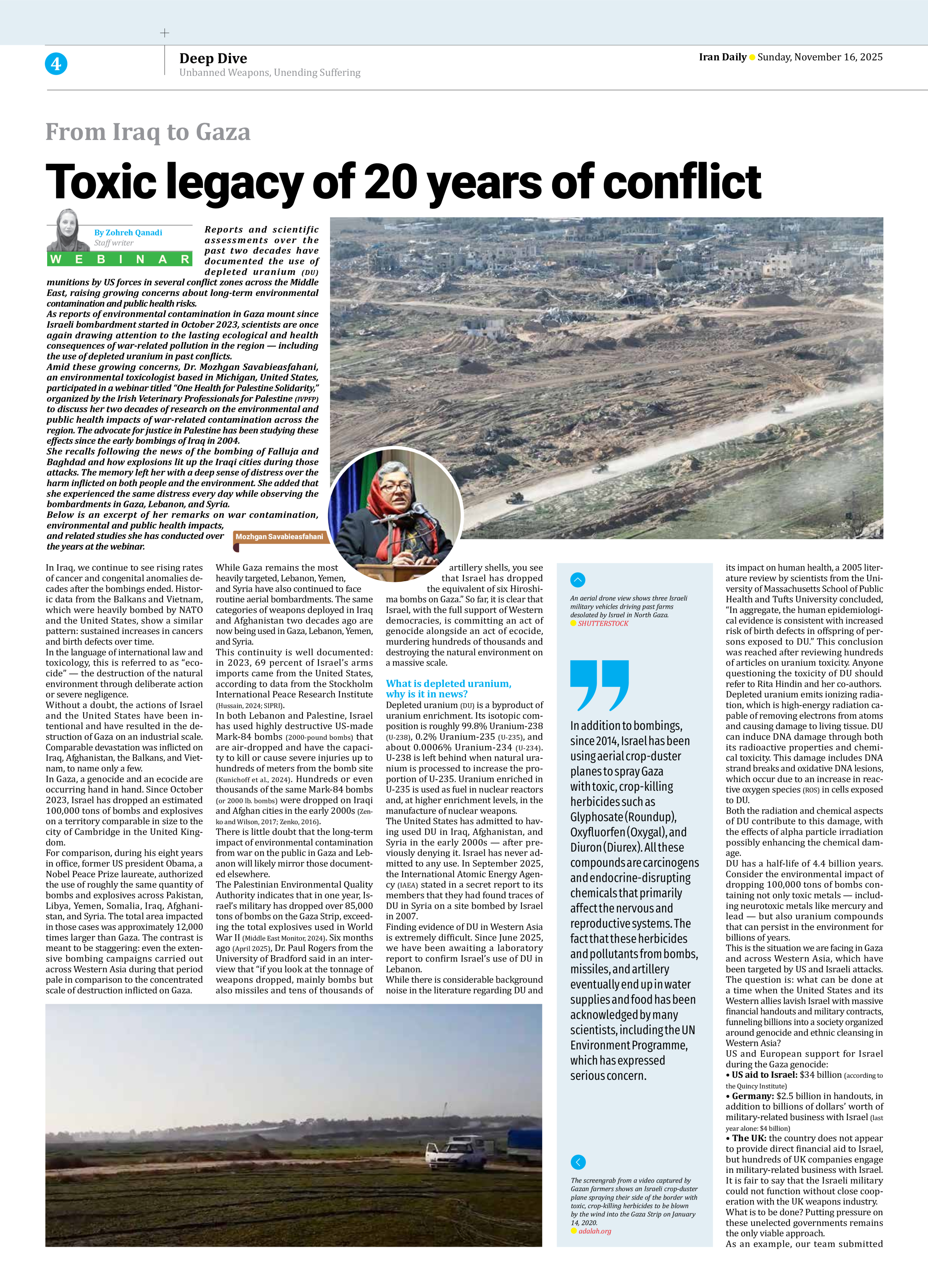


From Iraq to Gaza
Toxic legacy of 20 years of conflict
Reports and scientific assessments over the past two decades have documented the use of depleted uranium (DU) munitions by US forces in several conflict zones across the Middle East, raising growing concerns about long-term environmental contamination and public health risks. As reports of environmental contamination in Gaza mount since Israeli bombardment started in October 2023, scientists are once again drawing attention to the lasting ecological and health consequences of war-related pollution in the region — including the use of depleted uranium in past conflicts. Amid these growing concerns, Dr. Mozhgan Savabieasfahani, an environmental toxicologist based in Michigan, United States, participated in a webinar titled “One Health for Palestine Solidarity,” organized by the Irish Veterinary Professionals for Palestine (IVPFP) to discuss her two decades of research on the environmental and public health impacts of war-related contamination across the region. The advocate for justice in Palestine has been studying these effects since the early bombings of Iraq in 2004. She recalls following the news of the bombing of Falluja and Baghdad and how explosions lit up the Iraqi cities during those attacks. The memory left her with a deep sense of distress over the harm inflicted on both people and the environment. She added that she experienced the same distress every day while observing the bombardments in Gaza, Lebanon, and Syria. Below is an excerpt of her remarks on war contamination, environmental and public health impacts, and related studies she has conducted over the years at the webinar.
By Zohreh Qanadi
Staff writer
In Iraq, we continue to see rising rates of cancer and congenital anomalies decades after the bombings ended. Historic data from the Balkans and Vietnam, which were heavily bombed by NATO and the United States, show a similar pattern: sustained increases in cancers and birth defects over time.
In the language of international law and toxicology, this is referred to as “ecocide” — the destruction of the natural environment through deliberate action or severe negligence.
Without a doubt, the actions of Israel and the United States have been intentional and have resulted in the destruction of Gaza on an industrial scale. Comparable devastation was inflicted on Iraq, Afghanistan, the Balkans, and Vietnam, to name only a few.
In Gaza, a genocide and an ecocide are occurring hand in hand. Since October 2023, Israel has dropped an estimated 100,000 tons of bombs and explosives on a territory comparable in size to the city of Cambridge in the United Kingdom.
For comparison, during his eight years in office, former US president Obama, a Nobel Peace Prize laureate, authorized the use of roughly the same quantity of bombs and explosives across Pakistan, Libya, Yemen, Somalia, Iraq, Afghanistan, and Syria. The total area impacted in those cases was approximately 12,000 times larger than Gaza. The contrast is meant to be staggering: even the extensive bombing campaigns carried out across Western Asia during that period pale in comparison to the concentrated scale of destruction inflicted on Gaza.
While Gaza remains the most heavily targeted, Lebanon, Yemen, and Syria have also continued to face routine aerial bombardments. The same categories of weapons deployed in Iraq and Afghanistan two decades ago are now being used in Gaza, Lebanon, Yemen, and Syria.
This continuity is well documented: in 2023, 69 percent of Israel’s arms imports came from the United States, according to data from the Stockholm International Peace Research Institute (Hussain, 2024; SIPRI).
In both Lebanon and Palestine, Israel has used highly destructive US-made Mark-84 bombs (2000-pound bombs) that are air-dropped and have the capacity to kill or cause severe injuries up to hundreds of meters from the bomb site (Kunichoff et al., 2024). Hundreds or even thousands of the same Mark-84 bombs (or 2000 lb. bombs) were dropped on Iraqi and Afghan cities in the early 2000s (Zenko and Wilson, 2017; Zenko, 2016).
There is little doubt that the long-term impact of environmental contamination from war on the public in Gaza and Lebanon will likely mirror those documented elsewhere.
The Palestinian Environmental Quality Authority indicates that in one year, Israel’s military has dropped over 85,000 tons of bombs on the Gaza Strip, exceeding the total explosives used in World War II (Middle East Monitor, 2024). Six months ago (April 2025), Dr. Paul Rogers from the University of Bradford said in an interview that “if you look at the tonnage of weapons dropped, mainly bombs but also missiles and tens of thousands of artillery shells, you see that Israel has dropped the equivalent of six Hiroshima bombs on Gaza.” So far, it is clear that Israel, with the full support of Western democracies, is committing an act of genocide alongside an act of ecocide, murdering hundreds of thousands and destroying the natural environment on a massive scale.
What is depleted uranium,
why is it in news?
Depleted uranium (DU) is a byproduct of uranium enrichment. Its isotopic composition is roughly 99.8% Uranium-238 (U-238), 0.2% Uranium-235 (U-235), and about 0.0006% Uranium-234 (U-234). U-238 is left behind when natural uranium is processed to increase the proportion of U-235. Uranium enriched in U-235 is used as fuel in nuclear reactors and, at higher enrichment levels, in the manufacture of nuclear weapons.
The United States has admitted to having used DU in Iraq, Afghanistan, and Syria in the early 2000s — after previously denying it. Israel has never admitted to any use. In September 2025, the International Atomic Energy Agency (IAEA) stated in a secret report to its members that they had found traces of DU in Syria on a site bombed by Israel in 2007.
Finding evidence of DU in Western Asia is extremely difficult. Since June 2025, we have been awaiting a laboratory report to confirm Israel’s use of DU in Lebanon.
While there is considerable background noise in the literature regarding DU and its impact on human health, a 2005 literature review by scientists from the University of Massachusetts School of Public Health and Tufts University concluded, “In aggregate, the human epidemiological evidence is consistent with increased risk of birth defects in offspring of persons exposed to DU.” This conclusion was reached after reviewing hundreds of articles on uranium toxicity. Anyone questioning the toxicity of DU should refer to Rita Hindin and her co-authors.
Depleted uranium emits ionizing radiation, which is high-energy radiation capable of removing electrons from atoms and causing damage to living tissue. DU can induce DNA damage through both its radioactive properties and chemical toxicity. This damage includes DNA strand breaks and oxidative DNA lesions, which occur due to an increase in reactive oxygen species (ROS) in cells exposed to DU.
Both the radiation and chemical aspects of DU contribute to this damage, with the effects of alpha particle irradiation possibly enhancing the chemical damage.
DU has a half-life of 4.4 billion years. Consider the environmental impact of dropping 100,000 tons of bombs containing not only toxic metals — including neurotoxic metals like mercury and lead — but also uranium compounds that can persist in the environment for billions of years.
This is the situation we are facing in Gaza and across Western Asia, which have been targeted by US and Israeli attacks.
The question is: what can be done at a time when the United States and its Western allies lavish Israel with massive financial handouts and military contracts, funneling billions into a society organized around genocide and ethnic cleansing in Western Asia?
US and European support for Israel during the Gaza genocide:
• US aid to Israel: $34 billion (according to the Quincy Institute)
• Germany: $2.5 billion in handouts, in addition to billions of dollars’ worth of military-related business with Israel (last year alone: $4 billion)
• The UK: the country does not appear to provide direct financial aid to Israel, but hundreds of UK companies engage in military-related business with Israel. It is fair to say that the Israeli military could not function without close cooperation with the UK weapons industry.
What is to be done? Putting pressure on these unelected governments remains the only viable approach.
As an example, our team submitted Early Day Motions to the British Parliament in 2016, 2017, and 2018. These motions were signed by close to 100 UK parliamentarians.
Here is the text of one of these Motions: “That this House recognizes the problem of toxic contamination of war zones, particularly in Iraq, notes the research presented in March 2018 by Dr. Mozhgan Savabieasfahani at the European Environment Foundation expresses concern at reports of uranium and thorium contamination in the tissues of children living near the US military base in the ancient city of Ur [a major Sumerian city-state in ancient Mesopotamia, located at the site of modern Tell el-Muqayyar in Dhi Qar Governorate, southern Iraq], with those children being seven times more likely to have birth defects; [and] further notes a 2015 resolution by the American Public Health Association stating that parties involved in military activities have a post-conflict responsibility to decontaminate polluted areas; and calls on the Government to work with the US Administration to clean up areas polluted by allied military forces and assist the Iraqi people with remedial health care.”
Basically, this demands that those who have committed ecocides in our region take responsibility for cleaning them up.
Many then ask whether it is possible to clean up environmental pollution of this scale. My answer is that we certainly can, if, as a society, we refuse to spend our resources on war and genocide and, instead, invest those billions of dollars each year in environmental restoration, remediation, and cleanup. The technology for such large-scale cleanup certainly exists; what we need is the public will to implement it.
It is worth mentioning that, in addition to bombings, Israel has on several occasions been using aerial crop-duster planes to spray Gaza with toxic, crop-killing herbicides such as Glyphosate (Roundup), Oxyfluorfen (Oxygal), and Diuron (Diurex).
Between 2018 and 2020, Bayer, the producer of Roundup, paid $11 billion in lawsuits related to its use in the United States.
All these compounds are carcinogens and endocrine-disrupting chemicals that primarily affect the nervous and reproductive systems. The fact that these herbicides and pollutants from bombs, missiles, and artillery eventually end up in water supplies and food has been acknowledged by many scientists, including the UN Environment Programme, which has expressed serious concern.
Reports of crop and human health damage have been emerging since 2020 via Euro-Med Rights, an organization not funded by any US entity.
Overall, from the perspective of an environmental toxicologist, these assaults on Palestinians and their lands can be summarized as ecocide. These pollutants individually increase the risk of cancer and reproductive damage in human populations, and collectively, their damage could be greatly magnified.
We do not know how many tons of these herbicides Israel has dropped on Gaza. However, if the United States’ spraying of Agent Orange in Vietnam is any guide, it is likely to have been a significant amount. This is particularly concerning given that all these herbicides are supplied to Israel by the United States.