





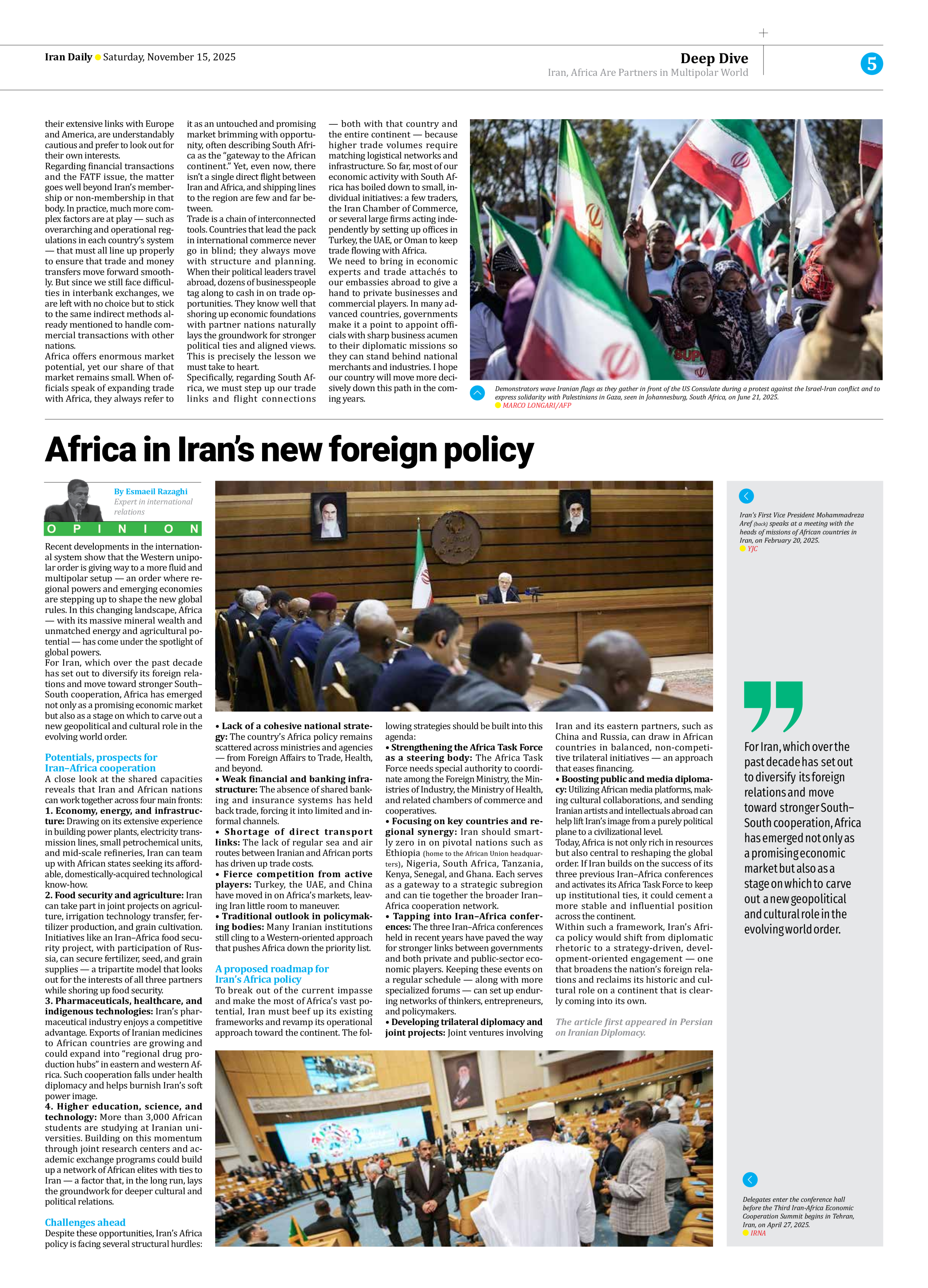


Africa in Iran’s new foreign policy
By Esmaeil Razaghi
Expert in international relations
Recent developments in the international system show that the Western unipolar order is giving way to a more fluid and multipolar setup — an order where regional powers and emerging economies are stepping up to shape the new global rules. In this changing landscape, Africa — with its massive mineral wealth and unmatched energy and agricultural potential — has come under the spotlight of global powers.
For Iran, which over the past decade has set out to diversify its foreign relations and move toward stronger South–South cooperation, Africa has emerged not only as a promising economic market but also as a stage on which to carve out a new geopolitical and cultural role in the evolving world order.
Potentials, prospects for
Iran–Africa cooperation
A close look at the shared capacities reveals that Iran and African nations can work together across four main fronts:
1. Economy, energy, and infrastructure: Drawing on its extensive experience in building power plants, electricity transmission lines, small petrochemical units, and mid-scale refineries, Iran can team up with African states seeking its affordable, domestically-acquired technological know-how.
2. Food security and agriculture: Iran can take part in joint projects on agriculture, irrigation technology transfer, fertilizer production, and grain cultivation. Initiatives like an Iran–Africa food security project, with participation of Russia, can secure fertilizer, seed, and grain supplies — a tripartite model that looks out for the interests of all three partners while shoring up food security.
3. Pharmaceuticals, healthcare, and indigenous technologies: Iran’s pharmaceutical industry enjoys a competitive advantage. Exports of Iranian medicines to African countries are growing and could expand into “regional drug production hubs” in eastern and western Africa. Such cooperation falls under health diplomacy and helps burnish Iran’s soft power image.
4. Higher education, science, and technology: More than 3,000 African students are studying at Iranian universities. Building on this momentum through joint research centers and academic exchange programs could build up a network of African elites with ties to Iran — a factor that, in the long run, lays the groundwork for deeper cultural and political relations.
Challenges ahead
Despite these opportunities, Iran’s Africa policy is facing several structural hurdles:
• Lack of a cohesive national strategy: The country’s Africa policy remains scattered across ministries and agencies — from Foreign Affairs to Trade, Health, and beyond.
• Weak financial and banking infrastructure: The absence of shared banking and insurance systems has held back trade, forcing it into limited and informal channels.
• Shortage of direct transport links: The lack of regular sea and air routes between Iranian and African ports has driven up trade costs.
• Fierce competition from active players: Turkey, the UAE, and China have moved in on Africa’s markets, leaving Iran little room to maneuver.
• Traditional outlook in policymaking bodies: Many Iranian institutions still cling to a Western-oriented approach that pushes Africa down the priority list.
A proposed roadmap for
Iran’s Africa policy
To break out of the current impasse and make the most of Africa’s vast potential, Iran must beef up its existing frameworks and revamp its operational approach toward the continent. The following strategies should be built into this agenda:
• Strengthening the Africa Task Force as a steering body: The Africa Task Force needs special authority to coordinate among the Foreign Ministry, the Ministries of Industry, the Ministry of Health, and related chambers of commerce and cooperatives.
• Focusing on key countries and regional synergy: Iran should smartly zero in on pivotal nations such as Ethiopia (home to the African Union headquarters), Nigeria, South Africa, Tanzania, Kenya, Senegal, and Ghana. Each serves as a gateway to a strategic subregion and can tie together the broader Iran–Africa cooperation network.
• Tapping into Iran–Africa conferences: The three Iran–Africa conferences held in recent years have paved the way for stronger links between governments and both private and public-sector economic players. Keeping these events on a regular schedule — along with more specialized forums — can set up enduring networks of thinkers, entrepreneurs, and policymakers.
• Developing trilateral diplomacy and joint projects: Joint ventures involving Iran and its eastern partners, such as China and Russia, can draw in African countries in balanced, non-competitive trilateral initiatives — an approach that eases financing.
• Boosting public and media diplomacy: Utilizing African media platforms, making cultural collaborations, and sending Iranian artists and intellectuals abroad can help lift Iran’s image from a purely political plane to a civilizational level.
Today, Africa is not only rich in resources but also central to reshaping the global order. If Iran builds on the success of its three previous Iran–Africa conferences and activates its Africa Task Force to keep up institutional ties, it could cement a more stable and influential position across the continent.
Within such a framework, Iran’s Africa policy would shift from diplomatic rhetoric to a strategy-driven, development-oriented engagement — one that broadens the nation’s foreign relations and reclaims its historic and cultural role on a continent that is clearly coming into its own.
The article first appeared in Persian
on Iranian Diplomacy.