





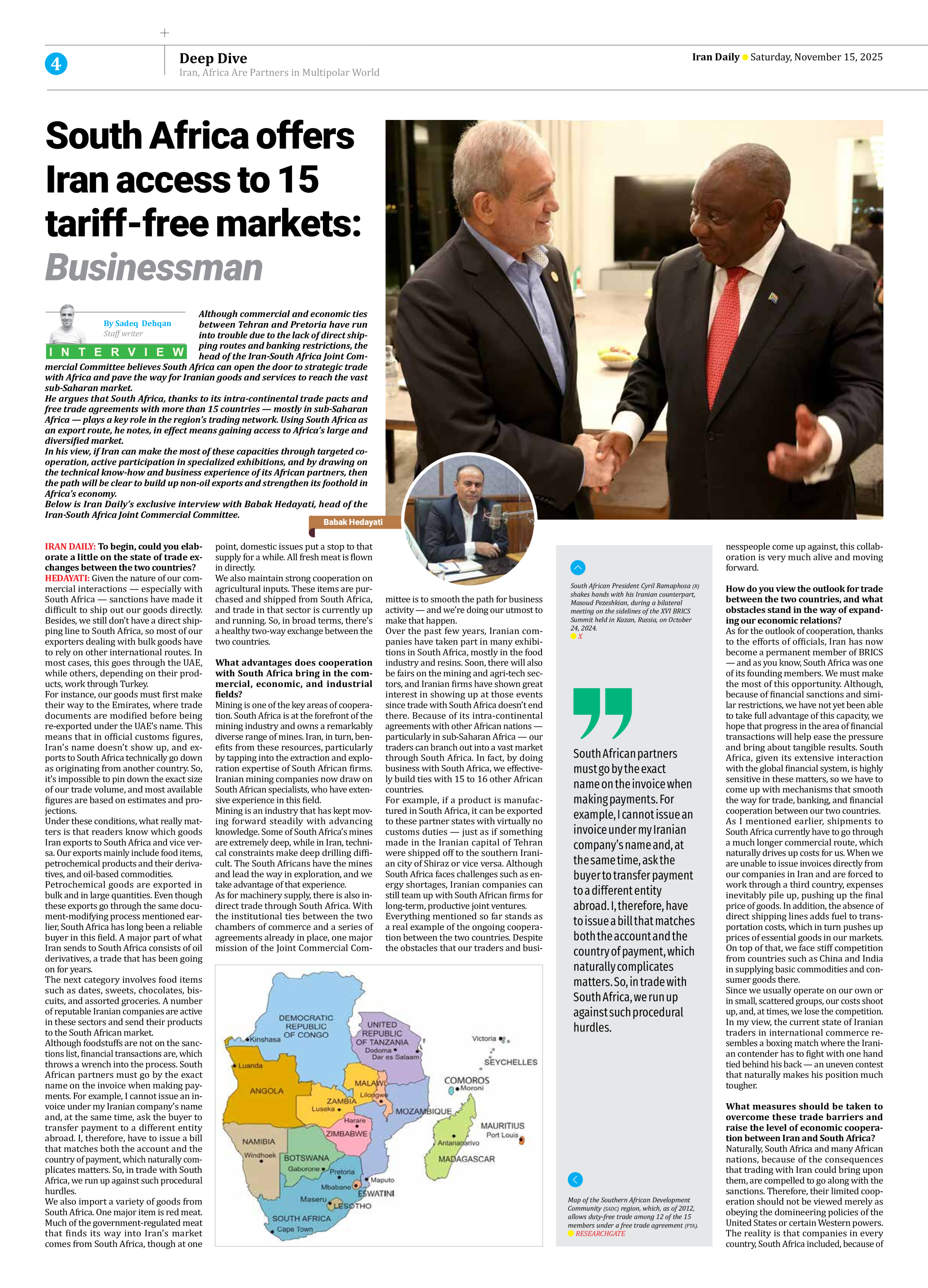


South Africa offers Iran access to 15 tariff‑free markets: Businessman
Although commercial and economic ties between Tehran and Pretoria have run into trouble due to the lack of direct shipping routes and banking restrictions, the head of the Iran‑South Africa Joint Commercial Committee believes South Africa can open the door to strategic trade with Africa and pave the way for Iranian goods and services to reach the vast sub‑Saharan market. He argues that South Africa, thanks to its intra‑continental trade pacts and free trade agreements with more than 15 countries — mostly in sub‑Saharan Africa — plays a key role in the region’s trading network. Using South Africa as an export route, he notes, in effect means gaining access to Africa’s large and diversified market. In his view, if Iran can make the most of these capacities through targeted cooperation, active participation in specialized exhibitions, and by drawing on the technical know‑how and business experience of its African partners, then the path will be clear to build up non‑oil exports and strengthen its foothold in Africa’s economy. Below is Iran Daily’s exclusive interview with Babak Hedayati, head of the Iran‑South Africa Joint Commercial Committee.
By Sadeq Dehqan
Staff writer
IRAN DAILY: To begin, could you elaborate a little on the state of trade exchanges between the two countries?
HEDAYATI: Given the nature of our commercial interactions — especially with South Africa — sanctions have made it difficult to ship out our goods directly. Besides, we still don’t have a direct shipping line to South Africa, so most of our exporters dealing with bulk goods have to rely on other international routes. In most cases, this goes through the UAE, while others, depending on their products, work through Turkey.
For instance, our goods must first make their way to the Emirates, where trade documents are modified before being re‑exported under the UAE’s name. This means that in official customs figures, Iran’s name doesn’t show up, and exports to South Africa technically go down as originating from another country. So, it’s impossible to pin down the exact size of our trade volume, and most available figures are based on estimates and projections.
Under these conditions, what really matters is that readers know which goods Iran exports to South Africa and vice versa. Our exports mainly include food items, petrochemical products and their derivatives, and oil‑based commodities.
Petrochemical goods are exported in bulk and in large quantities. Even though these exports go through the same document‑modifying process mentioned earlier, South Africa has long been a reliable buyer in this field. A major part of what Iran sends to South Africa consists of oil derivatives, a trade that has been going on for years.
The next category involves food items such as dates, sweets, chocolates, biscuits, and assorted groceries. A number of reputable Iranian companies are active in these sectors and send their products to the South African market.
Although foodstuffs are not on the sanctions list, financial transactions are, which throws a wrench into the process. South African partners must go by the exact name on the invoice when making payments. For example, I cannot issue an invoice under my Iranian company’s name and, at the same time, ask the buyer to transfer payment to a different entity abroad. I, therefore, have to issue a bill that matches both the account and the country of payment, which naturally complicates matters. So, in trade with South Africa, we run up against such procedural hurdles.
We also import a variety of goods from South Africa. One major item is red meat. Much of the government‑regulated meat that finds its way into Iran’s market comes from South Africa, though at one point, domestic issues put a stop to that supply for a while. All fresh meat is flown in directly.
We also maintain strong cooperation on agricultural inputs. These items are purchased and shipped from South Africa, and trade in that sector is currently up and running. So, in broad terms, there’s a healthy two‑way exchange between the two countries.
What advantages does cooperation with South Africa bring in the commercial, economic, and industrial fields?
Mining is one of the key areas of cooperation. South Africa is at the forefront of the mining industry and owns a remarkably diverse range of mines. Iran, in turn, benefits from these resources, particularly by tapping into the extraction and exploration expertise of South African firms. Iranian mining companies now draw on South African specialists, who have extensive experience in this field.
Mining is an industry that has kept moving forward steadily with advancing knowledge. Some of South Africa’s mines are extremely deep, while in Iran, technical constraints make deep drilling difficult. The South Africans have the mines and lead the way in exploration, and we take advantage of that experience.
As for machinery supply, there is also indirect trade through South Africa. With the institutional ties between the two chambers of commerce and a series of agreements already in place, one major mission of the Joint Commercial Committee is to smooth the path for business activity — and we’re doing our utmost to make that happen.
Over the past few years, Iranian companies have taken part in many exhibitions in South Africa, mostly in the food industry and resins. Soon, there will also be fairs on the mining and agri‑tech sectors, and Iranian firms have shown great interest in showing up at those events since trade with South Africa doesn’t end there. Because of its intra‑continental agreements with other African nations — particularly in sub‑Saharan Africa — our traders can branch out into a vast market through South Africa. In fact, by doing business with South Africa, we effectively build ties with 15 to 16 other African countries.
For example, if a product is manufactured in South Africa, it can be exported to these partner states with virtually no customs duties — just as if something made in the Iranian capital of Tehran were shipped off to the southern Iranian city of Shiraz or vice versa. Although South Africa faces challenges such as energy shortages, Iranian companies can still team up with South African firms for long‑term, productive joint ventures.
Everything mentioned so far stands as a real example of the ongoing cooperation between the two countries. Despite the obstacles that our traders and businesspeople come up against, this collaboration is very much alive and moving forward.
How do you view the outlook for trade between the two countries, and what obstacles stand in the way of expanding our economic relations?
As for the outlook of cooperation, thanks to the efforts of officials, Iran has now become a permanent member of BRICS — and as you know, South Africa was one of its founding members. We must make the most of this opportunity. Although, because of financial sanctions and similar restrictions, we have not yet been able to take full advantage of this capacity, we hope that progress in the area of financial transactions will help ease the pressure and bring about tangible results. South Africa, given its extensive interaction with the global financial system, is highly sensitive in these matters, so we have to come up with mechanisms that smooth the way for trade, banking, and financial cooperation between our two countries.
As I mentioned earlier, shipments to South Africa currently have to go through a much longer commercial route, which naturally drives up costs for us. When we are unable to issue invoices directly from our companies in Iran and are forced to work through a third country, expenses inevitably pile up, pushing up the final price of goods. In addition, the absence of direct shipping lines adds fuel to transportation costs, which in turn pushes up prices of essential goods in our markets. On top of that, we face stiff competition from countries such as China and India in supplying basic commodities and consumer goods there.
Since we usually operate on our own or in small, scattered groups, our costs shoot up, and, at times, we lose the competition. In my view, the current state of Iranian traders in international commerce resembles a boxing match where the Iranian contender has to fight with one hand tied behind his back — an uneven contest that naturally makes his position much tougher.
What measures should be taken to overcome these trade barriers and raise the level of economic cooperation between Iran and South Africa?
Naturally, South Africa and many African nations, because of the consequences that trading with Iran could bring upon them, are compelled to go along with the sanctions. Therefore, their limited cooperation should not be viewed merely as obeying the domineering policies of the United States or certain Western powers. The reality is that companies in every country, South Africa included, because of their extensive links with Europe and America, are understandably cautious and prefer to look out for their own interests.
Regarding financial transactions and the FATF issue, the matter goes well beyond Iran’s membership or non-membership in that body. In practice, much more complex factors are at play — such as overarching and operational regulations in each country’s system — that must all line up properly to ensure that trade and money transfers move forward smoothly. But since we still face difficulties in interbank exchanges, we are left with no choice but to stick to the same indirect methods already mentioned to handle commercial transactions with other nations.
Africa offers enormous market potential, yet our share of that market remains small. When officials speak of expanding trade with Africa, they always refer to it as an untouched and promising market brimming with opportunity, often describing South Africa as the “gateway to the African continent.” Yet, even now, there isn’t a single direct flight between Iran and Africa, and shipping lines to the region are few and far between.
Trade is a chain of interconnected tools. Countries that lead the pack in international commerce never go in blind; they always move with structure and planning. When their political leaders travel abroad, dozens of businesspeople tag along to cash in on trade opportunities. They know well that shoring up economic foundations with partner nations naturally lays the groundwork for stronger political ties and aligned views. This is precisely the lesson we must take to heart.
Specifically, regarding South Africa, we must step up our trade links and flight connections — both with that country and the entire continent — because higher trade volumes require matching logistical networks and infrastructure. So far, most of our economic activity with South Africa has boiled down to small, individual initiatives: a few traders, the Iran Chamber of Commerce, or several large firms acting independently by setting up offices in Turkey, the UAE, or Oman to keep trade flowing with Africa.
We need to bring in economic experts and trade attachés to our embassies abroad to give a hand to private businesses and commercial players. In many advanced countries, governments make it a point to appoint officials with sharp business acumen to their diplomatic missions so they can stand behind national merchants and industries. I hope our country will move more decisively down this path in the coming years.